


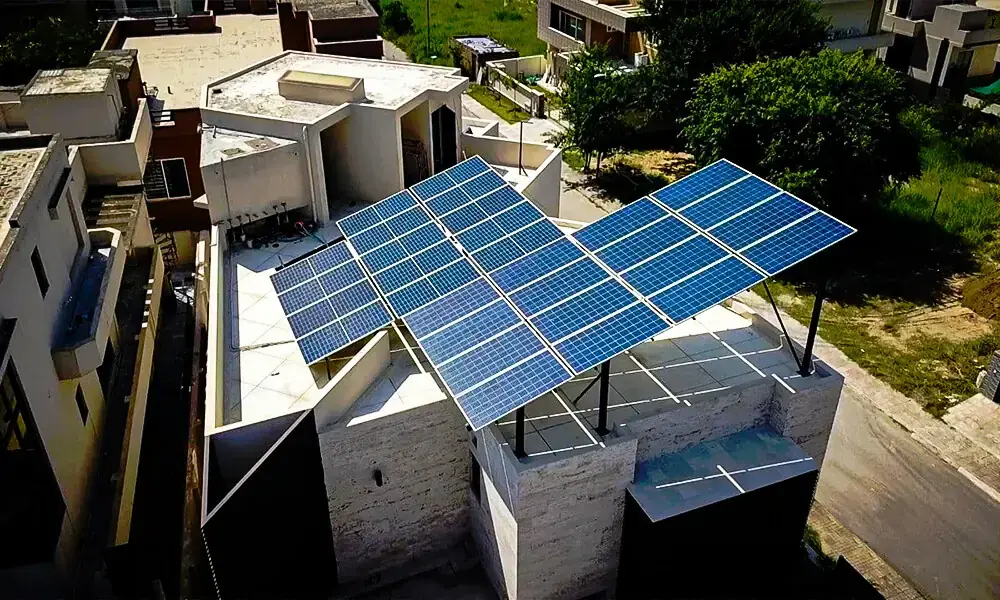
Pakistan imported over 50 Gigawatt (GW) of solar panels at an estimated cost of almost $18 billion in the past five years, a volume equivalent to the country’s entire grid capacity, a study has said. The boom in renewable energy has protected seven million households and many big businesses against energy price shocks and geopolitical risk, it added. However, as per the study, the development has continued to surge the price of power for those households and small and medium-sized enterprises (SME) that continue to drive electricity from the grid due to lack of finances and/or space to install solar equipment on rooftops in the country. Also read: Crown to set up lithium battery plant in Karachi Speaking at the launch of the study titled ‘Mapping Pakistan’s Distributed Energy Finance’, at Karachi School of Business and Leadership (KSBL), on Friday, Ahtasam Ahmad, Energy Finance & Climate Tech Lead, Renewables First, said the government and the power plants integrated in the national grid were having some three to five years to make the power affordable from the national grid. “The upcoming cheaper battery storage systems are going to make the national grid almost completely irrelevant for hundreds of thousands of households and businesses running on solar power and multiplying the power crisis for the grid dependents, ” he said. The price of power from the national grid has continued to rise, as drop in demand for electricity from the system has kept surging capacity payment (fixed cost of maintaining ideal power plants) and circular debt. Ahmad said the demand for the grid power goes significantly down during the broader daylight everyday when consumers use solar power. “They mostly continued to depend on grid power during morning and night timings. ” However, people are now installing battery storage systems to avoid the expensive grid power during morning and night timing as well, according to Ahmad. A participant from the audience, who introduced himself as an engineer, said, “the cost of the latest sodium-based battery storage stand almost half compared to lithium batteries in use at present”. “The cut in cost is expected to further reduce consumers’ reliance on grid power going forward, ” he said. Renewables First officials said the study showed out of the over 50 GW imported solar panels, a total of 38 GW worth $13. 6 billion was found in use in the country as of 2025. The breakdown suggests 16. 6 GW (almost 44% of the total solar installed capacity) was installed in the residential sector, showing households were leading the solar consumption among all. Another 9. 9 GW (26%) of the solar system was installed in the industrial sector, some 8. 1 GW (21. 3%) in the commercial sector and the remaining 3. 3 GW (8. 7%) worth of solar panels were found in use in the agriculture sector in Pakistan. The remaining 10-12 GW out of the total imported solar panels were believed to be in godowns of solar dealers and/or installed in far flung areas, a climate expert added. Despite the boom in solar consumption, the transition to clean energy has been deeply unequal. Access has been almost entirely concentrated among high-income households and large businesses – those who can absorb high upfront capital costs without financing support. Low-to-middle-income households and SMEs (which contribute nearly 40% in Pakistan’s economic growth) have been largely left behind. Naveen Ahmed, Green Finance Lead, Renewables First, said for millions of households and SMEs, clean energy remained financially out of reach not because demand was absent, but because of limited access to financing. She said banks in Pakistan were managing deposits worth $140 billion. “However, the formal financial sector has extended merely around $300 million in financing for solar systems. ” According to her, the gap in financing is not a result of insufficient capital in the system, but structural weaknesses in credit intermediation. The two officials argued the solar loan remained a major hurdle for most customers due to lack of collateral with them. Also read: Solar power growth creates challenges to national grid: expert Solar consumers, they added, could repay loans from monthly savings to be earned through utilisation of cheaper solar power and generating the electricity in surplus to be inducted into the system. Mutaher Khan, Head of Insight Lab, KSBL, said banks should adopt a separate reporting system for solar and other clean energy financings unlike they report the financings in general to industries, commercial and agriculture sectors. The separate reporting would help better understand the lending landscape in the energy sector, he added. Bankers, academics, and energy experts from the audience argued the national power grid system would remain intact despite continuous cut in reliance on the system due to rising power tariff from the grid.



GrowthPakistan brings you the latest news to keep an eye on Pakistan’s startup ecosystem. Business keeps you growing when you stay aware of your competitors' moves. GrowthPakistan offers Business, Tech, Global Tech, Global, Auto, and Startup News straight from industries all around the globe. This platform will help you identify upcoming opportunities not only in Pakistan but worldwide.
Email : growthpakistan@gmail.com
Whatsapp : +92320-9497079
© growthpakistan