


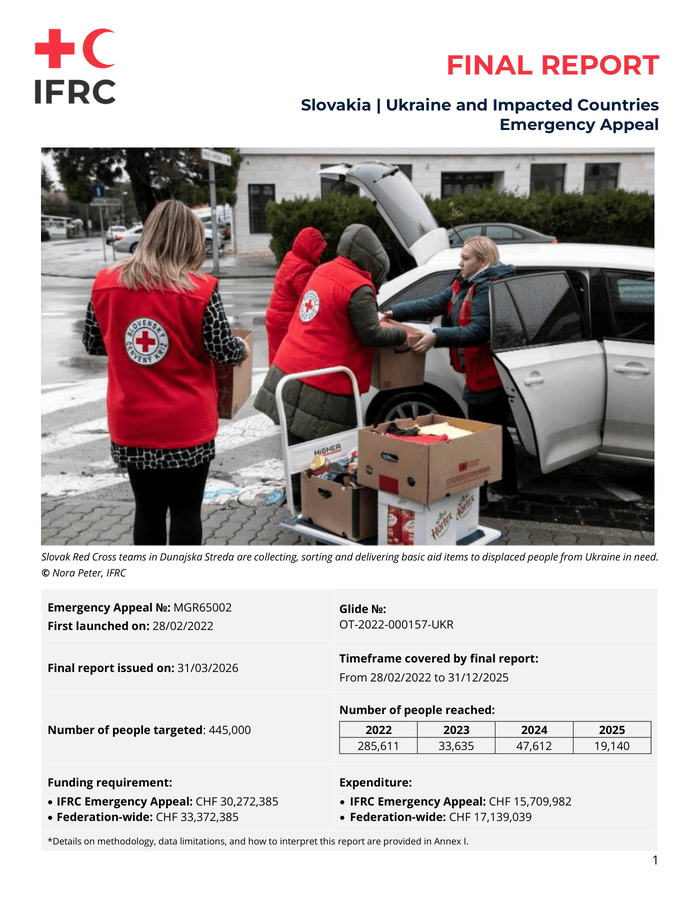
Countries: Slovakia, Ukraine Source: International Federation of Red Cross and Red Crescent Societies Please refer to the attached file. A. SITUATION ANALYSIS Since the escalation of the Russia-Ukraine international armed conflict in 2022, nearly 8 million people fled Ukraine and sought safety in neighbouring countries, including Hungary, Moldova, Poland, Romania, and Slovakia. Women with children fled Ukraine and found themselves in a foreign country without an adequate support system and in a vulnerable position, prompting an urgent response from Slovak Red Cross (SRC). With only around 5. 5 million inhabitants, Slovakia has struggled to host the comparatively large number of displaced people from Ukraine. The International Federation of the Red Cross and Red Crescent Societies (IFRC) has launched an Emergency Appeal to ensure coverage of the basic needs of people fleeing from Ukraine. Throughout 2023, the context in Ukraine continued to evolve, marked by ongoing conflict and continuous displacement. Although initial emergency needs were partially addressed, most non-governmental organisations and UN agencies gradually scaled down their humanitarian services in Slovakia due to limited funding opportunities. The operating context became increasingly complex due to political changes resulting in funding constraints as well. With this shift, SRC quickly scaled up support along the migratory routes. Emergency assistance was newly focused on the provision of multipurpose cash assistance, including the payment of a winterization grant and a cash for education top-up. Since October 2023, the National Society also started an innovative cash for shelter program for displaced people and host families. Moreover, Slovak Red Cross is supporting displaced people from Ukraine with psychosocial support (PSS) activities, livelihoods activities, access to information, communication services, community-based activities, first aid (FA) and other services according to the needs of the displaced population. In 2024, Ukraine remained affected by the protracted consequences of the crisis. During this period, access to public services and social protection measures available to refugees and migrants in Slovakia was reduced. Government-supported vocational training programmes were limited to Slovak citizens, and people displaced from Ukraine holding temporary protection status were not eligible to access this support. With challenges related to qualification recognition, for many, the opportunity to requalify was an important livelihood opportunity and a path out of illegal work and low-wage manual labour. Vocational training in specific trades allowed for opening a trade license and a business, empowering many people to generate income as self-employed. These contextual changes had a major impact on the ability of displaced people from Ukraine to rebuild their lives and integrate into Slovak society. The ongoing situation in the country highlighted the importance of the work done by the SRC in helping people access basic services and the labour market. While many people returned to Ukraine or moved further west, those who remained began rebuilding their lives in Slovakia. Ongoing integration support was necessary, including language learning, livelihoods, and affordable housing. In the long term, systemic solutions were needed to support the successful integration of those who decided to stay in Slovakia, including affordable housing and health and social support for vulnerable groups such as people with disabilities and the elderly. As of 2025, the international armed conflict in Ukraine remains ongoing, with humanitarian needs persisting among vulnerable groups. The people that had applied for Temporary Protection Status, received access to healthcare, social services, and work. However, challenges persisted, including limited access to specialized services. Many faced insufficient support, leaving them to rely on loans or remittances. Slovakia faced significant socio-economic challenges, including reduced public spending, increased taxes, and inflation, which, along with cuts to social benefits like child allowance and insufficient pension indexation, intensified financial hardship for vulnerable groups. SRC continued to provide vital assistance.



GrowthPakistan brings you the latest news to keep an eye on Pakistan’s startup ecosystem. Business keeps you growing when you stay aware of your competitors' moves. GrowthPakistan offers Business, Tech, Global Tech, Global, Auto, and Startup News straight from industries all around the globe. This platform will help you identify upcoming opportunities not only in Pakistan but worldwide.
Email : growthpakistan@gmail.com
Whatsapp : +92320-9497079
© growthpakistan