


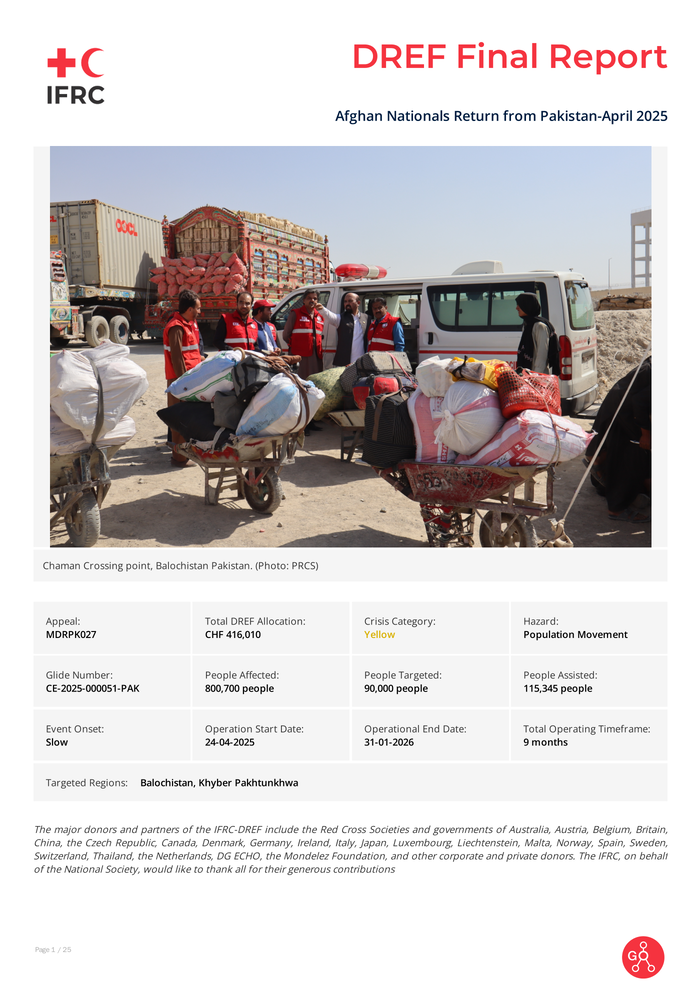
Countries: Afghanistan, Pakistan Source: International Federation of Red Cross and Red Crescent Societies Please refer to the attached files. Description of the Event Date when the trigger was met 11-04-2025 What happened, where and when? The Government of Pakistan launched the Illegal Foreigners Repatriation Plan (IFRP) on 1 November 2023 to facilitate the return of undocumented foreign nationals, primarily Afghan citizens. The policy has evolved over time, with a significant shift in March 2025 when authorities mandated all Afghan Citizen Card (ACC) holders and undocumented Afghans to leave voluntarily by 31 March 2025, followed by the resumption of deportations from 1 April 2025. The implementation of IFRP Phase III from mid-2025 led to a sharp increase in cross-border movements, particularly at Torkham and Chaman, driven by the closure of informal settlements and intensified enforcement measures. This surge placed considerable strain on humanitarian service delivery points, particularly on health, WASH and protection. To address the emerging humanitarian needs of Afghan returnees, particularly vulnerable groups including women, children, pregnant and lactating women, the elderly, and PWDs—the Pakistan Red Crescent Society (PRCS) launched a DREF operation in April 2025 with an allocation of CHF 416, 010 with the support of IFRC. The operation aimed to provide timely, medical attention and protection-sensitive assistance to approximately 90, 000 individuals affected by the return movements, ensuring access to essential services such as health care, first aid, psychosocial support, and restoring family links, while upholding dignity and inclusiveness in service delivery. The target locations were the Torkham crossing point in Khyber Pakhtunkhwa and the Chaman border in Balochistan where a huge influx of Afghan returnees was seen. Despite returns, Pakistan continues to host a large Afghan population with varying legal statuses, many of whom remain vulnerable to protection risks, including family separation, limited access to services, and uncertainty related to their residency status. Below is a detail of the Afghan return trends between 2023 to 2025: • Total Afghan returns to Afghanistan: Approximately 1. 44 million individuals returned between October 2023 and September 2025. • Afghan returns (initial phase): Around 861, 263 individuals returned between September 2023 and March 2025. • PoR card holders in Pakistan: Approximately 1. 43 million individuals are recorded as of 2025. • ACC holders in Pakistan: Approximately 800, 700 individuals are recorded as of 2025. • Undocumented Afghans (estimated): Around 1. 7 million individuals are estimated to be residing in Pakistan as of 2025. • Unregistered family members in PoR households: Approximately 143, 900 individuals as of 2025. • Afghans in refugee villages: Around 444, 000 individuals are residing in refugee villages as of 2025. • Afghans in host communities: Approximately 991, 000 individuals are living in host communities as of 2025. In response to the evolving context, including the Government of Pakistan’s third phase of the Illegal Foreigners Repatriation Plan (IFRP) and the resulting surge in returnee influx at key border crossing points, a no-cost extension of three months was granted at the end of the operation in October 2025 to sustain critical service delivery. An operations update was issued for the no-cost extension. This extension enabled PRCS to scale up and maintain essential humanitarian assistance in high-pressure locations where needs remained acute and dynamic. In October 2025, cross-border clashes between Pakistan and Afghanistan were reported at several border crossings, resulting in the closure of both the Chaman and Torkham borders. The border management authorities subsequently closed the holding centers and recommended that PRCS temporarily suspend the HSP and Medical Health Facility services at Torkham and Chaman. PRCS temporarily halted the services in line with the authorities’ recommendation and in consideration of duty of care for its staff and volunteers. PRCS monitored the situation closely at both borders and maintained regular coordination with the border management authorities to assess security conditions, the reopening timeline, and the emerging needs of Afghan nationals on the move. PRCS services resumed at the Chaman Border after a two-day pause, while at Torkham, services were restored after a 20-day suspension due to the prolonged border closure. Building on the progress achieved under the DREF operation, PRCS, in coordination with Movement partners, has developed a forwardlooking plan to ensure continuity of essential services beyond the DREF timeframe. This includes sustained support for health, MHPSS, and RFL services through complementary funding and operational support, thereby reinforcing the collective commitment of the Red Cross Red Crescent Movement (RCRC) to respond to the ongoing humanitarian needs in a timely and coordinated manner. The essential services at both crossing points will be retained through the available funding support from British Red Cross, Swiss Red Cross and Netherland Red Cross. The operation will be scaled up as the situation evolves, and additional funding becomes available.



GrowthPakistan brings you the latest news to keep an eye on Pakistan’s startup ecosystem. Business keeps you growing when you stay aware of your competitors' moves. GrowthPakistan offers Business, Tech, Global Tech, Global, Auto, and Startup News straight from industries all around the globe. This platform will help you identify upcoming opportunities not only in Pakistan but worldwide.
Email : growthpakistan@gmail.com
Whatsapp : +92320-9497079
© growthpakistan