


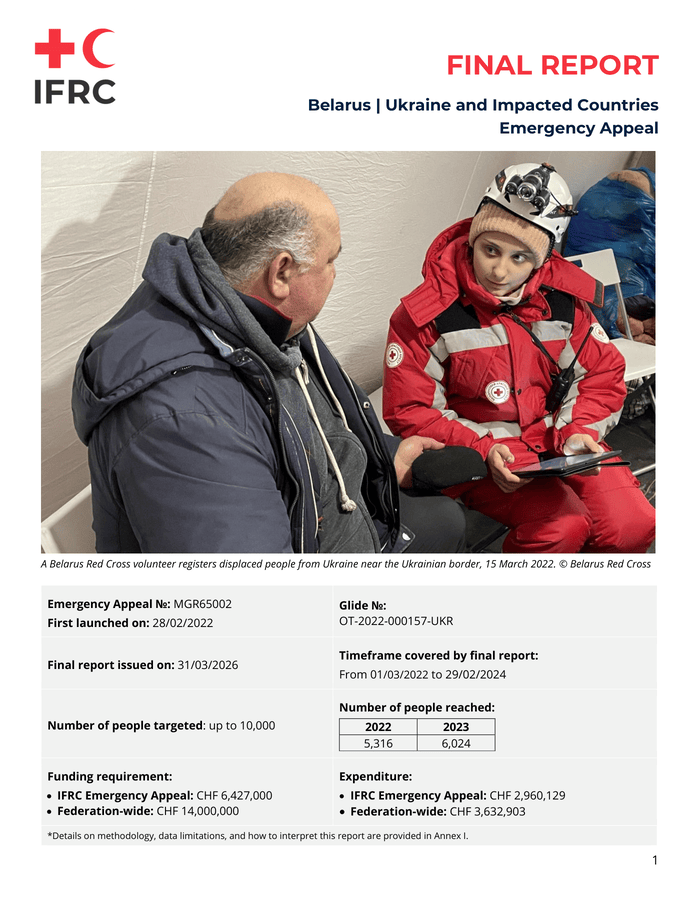
Countries: Belarus, Ukraine Source: International Federation of Red Cross and Red Crescent Societies Please refer to the attached file. A. SITUATION ANALYSIS Description of the crisis In February 2022, Belarus was affected by the international armed conflict in Ukraine, resulting in a rapid influx of people seeking safety and widespread disruption to lives and services for those arriving across the border. By late September 2022, around 56, 000 border crossings from Ukraine to Belarus had been recorded, and a significant proportion of arrivals were assessed as needing immediate humanitarian support. 1 Initial needs were most acute in basic assistance (cash/food and essential items), access to health services (including medicines), and psychosocial support, particularly for people with specific vulnerabilities and limited resources. Evidence from the Belarus Red Cross (BRC) needs assessment conducted in July–August 2022 (covering 2, 538 people / 974 households) highlighted vulnerabilities among displaced households, including health-related needs and reliance on humanitarian assistance to meet basic living costs. 2 The situation continued to evolve as cross-border movements fluctuated, necessitating an urgent response from the Belarus Red Cross. Throughout 2023, the crisis context in Belarus became increasingly protracted, with humanitarian needs gradually shifting from immediate emergency relief towards integration-oriented support. A key driver of vulnerability remained insufficient income and high out-of-pocket costs, with displaced people reporting priority needs for financial support (84%) and food (74%), alongside hygiene items (64%) and health services (48%). 3 As displacement continued into its second year, demand increased for livelihoods and self-reliance support, sustained access to health care and medicines, and mental health and psychosocial support (MHPSS), reflecting both accumulated stress and longer-term integration challenges. The operating context remained sensitive and resource-constrained, requiring careful prioritisation, strong coordination, and approaches that balanced immediate assistance with pathways to longer-term stability.



GrowthPakistan brings you the latest news to keep an eye on Pakistan’s startup ecosystem. Business keeps you growing when you stay aware of your competitors' moves. GrowthPakistan offers Business, Tech, Global Tech, Global, Auto, and Startup News straight from industries all around the globe. This platform will help you identify upcoming opportunities not only in Pakistan but worldwide.
Email : growthpakistan@gmail.com
Whatsapp : +92320-9497079
© growthpakistan