


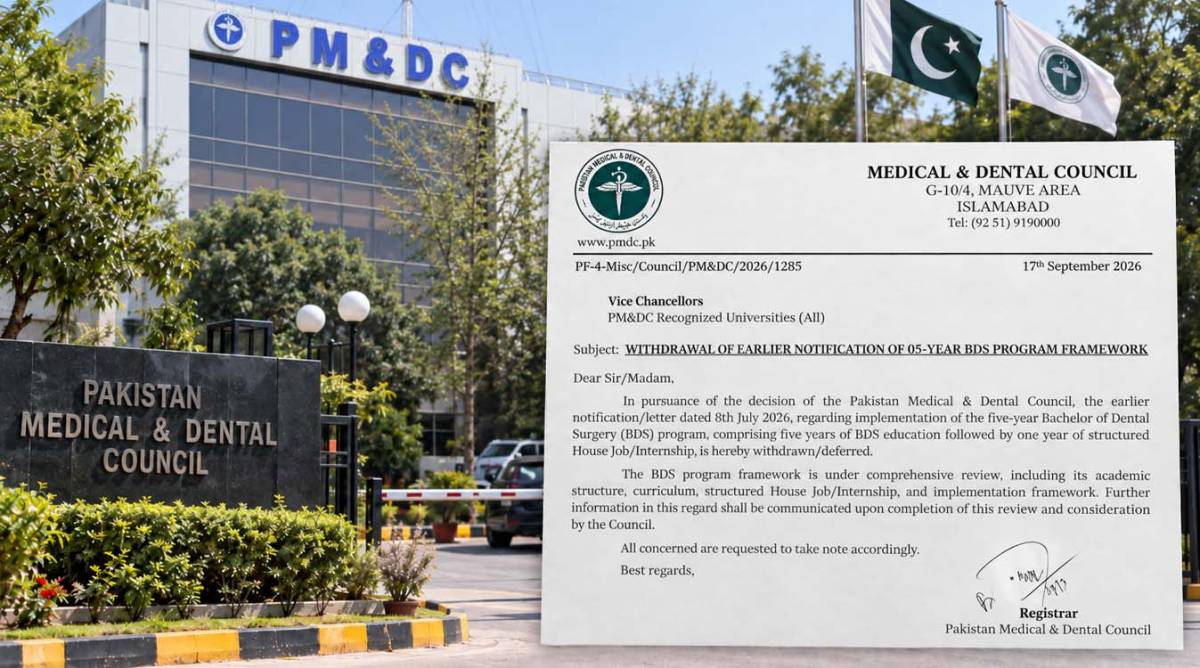
ISLAMABAD: The Pakistan Medical and Dental Council (PMDC) has formally withdrawn its July 8, 2026 notification introducing a five-year Bachelor of Dental Surgery (BDS) programme followed by a one-year structured House Job/Internship, reopening the future structure of dental education in Pakistan. In a notification dated September 17, 2026, PMDC said the July 8, 2026 notification was being withdrawn/deferred while the Council undertakes a comprehensive review of the BDS programme framework. The review covers the academic structure, curriculum, structured House Job/Internship and overall implementation framework, according to the latest PMDC communication. The Council said further information would be communicated after completion of the review and consideration by the Council. For thousands of dental students, prospective BDS candidates, dental colleges, universities and faculty members, the move reopens a question that has repeatedly shifted over the past two years: should Pakistan move to five academic years followed by house job, or retain four academic years and strengthen the subsequent supervised clinical training year? That question has become increasingly important as the Pakistan Dental Association (PDA), under President Dr Khurshid Ahmad, has advocated an alternative model that would preserve four years of formal BDS education while making the fifth year a structured, supervised House Job/Internship. PMDC puts the five-year framework back under review The July 8 notification had represented PMDC’s clearest move toward nationwide implementation of the 5+1 BDS pathway. Under that framework, BDS would comprise five academic years, followed by one year of structured House Job/Internship. Dental institutions that were ready to adopt the revised curriculum could begin implementation, while others were given a transition period to prepare. The September 17 communication now puts that framework on hold. PMDC’s latest position is significant because it does not simply defer an implementation date. It identifies the programme structure, curriculum, House Job/Internship and implementation framework as areas requiring comprehensive review. Senate committee had already called for four years plus house job The latest PMDC development follows parliamentary scrutiny of the BDS duration issue. On August 20, 2026, the Senate Standing Committee on National Health Services, Regulations and Coordination considered the proposed increase in the BDS programme from four to five academic years. The committee retained the four-year BDS programme after deliberations involving the relevant authorities and stakeholders. The committee’s position was subsequently reiterated in September, with the Senate record stating that the BDS degree should comprise four years plus one year of house job, rather than five years plus one year. The August 20 meeting was chaired by Senator Amir Waliuddin Chishti, Chairman of the Senate Standing Committee on National Health Services, Regulations and Coordination. Federal Health Minister Mustafa Kamal, PMDC representatives and dental stakeholders also participated in the deliberations. However, the Senate committee’s position should not be confused with a final PMDC regulatory notification permanently restoring the four-year BDS structure. The September 17 PMDC letter instead confirms that the Council is undertaking its own comprehensive review. PDA’s alternative BDS model is back at the centre A major part of that policy debate has been driven by the Pakistan Dental Association (PDA). Rather than opposing reform of BDS education itself, PDA has advocated a different way of achieving it. The association’s alternative model proposes retaining four formal academic years of BDS, followed by a structured and supervised one-year House Job/Internship. Under this approach, the total education and clinical training pathway would still span five years, but the fifth year would function as structured supervised clinical training rather than being added as another academic year to the BDS degree. The PDA has argued that the existing four academic years should instead be strengthened through improvements in curriculum, clinical competencies, practical training, assessment and professional preparedness, while the house job should be made a meaningful, structured transition into independent dental practice. This is materially different from the 5+1 framework notified by PMDC in July. Under the July framework, a student would complete five academic years of BDS plus one year of House Job/Internship, creating a six-year pathway. Under the PDA’s proposed model, the pathway would remain four academic years plus one structured clinical house job, creating a five-year education-and-training pathway. The distinction has therefore never been simply about whether BDS should be “four years” or “five years”. It is also about where the additional year should sit, what students should do during it and whether it should be academic or supervised clinical training. From 4+1 to 5+1 — and now back to review Pakistan’s BDS debate has therefore moved through several stages. The original structure was four academic years followed by house job. PMDC subsequently proposed extending BDS to five years, with different models considered during the consultation process. The July 8, 2026 notification formally moved toward five academic years plus one year of House Job/Internship. On August 20, the Senate Standing Committee on National Health Services, Regulations and Coordination retained the four-year academic BDS model, with the committee’s position subsequently reaffirmed as four years plus one year of house job. Now, through its September 17 communication, PMDC has withdrawn/deferred the July notification and reopened the entire framework for comprehensive review. That leaves the most consequential question unanswered: what will Pakistan’s final national BDS structure look like? For dental students, colleges, universities and faculty, the answer will determine not only the duration of the degree but also the balance between academic education, clinical training and supervised professional practice. And with PDA’s four-year BDS plus structured house job proposal already on the table, the coming PMDC review is likely to determine whether the next framework represents another extension of academic duration or a restructuring of how the existing years and clinical training are delivered. Stay connected with Dental News Pakistan pk/18-Sep-2026/pmdc-withdraws-five-year-bds-notification-review” target=”_blank” rel=”nofollow noopener noreferrer”>Read full story on Dental News



GrowthPakistan brings you the latest news to keep an eye on Pakistan’s startup ecosystem. Business keeps you growing when you stay aware of your competitors' moves. GrowthPakistan offers Business, Tech, Global Tech, Global, Auto, and Startup News straight from industries all around the globe. This platform will help you identify upcoming opportunities not only in Pakistan but worldwide.
Email : growthpakistan@gmail.com
Whatsapp : +92320-9497079
© growthpakistan