

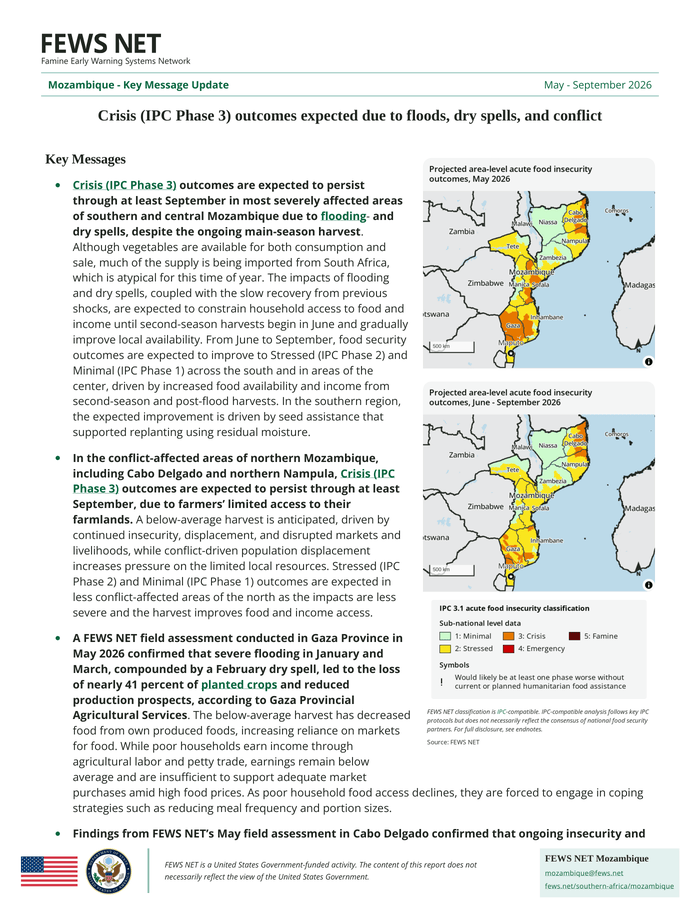
Country: Mozambique Source: Famine Early Warning System Network Please refer to the attached file. Key Messages Crisis (IPC Phase 3) outcomes are expected to persist through at least September in most severely affected areas of southern and central Mozambique due to flooding – and dry spells, despite the ongoing main-season harvest. Although vegetables are available for both consumption and sale, much of the supply is being imported from South Africa, which is atypical for this time of year. The impacts of flooding and dry spells, coupled with the slow recovery from previous shocks, are expected to constrain household access to food and income until second-season harvests begin in June and gradually improve local availability. From June to September, food security outcomes are expected to improve to Stressed (IPC Phase 2) and Minimal (IPC Phase 1) across the south and in areas of the center, driven by increased food availability and income from second-season and post-flood harvests. In the southern region, the expected improvement is driven by seed assistance that supported replanting using residual moisture. In the conflict-affected areas of northern Mozambique, including Cabo Delgado and northern Nampula, Crisis (IPC Phase 3) outcomes are expected to persist through at least September, due to farmers’ limited access to their farmlands. A below-average harvest is anticipated, driven by continued insecurity, displacement, and disrupted markets and livelihoods, while conflict-driven population displacement increases pressure on the limited local resources. Stressed (IPC Phase 2) and Minimal (IPC Phase 1) outcomes are expected in less conflict-affected areas of the north as the impacts are less severe and the harvest improves food and income access. A FEWS NET field assessment conducted in Gaza Province in May 2026 confirmed that severe flooding in January and March, compounded by a February dry spell, led to the loss of nearly 41 percent of planted crops and reduced production prospects, according to Gaza Provincial Agricultural Services. The below-average harvest has decreased food from own produced foods, increasing reliance on markets for food. While poor households earn income through agricultural labor and petty trade, earnings remain below average and are insufficient to support adequate market purchases amid high food prices. As poor household food access declines, they are forced to engage in coping strategies such as reducing meal frequency and portion sizes. Findings from FEWS NET’s May field assessment in Cabo Delgado confirmed that ongoing insecurity and displacement continue to restrict farmers’ access to agricultural land and disrupt livelihood activities, resulting in a below-average harvest in affected areas. However, in areas with lower levels of conflict, the ongoing harvest is improving household food availability and access. Increased market supplies from local production and imports are also contributing to seasonal declines in staple food prices. Maize grain prices in southern Mozambique increased by up to 10 percent in April compared to March 2026, a deviation from the typical seasonal trend of declining food prices following the harvest. While maize prices are 10 to 20 percent below April 2025, they remain 25-35 percent above the five-year average in the south. The elevated maize prices are mainly due to a below-average market supply caused by weather shocks during the 2025/26 season, which reduced production in the southern region to below-average levels. In contrast, maize grain prices in central and northern Mozambique declined by an average of 10 percent, supported by improved availability from ongoing harvests and increased supply. In May, the Government of Mozambique revised fuel prices upward to align with international market rates. As part of this adjustment, gasoline prices increased by 12. 1 percent and diesel prices by 45. 5 percent. The higher fuel costs are expected to increase transportation expenses and place upward pressure on staple food prices across the country in the coming months. Although the government has announced plans to maintain current transport fares through subsidies for public transportation, implementation is likely to be delayed by administrative requirements. Meanwhile, transportation costs are already increasing in some areas, and traders are likely to pass these higher operating costs on to consumers through higher food prices. Poor urban households that rely heavily on market purchases are expected to be most affected, as limited income-earning opportunities will further constrain their purchasing power. In April 2026, humanitarian food assistance was provided to approximately 335, 000 people, mainly in Cabo Delgado, Gaza, and Nampula provinces, according to the Food Security Cluster. Food assistance reached at least 25 percent of the total population in the covered areas of Cabo Delgado and met 40 percent of beneficiaries’ monthly caloric needs in both flood- and conflict-affected areas. By September 2026, the number of people projected to receive food assistance in Cabo Delgado is expected to range from 160, 000 to 425, 000. In May 2026, flood response operations assisted nearly 280, 000 people, accommodated in the displacement centers. Beneficiaries received one-month food rations, return kits upon departure, and agricultural inputs to support the resumption of production activities.
Mozambique Key Message Update, May – September 2026: Crisis (IPC Phase 3) outcomes expected due to floods, dry spells, and conflict

RELATED ARTICLES


