

Country: Jamaica Sources: Caribbean Community Secretariat, World Food Programme Please refer to the attached file. HIGHLIGHTS Five months after Hurricane Melissa, food security conditions show partial stabilization but remain significantly worse than before the storm. Insufficient food consumption declined from its November peak (30%) to 13% four months after but rose again to 17% at five months, indicating a slowdown in recovery and continued pressure on household food access. Diet quality remains poor, with one-third of households still consuming no fruit in the previous week and dairy intake recovering slowly, reflecting persistent nutrient gaps. Severe coping and livelihood stress have eased but remain elevated, with signs of renewed reliance on more severe strategies in some cases. Market access has improved from peak disruption but remains constrained, and has shown signs of weakening again, particularly in the west and north-west. Moderate or severe food insecurity remains high (42%) despite improvements in short-term indicators, underscoring a fragile and uneven recovery. Insufficient food consumption has declined from its November peak (30%) to 13% four months after, yet remains nearly double the pre-Melissa rate (7%), indicating incomplete recovery. At five months after, however, insufficient consumption increased slightly to 17%, suggesting a slowdown in recovery and possible renewed pressure on household food access. Crisis or emergency food-based coping remains elevated, declining from 36% one month after the storm to 18% at four months, but still above pre-Melissa levels (14%). At five months after, coping levels have stabilized at around 18–19%, indicating lingering consumption-related stress. The most severe stress continues to be concentrated in Trelawny, Westmoreland, St. Elizabeth, Hanover, and St. James, forming a persistent high-impact belt in the west and north-west. The largest increases in asset-depleting coping continue to be observed in Westmoreland, Trelawny, and Hanover. Moderate or severe food insecurity (FIES) remains high despite short-term improvements in FCS and rCSI. FIES rose from 33% pre-Melissa to 54% two months post-event, and although it declined to 43% four months after, levels remain well above baseline. At five months after, food insecurity decreased only marginally to around 42%, indicating that recovery remains fragile and households continue to face persistent constraints in accessing adequate food, including ongoing experiences of skipping meals or going hungry. Market access deteriorated sharply after Hurricane Melissa, with challenges increasing from 35% pre-event to 54% two months after. Although improving to 41% by four months, constraints rose slightly again to ~43% at five months, indicating a slowdown in recovery. Disruptions remain most acute in the west and north-west, where market functioning continues to lag.
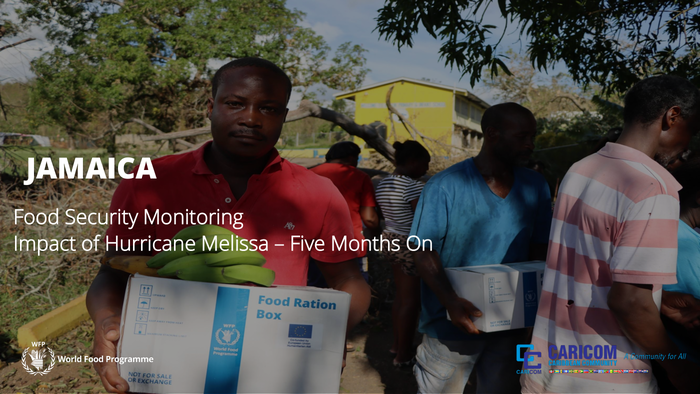
Jamaica: Food Security Monitoring Impact of Hurricane Melissa – Five Months On

RELATED ARTICLES


