


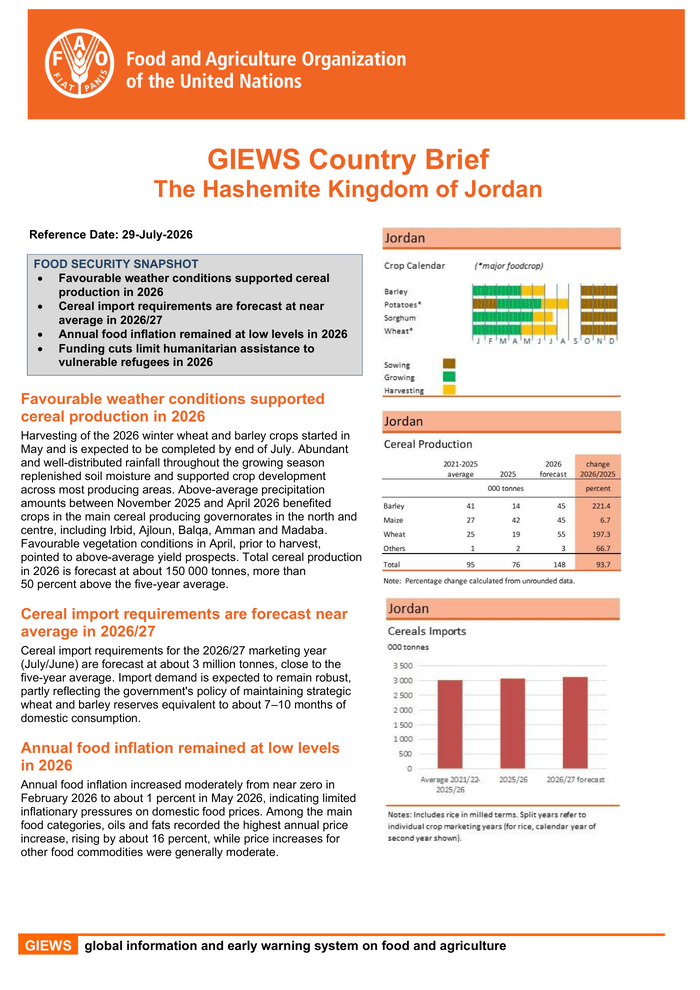
Countries: Jordan, Syrian Arab Republic Source: Food and Agriculture Organization of the United Nations Please refer to the attached file. FOOD SECURITY SNAPSHOT Favourable weather conditions supported cereal production in 2026 Cereal import requirements are forecast at near average in 2026/27 Annual food inflation remained at low levels in 2026 Funding cuts limit humanitarian assistance to vulnerable refugees in 2026 Favourable weather conditions supported cereal production in 2026 Harvesting of the 2026 winter wheat and barley crops started in May and is expected to be completed by end of July. Abundant and well-distributed rainfall throughout the growing season replenished soil moisture and supported crop development across most producing areas. Above‐average precipitation amounts between November 2025 and April 2026 benefited crops in the main cereal producing governorates in the north and centre, including Irbid, Ajloun, Balqa, Amman and Madaba. Favourable vegetation conditions in April, prior to harvest, pointed to above‐average yield prospects. Total cereal production in 2026 is forecast at about 150 000 tonnes, more than 50 percent above the five‐year average. Cereal import requirements are forecast near average in 2026/27 Cereal import requirements for the 2026/27 marketing year (July/June) are forecast at about 3 million tonnes, close to the five-year average. Import demand is expected to remain robust, partly reflecting the government’s policy of maintaining strategic wheat and barley reserves equivalent to about 7–10 months of domestic consumption. Annual food inflation remained at low levels in 2026 Annual food inflation increased moderately from near zero in February 2026 to about 1 percent in May 2026, indicating limited inflationary pressures on domestic food prices. Among the main food categories, oils and fats recorded the highest annual price increase, rising by about 16 percent, while price increases for other food commodities were generally moderate. Funding cuts limit food assistance to vulnerable refugees in 2026 The country continues to host a large refugee population, while ongoing regional conflicts add pressure to an already challenging economic environment. According to United Nations High Commissioner for Refugees (UNHCR), more than 390 000 Syrian refugees were registered in the country as of June 2026. Funding shortfalls have caused the suspension of food assistance for refugees living in host communities since April 2026 and the reduction of cash transfers for refugees living in camps.



GrowthPakistan brings you the latest news to keep an eye on Pakistan’s startup ecosystem. Business keeps you growing when you stay aware of your competitors' moves. GrowthPakistan offers Business, Tech, Global Tech, Global, Auto, and Startup News straight from industries all around the globe. This platform will help you identify upcoming opportunities not only in Pakistan but worldwide.
Email : growthpakistan@gmail.com
Whatsapp : +92320-9497079
© growthpakistan