


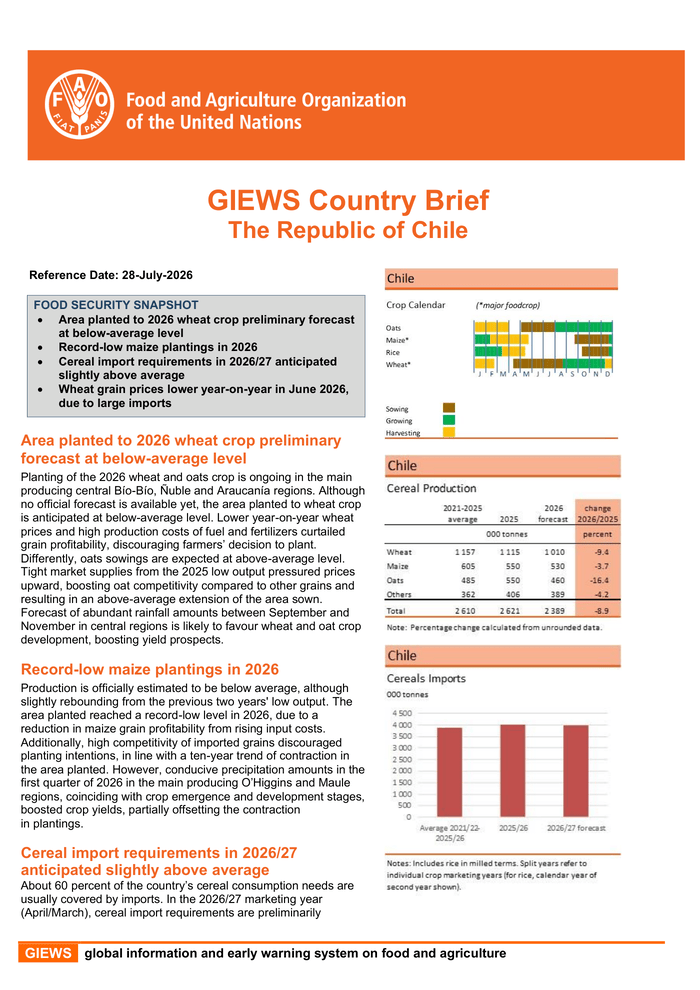
Country: Chile Source: Food and Agriculture Organization of the United Nations Please refer to the attached file. FOOD SECURITY SNAPSHOT Area planted to 2026 wheat crop preliminary forecast at below‐average level Record‐low maize plantings in 2026 Cereal import requirements in 2026/27 anticipated slightly above average Wheat grain prices lower year‐on‐year in June 2026, due to large imports Area planted to 2026 wheat crop preliminary forecast at below-average level Planting of the 2026 wheat and oats crop is ongoing in the main producing central Bío-Bío, Ñuble and Araucanía regions. Although no official forecast is available yet, the area planted to wheat crop is anticipated at below‐average level. Lower year‐on‐year wheat prices and high production costs of fuel and fertilizers curtailed grain profitability, discouraging farmers’ decision to plant. Differently, oats sowings are expected at above‐average level. Tight market supplies from the 2025 low output pressured prices upward, boosting oat competitivity compared to other grains and resulting in an above-average extension of the area sown. Forecast of abundant rainfall amounts between September and November in central regions is likely to favour wheat and oat crop development, boosting yield prospects. Record‐low maize plantings in 2026 Production is officially estimated to be below average, although slightly rebounding from the previous two years’ low output. The area planted reached a record‐low level in 2026, due to a reduction in maize grain profitability from rising input costs. Additionally, high competitivity of imported grains discouraged planting intentions, in line with a ten‐year trend of contraction in the area planted. However, conducive precipitation amounts in the first quarter of 2026 in the main producing O’Higgins and Maule regions, coinciding with crop emergence and development stages, boosted crop yields, partially offsetting the contraction in plantings. Cereal import requirements in 2026/27 anticipated slightly above average About 60 percent of the country’s cereal consumption needs are usually covered by imports. In the 2026/27 marketing year (April/March), cereal import requirements are preliminarily forecast at 4 million tonnes, slightly above the five‐year average and close to the previous year, reflecting a nearly stable demand of wheat grain and maize imports from swine and poultry industries. Wheat grain prices lower year‐on‐year in June 2026, due to large imports Wholesale prices of wheat grain increased continuously from March to May 2026, pressured by limited seasonal availabilities, and were about 11 percent below their level of the previous year in May 2026, reflecting ample market supply from above‐average import amounts between April 2025 and March 2026. In retail markets, prices of rice were on the rise in April and May 2026, before falling by 5 percent month‐on‐month in June, driven by improved seasonal supplies from the ongoing harvest, and were about 10 percent lower than the previous year, in line with declining international quotations. Retail prices of potatoes strengthened continuously from October 2025 to June 2026, reaching a level about 16 percent above the previous year, reflecting higher production costs from increased fuel and fertilizer prices. Bread prices were nearly stable from April to June 2026, at a slightly lower year‐on‐year price level, which reflected the decline of wheat grain prices.



GrowthPakistan brings you the latest news to keep an eye on Pakistan’s startup ecosystem. Business keeps you growing when you stay aware of your competitors' moves. GrowthPakistan offers Business, Tech, Global Tech, Global, Auto, and Startup News straight from industries all around the globe. This platform will help you identify upcoming opportunities not only in Pakistan but worldwide.
Email : growthpakistan@gmail.com
Whatsapp : +92320-9497079
© growthpakistan