


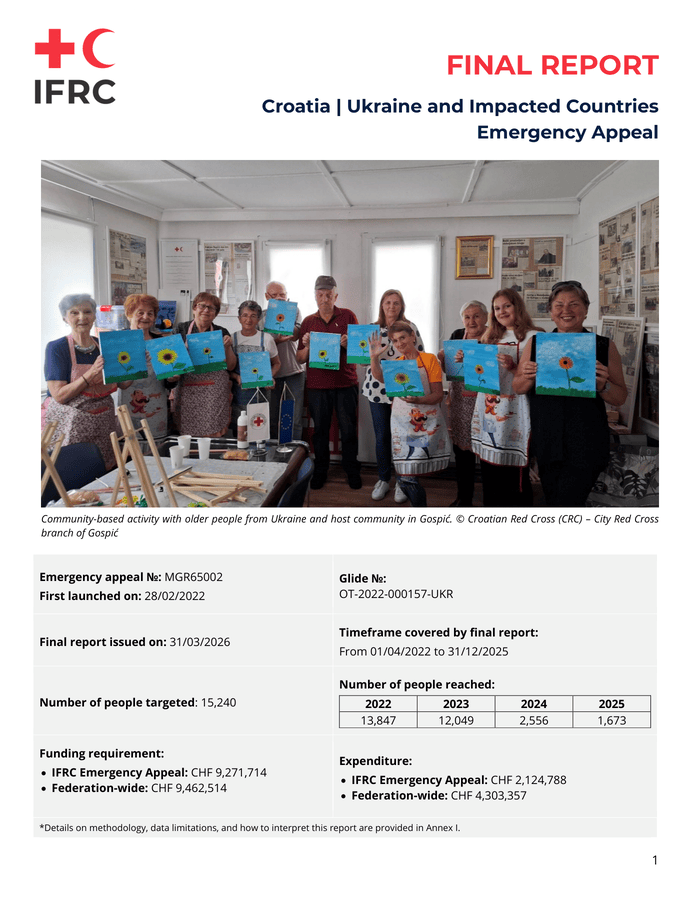
Countries: Croatia, Ukraine Source: International Federation of Red Cross and Red Crescent Societies Please refer to the attached file. A. SITUATION ANALYSIS Description of the crisis Following the escalation of the international armed conflict between Russia and Ukraine on 24 February 2022, many people were forced to leave their homes and seek refuge in other parts of Ukraine or other European countries, including Croatia. Displaced people from Ukraine started arriving to Croatia on 25 February 2022 with the number of arrivals steadily rising ever since. By 29 December 2025, a total of 32, 605 displaced people from Ukraine had been registered by the Ministry of Interior of the Republic of Croatia and have been provided with the temporary protection status (TPS). In line with its humanitarian mandate and as a part of the civil protection system, the Croatian Red Cross (CRC) immediately started responding to the needs of the displaced people from Ukraine. Displaced people from Ukraine granted with TPS were entitled to receive social welfare support from the state, including health services, education for children and accommodation in collective shelters or private housing. On 29 December 2025, there were 3, 506 displaced people accommodated in private family houses and flats, while 2, 134 people were accommodated in 44 shared facilities provided by the state. All people with TPS were supposed to register with CRC as per recommendation of the Ministry of Interior of the Republic of Croatia. As per the needs assessments carried out on multiple intervals, people in vulnerable situations included single-parent households (mainly led by single mothers), households with members 65 years or older, families with three or more children below the age of 18 years, households with members suffering from chronic diseases or mental or physical disability who depend on permanent care by another family member. Across the assessments, it was consistently found that the families are unable to meet their basic minimum needs without regular delivery of humanitarian aid irrelevant of the fact they are in public or private accommodation.



GrowthPakistan brings you the latest news to keep an eye on Pakistan’s startup ecosystem. Business keeps you growing when you stay aware of your competitors' moves. GrowthPakistan offers Business, Tech, Global Tech, Global, Auto, and Startup News straight from industries all around the globe. This platform will help you identify upcoming opportunities not only in Pakistan but worldwide.
Email : growthpakistan@gmail.com
Whatsapp : +92320-9497079
© growthpakistan