


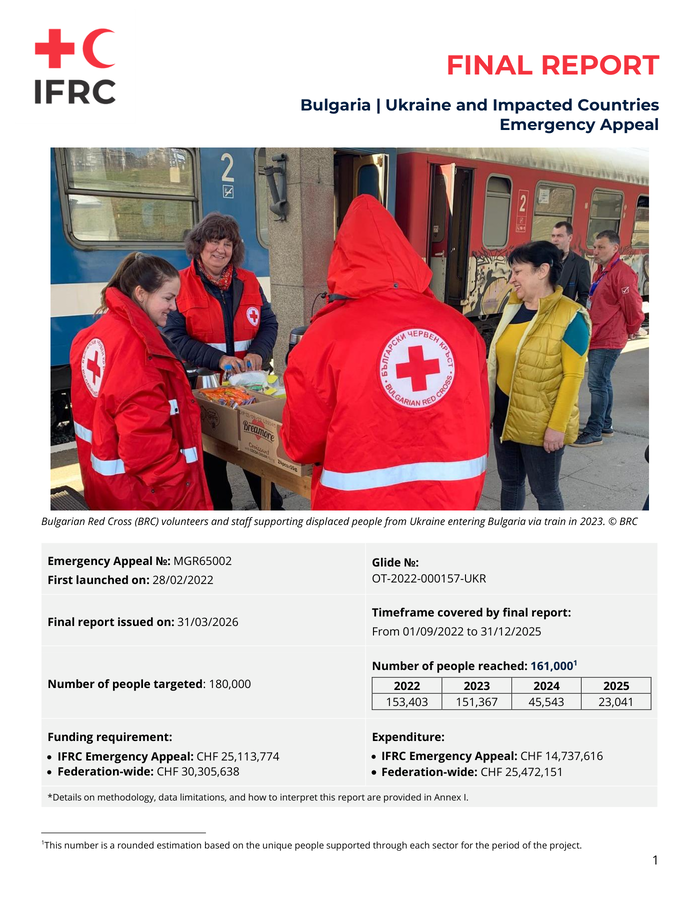
Countries: Bulgaria, Ukraine Source: International Federation of Red Cross and Red Crescent Societies Please refer to the attached file. A. SITUATION ANALYSIS Description of the crisis The escalation of the international armed conflict between Russia and Ukraine resulted in a widespread displacement of people from Ukraine, with some seeking refuge in Bulgaria. This led to a total 997, 344 people displaced from Ukraine entering the territory of Bulgaria during the first year2, with an estimated 149, 268 displaced individuals registering for temporary protection, and 49, 704 remaining in Bulgaria as of 31 December 2022. 3 The regions of Russe, Dobrich, Varna and Burgas were the first branches to be significantly impacted by the sudden and large number of displaced people from Ukraine, which played a direct part in Bulgarian Red Cross (BRC) initiating a national campaign that raised a total of CHF 2 million. Despite the overwhelming support that BRC received through its national campaign, the continued flow of newly arriving people meant that BRC required additional support from the International Federation of Red Cross and Red Crescent Societies (IFRC) Emergency Appeal for Ukraine and Impacted Countries. This additional funding allowed BRC to start its largest ever cash and voucher assistance (CVA) project, with 28, 190 people being provided with support to address some the immediate needs linked to the approaching winter season of 2022/2023. On 1 February 2023, the Council of Ministers extended the temporary protection status (TPS) for displaced people from Ukraine from 1 February 2023 until 4 March 2024, aligning with the European Council’s directive and covering all previously registered people. With this ruling in place the context in Bulgaria continued to evolve, with 1, 254, 470 displaced people from Ukraine entering Bulgaria during the year4 and an estimated 90, 000 people with TPS residing in Bulgaria by July 2024. 5 The shifting priorities of transiting people and those that planned to remain in Bulgaria continued to create operating challenges for BRC. This required the design and development of activities that could respond to the needs of both groups. An additional challenge in Bulgaria was the record high number of asylum applications coming from people entering Bulgaria from its southern border, with 22, 518 people applying in 2023. In 2024, the influx of displaced people from Ukraine into Bulgaria continued, albeit at a slower pace than previous years, with the total number of people reaching a peak of 106, 300 by the end of June 2024. 6 While the situation associated with basic needs improved for some displaced people, the continuation of the conflict required BRC to focus on supporting people to adapt and integrate into what was becoming a longer-term living arrangement in Bulgaria. This challenge was addressed through additional investments in Bulgarian language classes, increased support for children’s access to schools, strengthened engagement with host communities and mental health and psychosocial support (MHPSS) services. As of 2025, the situation in Bulgaria remains unresolved, with humanitarian needs varying among the different vulnerable groups. With 73, 880 displaced people from Ukraine remaining in Bulgaria (approximately 1. 2% of the total population of Bulgaria) as October 20257, which includes an estimated 17, 678 newly arrived people being granted TPS in 2025. 8 Recent surveys of this population showed that 42% of households have not considered the need to return to Ukraine since the escalation of the international armed conflict and 29% have only returned to Ukraine once since the start of the conflict. 9 This indicates that there will be a continuing need to provide support to this segment of the population, with a focus being on supporting the integration journey of these families while the international armed conflict between Russia and Ukraine continues.



GrowthPakistan brings you the latest news to keep an eye on Pakistan’s startup ecosystem. Business keeps you growing when you stay aware of your competitors' moves. GrowthPakistan offers Business, Tech, Global Tech, Global, Auto, and Startup News straight from industries all around the globe. This platform will help you identify upcoming opportunities not only in Pakistan but worldwide.
Email : growthpakistan@gmail.com
Whatsapp : +92320-9497079
© growthpakistan