


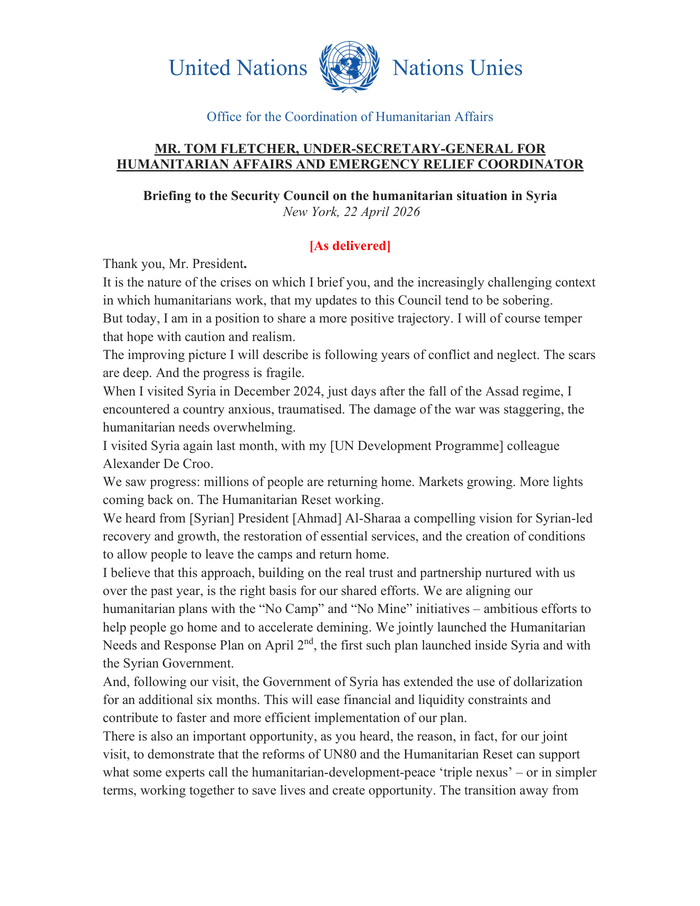
Country: Syrian Arab Republic Source: UN Office for the Coordination of Humanitarian Affairs Please refer to the attached file. As delivered Thank you, Mr. President. It is the nature of the crises on which I brief you, and the increasingly challenging context in which humanitarians work, that my updates to this Council tend to be sobering. But today, I am in a position to share a more positive trajectory. I will of course temper that hope with caution and realism. The improving picture I will describe is following years of conflict and neglect. The scars are deep. And the progress is fragile. When I visited Syria in December 2024, just days after the fall of the Assad regime, I encountered a country anxious, traumatised. The damage of the war was staggering, the humanitarian needs overwhelming. I visited Syria again last month, with my [UN Development Programme] colleague Alexander De Croo. We saw progress: millions of people are returning home. Markets growing. More lights coming back on. The Humanitarian Reset working. We heard from [Syrian] President [Ahmad] Al-Sharaa a compelling vision for Syrian-led recovery and growth, the restoration of essential services, and the creation of conditions to allow people to leave the camps and return home. I believe that this approach, building on the real trust and partnership nurtured with us over the past year, is the right basis for our shared efforts. We are aligning our humanitarian plans with the “No Camp” and “No Mine” initiatives – ambitious efforts to help people go home and to accelerate demining. We jointly launched the Humanitarian Needs and Response Plan on 2 April, the first such plan launched inside Syria and with the Syrian Government. And, following our visit, the Government of Syria has extended the use of dollarization for an additional six months. This will ease financial and liquidity constraints and contribute to faster and more efficient implementation of our plan. There is also an important opportunity, as you heard, the reason, in fact, for our joint visit, to demonstrate that the reforms of UN80 and the Humanitarian Reset can support what some experts call the humanitarian-development-peace ‘triple nexus’ – or in simpler terms, working together to save lives and create opportunity. The transition away from emergency humanitarian need into development, resilience and recovery is essential. We must move faster to turn this vision into reality. Meanwhile, humanitarians are stepping up. Our partners are helping over 200, 000 returnees each month with food, healthcare and water. In Quarter 1, we disbursed US$84 million from our recently merged country and cross-border pooled funds, with 72 local partners receiving almost two-thirds. We are ensuring that women-led organizations are at the centre of decision-making, strengthening our evidence-based, hyper-prioritized response. This month we have allocated a further $146 million of funding from the US Government to 17 life-saving projects. They will all start implementation, with facilitation and support where needed from the authorities, by the 1st of May, backed by a new Accountability and Impact Team to ensure robust oversight, risk analysis and strengthened accountability. Mr. President, And now, the realism. I want to share three major risks to this progress. First, external. Conflict across the region in March put immense pressure on Syria. As of 19 April, nearly 300, 000 people had crossed into Syria from Lebanon – overwhelmingly Syrian nationals – adding to the estimated 1. 6 million Syrian refugees who have returned to Syria from across the region since the end of 2024. They need food, shelter and other support. While the ceasefire between Iran and the United States and Israel holds, tensions in the region remain high. The risk of ongoing disruptions to critical supply routes persists, threatening to destabilize the fragile internal momentum and potentially setting back return and recovery efforts by years. Second risk, the internal challenges remain tough. Needs are still very high. Over 13 million need food, 12 million need clean water, nearly 13 million need healthcare support. In the northeast, 100, 000 displaced across Al-Hasakah and Aleppo Governorates. Services gradually stabilizing there as updated security arrangements are put in place, but gaps remain – electricity, especially in Kobani, where 400, 000 are estimated to be, and movements remain more restricted – we got 30 trucks in on 16 March. In the south, 20, 000-plus people have returned to their home areas, but 155, 000 people remain displaced. We have been able to reach, in the south, close to 400, 000 people per month since July. Access to As-Sweida has stabilized but remains fragile, and damage to power transmission has hit water, health and schools. Also internally, recent flooding across five governorates has affected more than 20, 000 people, many already displaced. More than 3, 500 shelters have been damaged or destroyed, and thousands of hectares of vital wheat crops are at risk. Mines and unexploded ordnance continue to exact a horrific toll, killing more than 50 people and injuring over 100 since mid-March alone. Nearly one in three victims, a child. So our efforts to clear those mines are essential so people return home voluntarily, children go to school and families earn a livelihood. The latest UNHCR survey of refugees in neighbouring countries illustrates these combined challenges: 18 per cent plan to return home in the coming year. While this is up from two to three per cent in 2024, it’s down from 27 per cent in January 2025. The barriers cited most: lack of livelihood, lack of economic opportunities; lack of housing; and localized insecurity. Third challenge: funding cuts. In 2025, the plan was 42 per cent funded, led by the [European Union], [United Kingdom], US, Germany, [Kingdom of Saudi Arabia], Qatar. Across Syria, over 400 health facilities – 20 per cent – were hit by that shortfall, over 300 suspended, affecting over 7 million people. And now, amid ongoing cold weather and floods, our winter support is at only 28 per cent of what’s required. WFP needs $200 million in six months to avoid large-scale suspensions. So, Mr. President, My three asks of the Council. First, sustain this diplomatic energy. Use your influence to resolve the remaining flashpoints and allow people to return safely, voluntarily, with dignity – inside Syria and across the region. The success, of course, hinges on the inclusion of all Syrians. Women and girls are critical to this transition. Second, support vital humanitarian operations. Our full requirement is $2. 9 billion. But to sustain the fragile progress I have described, to keep hospitals running, families fed over the next six months, we require a hyper-prioritized $1. 5 billion – the absolute minimum needed to prevent a reversal of gains. We are just 15 per cent funded, with the top 2026 donors so far: the US, $160 million; EU, $64 million; Japan, $40 million; Switzerland, $30 million; Germany, $29 million; Canada, $27 million; Denmark, $22 million; and the UK, $20 million. Third, invest in Syria’s future with sustained, predictable support for recovery and development. The world needs a success story right now and Syria could be that story, but only if this Council helps us overcome the three risks I have outlined: through sustained diplomatic engagement, immediate humanitarian support, and long-term investment in the future. We must stay the course. Thank you.



GrowthPakistan brings you the latest news to keep an eye on Pakistan’s startup ecosystem. Business keeps you growing when you stay aware of your competitors' moves. GrowthPakistan offers Business, Tech, Global Tech, Global, Auto, and Startup News straight from industries all around the globe. This platform will help you identify upcoming opportunities not only in Pakistan but worldwide.
Email : growthpakistan@gmail.com
Whatsapp : +92320-9497079
© growthpakistan