

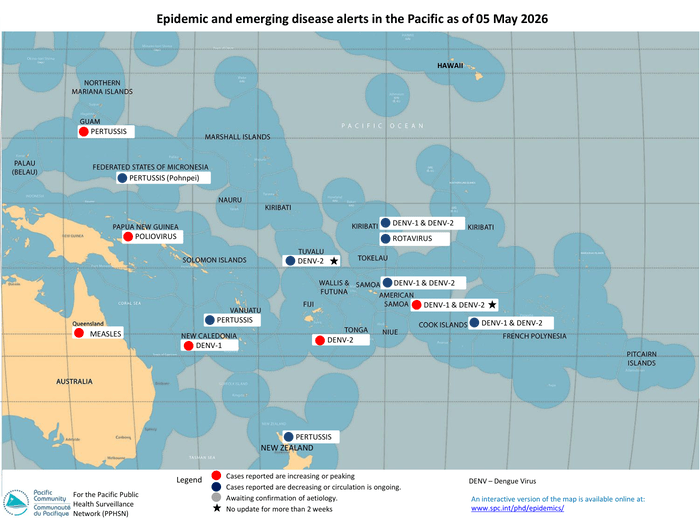
Countries: World, Australia, Cook Islands, French Polynesia (France), Guam, Kiribati, Micronesia (Federated States of), New Caledonia (France), New Zealand, Palau, Tonga, United States of America, Vanuatu Source: Pacific Community Please refer to the attached Map. Highlights/updates since the last map was sent on PacNet on 28 April 2026: Dengue New Caledonia: As of 4 May 2026, dengue transmission remains ongoing. A total of 1, 376 cases have been reported in 2026, showing a further increase since the previous update. The most recent case was reported on 2 May 2026. DENV‐1 remains the predominant circulating serotype. The red alert for DENV-1 remains in effect. – Source: La dengue | Direction des Affaires Sanitaires et Sociales de Nouvelle-Calédonie accessed on 05 May 2026. Samoa: As of EpiWeek 17 (20–26 April 2026), dengue transmission continues in Samoa. During the week, 159 new cases were reported, including 27 laboratory‐confirmed cases, representing a slight decrease in confirmed infections compared with the previous week. Six new hospital admissions were recorded, with no ICU admissions and no deaths. DENV‐1 (57%) and DENV‐2 (43%) continue to co‐circulate. Transmission remains widespread across Upolu (64%) and Savai‘i (36%), with children under 15 years (74%) remaining the most affected. The cumulative number of dengue‐related deaths remains nine. The blue alert for DENV-1 and DENV-2 remains in effect. – Source: Dengue Fever Outbreak Situation Report in Samoa Issue No 54 accessed on 05 May 2026. Tonga: As of 04 May 2026, dengue transmission continues in Tonga following the outbreak declared in April. A total of 53 laboratory‐confirmed cases have been reported, including three new cases since the previous day. Three cases are currently hospitalised, with no dengue‐related deaths reported. Children aged 10–14 years remain the most affected, with a predominance of male cases, and most infections reported from Tongatapu island. The red alert for DENV-2 remains in effect. – Source: Dengue Fever Outbreak Situation Report #15 – Ministry of Health Tonga – Official Facebook page accessed on 05 May 2026. Pertussis/Whooping cough Federated States of Micronesia: As of EpiWeek 17 (20–26 April 2026), pertussis transmission continues in Pohnpei State. Four new cases were reported during the week, including one laboratory‐confirmed case. This brings the cumulative total to 40 cases since January 2026, comprising 15 confirmed and 25 suspected cases. Cases continue to be reported across multiple communities, with young children and unvaccinated individuals remaining most at risk. Health authorities are maintaining enhanced surveillance, contact tracing, treatment, vaccination activities, and community awareness efforts. The blue alert for pertussis remains in effect *. – Source: Communicable Disease Weekly Bulletin (report for EpiWeek: 17) shared with PPHSN Coordinating Body Focal point on 01 May 2026. * Guam: As of 30 April 2026, pertussis transmission continues in Guam. A total of 23 cases have been detected since EpiWeek 21 of 2025, including 21 laboratory‐confirmed and two probable cases. Two new laboratory‐confirmed cases were identified on 28 April 2026, and one probable case was identified on 17 April 2026. No cases are currently hospitalised, and no pertussis‐related deaths have been reported. Case investigation, contact tracing, and vaccination activities continue, with a focus on infants, pregnant women, and close contacts. The red alert for pertussis remains in effec * t. – Sources: Pertussis Outbreak Situation Report N°5 shared on PacNet on 01 May 2026 and* news_1777355824_PR26-088 DPHSS Confirms Two New Cases of Pertussis in Guam. pdf and Epi Reports | Epidemiology and Laboratory Capacity (ELC) Guam – DPHSS accessed on 05 May 2026. New Zealand: Pertussis activity in New Zealand shows ongoing transmission. As of the week ending 24 April 2026, 38 cases were reported, an increase compared with 26 cases reported in the previous week. This brings the total number of reported cases in 2026 to 610. Weekly notifications continue to fluctuate, indicating sustained community transmission. The blue alert for pertussis remains in effect. – Source: Pertussis dashboard accessed on 05 May 2026. Polio/Poliomyelitis Papua New Guinea: The national poliovirus outbreak, declared in May 2025, continues to require sustained response efforts. Following two nationwide vaccination rounds, no new human poliovirus cases have been reported since October 2025, including from acute flaccid paralysis surveillance. However, recent environmental samples have detected poliovirus signals, indicating possible silent circulation. On 27 April 2026, Papua New Guinea launched the third round of the polio vaccination campaign, targeting children aged 0–59 months, with a focus on Morobe, Enga, the National Capital District, and Central Province, where coverage remains low. Enhanced surveillance and intensified immunisation activities continue, with the aim of interrupting transmission and reaching ≥95% coverage. The red alert for Polio remains in effect. – Source: Papua New Guinea intensifies final push to stop polio with targeted third vaccination campaign accessed on 05 May 2026. Other Information: Dengue New Zealand: In New Zealand (NZ), during EpiWeek 17 (25 April – 01 May 2026), five confirmed imported dengue cases and one case under investigation were reported. Among confirmed cases, two had returned from the Cook Islands, one from Malaysia, one from Samoa and 1 from Tonga. Given the known serological cross‐reactivity between dengue and other flaviviruses, some reported dengue cases may ultimately be reclassified as other flavivirus infections as epidemiological and laboratory investigations continue. – Source: NZ Arbovirus Notifications by Country (17: 25/04/2026–01/05/2026) shared with PPHSN Coordinating Body Focal point on 04 May 2026. Diarrhoea Federated States of Micronesia: As of EpiWeek 17 (20–26 April 2026), diarrhoea illness is on alert in Yap State for the second consecutive week. A total of 19 diarrhoeal cases were reported during the week, an increase compared with the previous week. Cases were reported from OPD Main Hospital and multiple outer island facilities, including Woleai. Laboratory testing confirmed enteric pathogens, including norovirus, rotavirus, and diarrhoeagenic E. coli (EPEC and ETEC). Public health authorities continue to promote hygiene, food safety, and community awareness measures, while surveillance remains ongoing. – Source: Yap State Department of Health Services, Communicable Disease report (Week #17; 20–26 April 2026) shared with PPHSN Coordinating Body focal point on 29 April 2026. Hantavirus Cruise ship (South Africa): A laboratory‐confirmed hantavirus case has been identified in a British passenger from the cruise ship MV Hondius, who remains critically ill in intensive care in South Africa. The vessel was travelling from Argentina to the Canary Islands via Cape Verde, carrying around 150 passengers and crew, when several passengers developed severe illness, including three reported deaths, now classified as suspected cases. WHO is coordinating a multi‐country response, including contact tracing, medical evacuations, and laboratory investigations, and assesses this as a serious but contained event, with low risk to the general public and no recommendation for travel restrictions at this stage. – Source: Call for calm as Hantavirus case confirmed | SAnews, Hantavirus cluster linked to cruise ship travel, Multi-country and WHO leads response to cruise ship hantavirus outbreak | UN News accessed on 05 May 2026 Mpox Hawai’i: As of 27 April 2026, clade I mpox virus has been detected in wastewater on Oʻahu, marking the first such detection in Hawaiʻi. The positive sample was collected on 13 April 2026 at a wastewater treatment facility serving Joint Base Pearl Harbor–Hickam. No clinical cases of clade I mpox have been identified to date, and there is no evidence of community transmission. A subsequent wastewater sample tested negative, and routine testing at major civilian sites remains negative. Health authorities report that the risk to the general public is low, while encouraging vaccination and vigilance among higher‐risk groups. – Source: MPOX DETECTED AT WASTEWATER SAMPLING SITE ON OʻAHU | News Releases from Department of Health accessed on 05 May 2026. Polio/Poliomyelitis Australia: In mid‐April 2026, vaccine‐derived poliovirus type 2 (VDPV2) was detected in a wastewater sample in Perth, Western Australia, through routine environmental surveillance. This was an environmental detection only, with no confirmed clinical cases and no evidence of local transmission. Health authorities report that the risk to the community is very low, given high polio vaccination coverage and Australia’s continued polio‐free status since 2000. Follow‐up wastewater testing has been intensified, while public health authorities continue to monitor the situation and reinforce vaccination messages. – Sources: Poliovirus detected in Western Australian wastewater – Government of Western Australia and Surveillance that works – finding poliovirus before it finds us – Australian Centre for Disease Control accessed on 05 May 2026.
World: Epidemic and emerging disease alerts in the Pacific as of 05 May 2026

RELATED ARTICLES


