


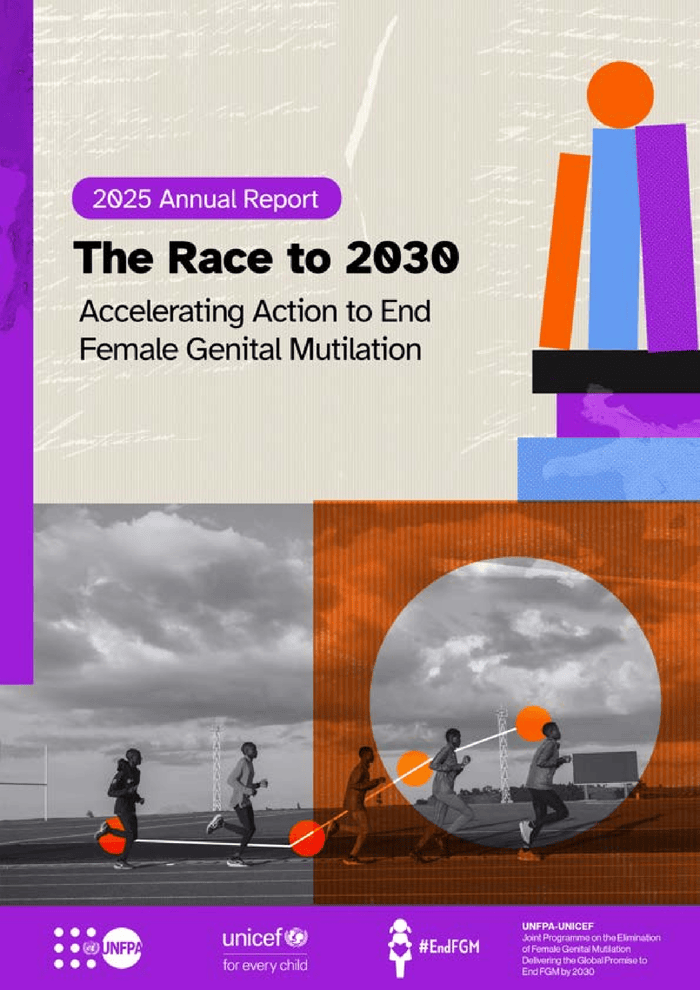
Countries: World, Burkina Faso, Djibouti, Egypt, Eritrea, Ethiopia, Gambia, Guinea, Guinea-Bissau, Indonesia, Kenya, Mali, Mauritania, Nigeria, Senegal, Somalia, Sudan, Uganda, Yemen Sources: UN Children’s Fund, United Nations Population Fund Please refer to the attached file. As the global community approaches the 2030 deadline for the Sustainable Development Goals (SDGs), the UNFPA-UNICEF Joint Programme on the Elimination of Female Genital Mutilation has released its 2025 annual report entitled “The Race to 2030: Accelerating Action to End Female Genital Mutilation”. The report presents both quantitative and qualitative results at the global, regional and country level. The country-level results focus on 18 countries, namely Burkina Faso, Djibouti, Egypt, Eritrea, Ethiopia, The Gambia, Guinea, Guinea-Bissau, Indonesia, Kenya, Mali, Mauritania, Nigeria, Senegal, Somalia, Sudan, Uganda and Yemen. While the 2025 annual report highlights significant institutional breakthroughs, it also issues a stark warning: progress is not keeping pace with demographic realities. Today, there are 30 million more survivors than there were eight years ago, and meeting the 2030 SDG target requires a 27-fold acceleration in elimination trends. Key achievements from 2025: Over 313 million people were reached through mass media on FGM, women’s and girls’ rights, and gender equality Over 7. 5 million people participated in community dialogues, with 4. 3 million people making public declarations to abandon FGM practices. Over 2. 2 million girls and women received essential prevention and protection services, marking a 54% increase. More than 560, 000 girls and women received FGM-related health services, counselling, and referrals, a fivefold increase compared to 2024. A total of 15, 070 health service points now have at least one trained worker on FGM prevention, protection, and care, representing a fourfold increase. Nearly 1. 8 million girls and young women participated in social and behaviour change programmes like life skills education. Over 1. 2 million men and boys actively participated in activities to promote positive masculinity and advocate for FGM elimination. Over 190, 000 religious leaders and community influencers publicly denounced FGM practices. Strategic engagement with supreme religious authorities, such as Al-Azhar in Egypt and the KUPI network in Indonesia, continued to dismantle theological justifications for FGM in selected countries. Legal enforcement had significant growth, with FGM-related arrests doubling (to 932 arrests) and cases brought to court increasing by 76% (to 711 cases). Landmark legal advances were achieved, including the explicit prohibition of FGM in Guinea’s and Djibouti’s new Constitution. New data suggests Eritrea is on track to meet the elimination target, in addition to Uganda’s expected elimination by 2030, proving that sustained, targeted action delivers results. The Path Forward Despite a 48 per cent decline in donor commitments in 2025, the Joint Programme remains resilient, pivoting toward more efficient systemic transformation. Evidence from the report confirms that the greatest reductions in FGM occur where community-led mobilisation, such as reflective dialogues and public declarations, is prioritised. To safeguard the rights of the estimated 22. 7 million girls at risk by 2030, we must rebalance investments toward the community level, reorient health systems toward prevention, and secure sustainable domestic financing.



GrowthPakistan brings you the latest news to keep an eye on Pakistan’s startup ecosystem. Business keeps you growing when you stay aware of your competitors' moves. GrowthPakistan offers Business, Tech, Global Tech, Global, Auto, and Startup News straight from industries all around the globe. This platform will help you identify upcoming opportunities not only in Pakistan but worldwide.
Email : growthpakistan@gmail.com
Whatsapp : +92320-9497079
© growthpakistan