


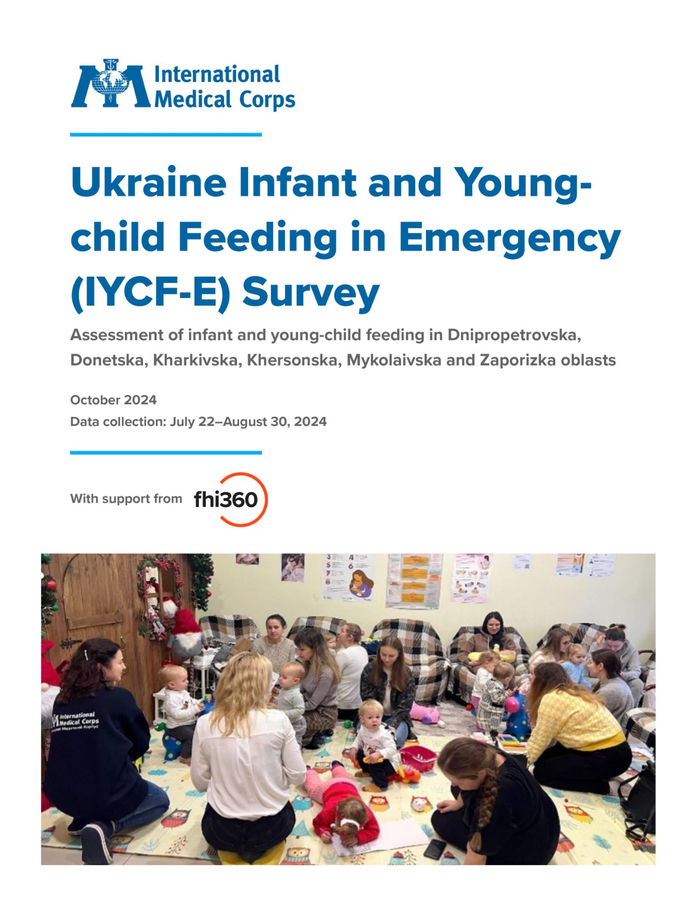
Country: Ukraine Source: International Medical Corps Please refer to the attached file. Executive Summary Background The full-scale Russian invasion of Ukraine in February 2022, a continuation of the aggression that began in 2014, has created an unprecedented humanitarian crisis. Displacement of millions, disrupted healthcare systems and food insecurity have increased the vulnerability of infants and young children (aged 0–23 months) to malnutrition. Understanding infant and young-child feeding (IYCF) practices is essential for informing targeted interventions in such challenging circumstances. Previous studies conducted in Ukraine, including a multiple indicator cluster survey in 2012, 1 research on internally displaced persons (IDPs) in 2015, 2, 3 and a 2023 survey conducted by International Medical Corps in Kyivska, Lvivska and Odeska oblasts, 4 as well as a qualitative study on the effects of the war on Ukrainian women’s infant feeding, 5 highlighted critical gaps in IYCF practices. However, these studies focused on different geographic and humanitarian contexts. The current study builds on earlier efforts by examining the most current IYCF practices in six frontline oblasts—Dnipropetrovska, Donetska, Kharkivska, Khersonska, Mykolaivska and Zaporizka—currently experiencing some of the most severe impacts of the conflict. Study Objectives The primary aim of this study was to assess IYCF practices among children aged 0–23 months in Ukraine’s frontline oblasts to guide humanitarian and public-health programming. Specific objectives included: • evaluating the prevalence of key IYCF indicators (e. g. , breastfeeding and complementary–feeding practices); • identifying barriers and facilitators to optimal IYCF practices; and • exploring the impact of conflict, displacement and disrupted services on caregiver behaviors.



GrowthPakistan brings you the latest news to keep an eye on Pakistan’s startup ecosystem. Business keeps you growing when you stay aware of your competitors' moves. GrowthPakistan offers Business, Tech, Global Tech, Global, Auto, and Startup News straight from industries all around the globe. This platform will help you identify upcoming opportunities not only in Pakistan but worldwide.
Email : growthpakistan@gmail.com
Whatsapp : +92320-9497079
© growthpakistan