


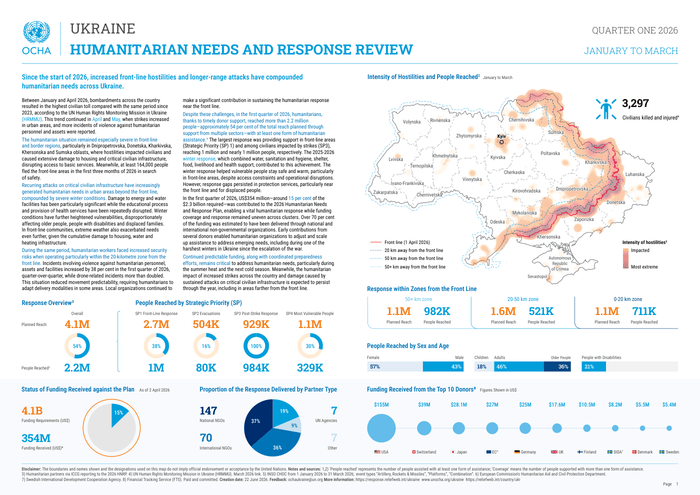
Country: Ukraine Source: UN Office for the Coordination of Humanitarian Affairs Please refer to the attached Infographic. Since the start of 2026, increased front-line hostilities and longer-range attacks have compounded humanitarian needs across Ukraine. Between January and April 2026, bombardments across the country resulted in the highest civilian tollcompared with the same period since 2023, according to the UN Human Rights Monitoring Mission in Ukraine ( HRMMU ). This trend continued in April and May, when strikes increased in urban areas, and more incidents of violence against humanitarian personnel and assets were reported. The humanitarian situation remained particularly severe in front-line and border regions, particularly in Dnipropetrovska, Donetska, Kharkivska, Khersonska and Sumska oblasts, where hostilities impacted civilians and caused extensive damage to housing and critical civilian infrastructure, disrupting access to basic services. Meanwhile, at least 164, 000 people fled the front-line areas in the first three months of 2026 in search of safety. Recurring attacks on critical civilian infrastructure have increasingly generated humanitarian needs in urban areas beyond the front line, compounded by severe winter conditions. Damage to energy and water facilities has been particularly significant while the educational process and provision of health services have been repeatedly disrupted. Winter conditions have further heightened vulnerabilities, disproportionately affecting older people, people with disabilities and displaced families. In front-line communities, extreme weather also exacerbated needs even further, given the cumulative damage to housing, water and heating infrastructure. During the same period, humanitarian workers faced increased security risks when operating particularly within the 20-kilometre zone from the front line. Incidents involving violence against humanitarian personnel, assets and facilities increased by 38 per cent in the first quarter of 2026, quarter-over-quarter, while drone-related incidents more than doubled. This situation reduced movement predictability, requiring humanitarians to adapt delivery modalities in some areas. Local organizations continued to make a significant contribution in sustaining the humanitarian response near the front line. Despite these challenges, in the first quarter of 2026, humanitarians, thanks to timely donor support, reached more than 2. 2 million people —approximately 54 per cent of the total reach planned through support from multiple sectors— with at least one form of humanitarian assistance. The largest response was providing support in front-line areas (Strategic Priority (SP) 1) and among civilians impacted by strikes (SP3), reaching 1. 2 million and 1. 1 million people, respectively. The 2025-2026 winter response, whichcombined water, sanitation and hygiene, shelter, food, livelihood and health support, contributed to this achievement. The winter response helped vulnerable people stay safe and warm, particularly in front-line areas, despite access constraints and operational disruptions. However, response gaps persisted in protection services, particularly near the front line and for displaced people. In the first quarter of 2026, US$354 million—around 15 per cent ofthe $2. 3 billion required—was contributed to the 2026 Humanitarian Needs and Response Plan, enabling a vital humanitarian response while funding coverage and response remained uneven across clusters. Over 70 per cent of the funding was estimated to have been delivered through national and international non-governmental organizations. Early contributions from several donors enabled humanitarian organizations to adjust and scale up assistance to address emerging needs, including during one of the harshest winters in Ukraine since the escalation of the war. Continued predictable funding, along with coordinated preparedness efforts, remains critical toaddress humanitarian needs, particularly during the summer heat and the next cold season. Meanwhile, the humanitarian impact of increased strikes across the country and damage caused by sustained attacks on critical civilian infrastructure is expected to persist through the year, including in areas farther from the front line. Strategic Priority 1: Supporting the most vulnerable who remain close to the front line Some 4. 2 million people remaining within 50 km of the front line and the border with the Russian Federation have suffered increased damage to education, energy, health, transport and water infrastructure. National and local humanitarian organizations played a particularly important role in delivering assistance, while growing security risks increasingly constrained humanitarian access and reduced access to basic services for front-line residents. In front-line areas, where older people and people with disabilities make up a significant portion of the vulnerable people in need, residents faced severe and complex vulnerabilities, with 25 per cent reporting extremely severe needs, according to the REACH Assessment. Responding to high needs and adapting to operational conditions, humanitarian partners supported the most vulnerable through emergency water supply, heating, health care, food, shelter and other multisector assistance. The winter response was integrated during the period through emergency repairs, health and non-food support, including winter-related support through cash, and emergency support for heating and water systems. Humanitarian response near the front line accounted for the largest share of the overall response in the reporting period, with SP 1 coverage at 24 per cent. Furthermore, activities within a 20 km zone from the front line reached 60 per cent of the target. Yet, gaps were reportedin protection services, hygiene support and infrastructure-related interventions in highly insecure locations. Strategic Priority 2: Responding to vulnerable newly displaced and people evacuated from their places of origin to safer hosting areas, including through transit centres and collective sites Civilians continued to flee areas of active hostilities: around 164, 000 people were displaced during the first three months of 2026, primarily from the front-line Dnipropetrovska, Donetska and Zaporizka oblasts, according to the IOM. The mandatory evacuation of civilians, particularly children with their families, announced by local authorities expanded significantly. Nearly 34, 000 evacuees reportedly passed through transit sites, including 2, 000 people with disabilities, according to the Protection Cluster. Accessible accommodation in collective sites remained a major concern. The Protection Cluster reported that only 23 per cent of available rooms were partially accessible to people with limited mobility. Integrated multisectoral assistance, which reached 75, 000 newly displaced people in transit sites, over 1, 500 collective sites and reception points, relied primarily on in-kind support and services, alongside multisectoral assistance through cash. It included protection and psychological services, health care, food, hygiene items, accommodation and the distribution of core essential household items. Coordination between front-line hubs, transit centres and receiving communities remained critical to sustaining continuity of assistance. Persistent gaps included support for people evacuating from high-risk areas using their own means, for vulnerable displaced people outside collective sites, and for access to longer-term accommodation beyond emergency transit arrangements. Strategic Priority 3: Providing emergency response after strikes Intensified and geographically expanded attacks across Ukraine, including in front-line areas and large urban centres farther from the front line, have generated widespread humanitarian impact. Damage to critical civilian infrastructure caused prolonged outages in different regions and deepened humanitarian needs among the most vulnerable. In the first three months of 2026, 95 per cent of families in front-line areas reported power outages, while across the country, 28 per cent of households reported water disruptions, according to the REACH Assessment. Winter conditions put additional pressure on public services, disrupting access to basic services beyond the scope of humanitarian response. Humanitarian partners scaled up emergency response to support the most vulnerable people affected, notably during prolonged blackouts, complementing the efforts of national authorities and service providers, particularly energy utilities, which played the key role in addressing the impact of attacks on critical civilian infrastructure. Aid organizations provided emergency shelter assistance, supported essential utility systems and health facilities and distributed other support, including hot meals and cash to cover the immediate needs of people affected by attacks. Yet, more assistance is required for psychosocial support, education continuity and sustained assistance for households affected by repeated damage to critical infrastructure and prolonged blackouts. The number of people assisted—nearly 1 million—is already above the planned reach, particularly within the 50+ km zone from the front line. Despite these efforts, disruptions to basic services are likely to continue beyond the winter season. Strategic Priority 4: Supporting the centrality of protection for vulnerable internally displaced people and severely vulnerable groups at risk of not being covered by social protection networks With 69 per cent of displaced people having been displaced for over two years, according to the IOM, coping capacities have eroded. Needs remained particularly severe among approximately 70, 500 vulnerable people in collective sites, social institutions and vulnerable farmers near the front line. Other vulnerable groups, including women and children, continue to face significant psychosocial and protection risksand require safe accommodation, health care, hygiene support and protection. People experiencing a long-term displacement and temporarily not covered by the state social protection system are also in need of multi-sectoral support, including through cash. Severe winter conditions further compounded their vulnerabilities. Humanitarian response under Strategic Priority 4 focused primarily on the most vulnerable internally displaced people living in collective sites and within 20 to 50 km of the front line, as well as vulnerable farmers within 20 km of the front line. Assistance included support for collective sites, protection and psychosocial services, health care, water and hygiene assistance, education continuity, winter support and cash assistance to meet basic needs. The response also extended beyond front-line areas to support vulnerable displaced people and reached non-displaced war-affected people whose needs and assistance to whom will be analyzed further to inform the scope of the priority. Yet, coverage remained insufficient relative to needs. Even though some 400, 000—37 per cent of the people planned to be supported were reached—the coverage with different forms of assistance was around 15 per cent, indicating a potential lag in the response. Persistent gaps were noted in child protection, mental health and sustained support for people facing protracted displacement and chronic vulnerability, compounded by funding constraints.



GrowthPakistan brings you the latest news to keep an eye on Pakistan’s startup ecosystem. Business keeps you growing when you stay aware of your competitors' moves. GrowthPakistan offers Business, Tech, Global Tech, Global, Auto, and Startup News straight from industries all around the globe. This platform will help you identify upcoming opportunities not only in Pakistan but worldwide.
Email : growthpakistan@gmail.com
Whatsapp : +92320-9497079
© growthpakistan