


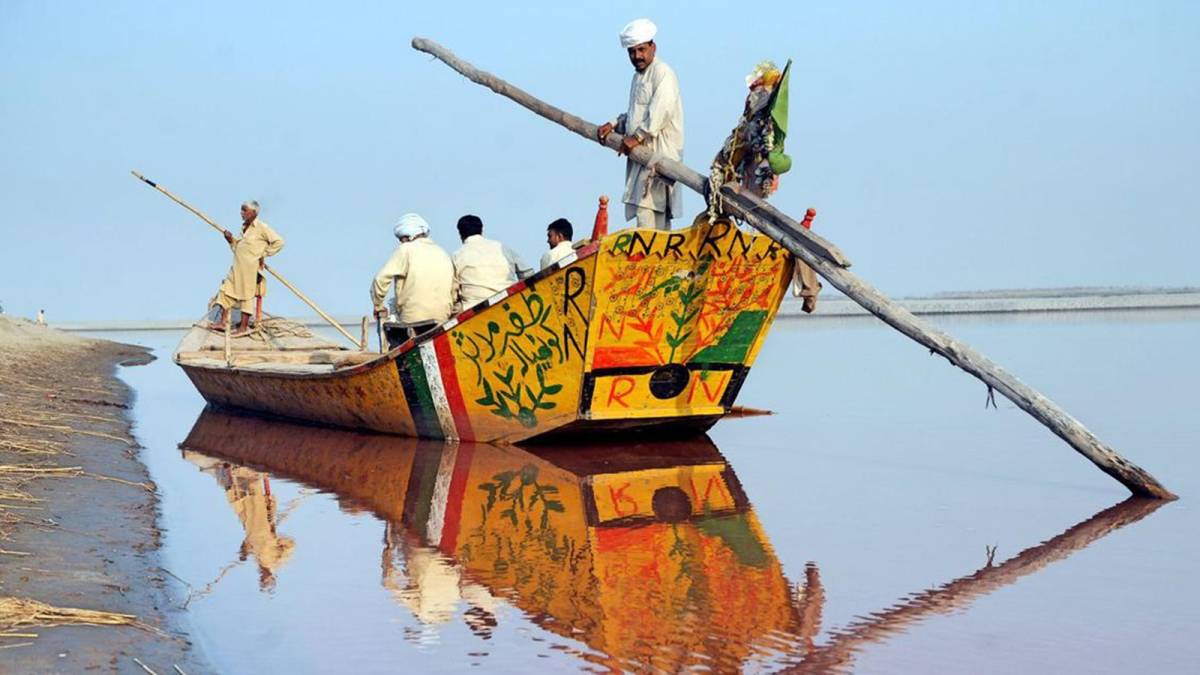
Cintu or Kintu was an early Proto-Dravidian name. It became Cintu in Late Dravidian languages. The Dravidian language family (comprising 24 indigenous languages) is 4, 500 years old. Intu or Intu nir means sea in the old Tamil language. It is possible that Intu became Sindhu later. Intu again comes with another meaning: the date-palm. According to A Dravidian Etymological Dictionary Supplement, compiled by T Burrow and Emeneau (Oxford, 1984), Intu means Date-Palm or Phoenix dactylifera; dwarf wild date-palm (p 227). See also: Henda means from the wild date tree and Bonda means Palmyra or wild date tree. So, Cint, Cind or Sindi means a date-palm. Was Intu or Sindhu a Land of the Date Palm Trees? Were these people called Cinti, Cindi or Sindhi? Yes. Dates of the Indus Valley were very famous in other lands. The people of these nations called these Meluhan Dates in their own languages. Dates have been cultivated in the Middle East and Indus Valley for thousands of years. Archaeological evidence of dates has been found at Mehrgarh, a Neolithic site dating back to 7000 BC. The Indus People living at Mehrgarh also cultivated cotton, wheat, barley, and dates. Some badly carbonised date seeds were found in chamber 37, House 1, VS Area at Mohenjo-Daro during the 1925-26 excavations. Sindh and Balochistan still produce the best quality dates. Sindhu means river and sea in Classical Sanskrit. In the Rigveda (1700 BC), the river known as Sindhu refers to the Indus River. In the Zend Avesta (1500-400 BC), the sacred texts of Zoroastrianism, Sindh is referenced under the Old Persian linguistic shift where the Sanskrit ‘s’ turns into ‘h’. The region of the Lower Indus Valley and Sindhu River is mentioned as Hindush (or Hindu). In the Vendidad, the first chapter lists the 16 lands created by the Ahura Mazda, the supreme deity. Hapta Hindu is listed as the 15th land, and the Avestan texts mention that it was known for its abnormal heat. From the Persians, the name Hindu passed to the Greeks as Indos after Alexander’s conquest of the Indus Valley in 326 BC. Afterwards, it was adopted by the Romans as Indus. Unearthing Commerce In Mohenjo-Daro: Ports, Agriculture And Ancient Infrastructure Depiction of the citadel of Mohenj-Daro 2600-1900 BC Sindh, its kings, seaport, and elephants were described by a Christian monk, Cosmas of Alexandria, Egypt, in his Greek work called Christian Topography (547 AD). The Holy Prophet Muhammad (PBUH) was born in 571 AD at Makkah, 24 years after the compilation of this book. The Christian monk Cosmas of Alexandria writes regarding the Buddhist Rai Dynasty rulers of Sindh that, “And to Sindu also where musk and castor is procured and androstachys, and to Persia and the Homerite country, and to Adule. And the island receives imports from all these marts which we have mentioned and passes them on to the remoter ports, while at the same time, exporting its own produce in both directions. Sindu is on the frontier of India, for the river Indus, that is, the Phison, which discharges into the Persian Gulf, forms the boundary between Persia and India” (p 366). Cosmas again writes that, “The kings of various places in India keep elephants, such as the King of Orrhota, and the King of Calliana and the King of Sindu, Sibor and Male. They may have each 600 or 500, some more, some fewer”. (p 371) The ancestry of the Indus Valley Civilisation and Mohenjo-Daro can be traced through archaeology, genetics, linguistics, and ancient history because all the written inscriptions on Indus Seals and other cultural material remain undeciphered. From the house structures, diet, cultural patterns, water sources, pottery styles, ornaments, migration, trade, and farming activities we may know something regarding the builders of Mohenjo-Daro. Furthermore, the presence of words and names in the modern Sindhi language belonging to the Proto-Dravidian and Dravidian or Proto-Indo-Aryan languages can help us in this connection. Sometimes the Indus-Sumerian connections and clues also shed light on such ancient Indus Valley tribes, kingdoms, trade networks, and goods. Many populations in Sindh, Punjab, Balochistan, and Gujarat still carry ancestry which is partly linked to the ancient Indus Valley Civilisation. Discovering Mohenjo-Daro’s Ancient Defences The Indus Valley Civilisation and Mesopotamia engaged in significant trade, evidenced by Indus seals found in Iraq around 2600-1900 BC Following are some ancient tribes, clans, and families which can be connected with the ancient Indus Valley Civilisation who took part in the foundation of urban cities like Harappa, Mohenjo-Daro, Chanhudaro, and others that flourished around the Mature Indus Phase of 2600-1900 BC. In short, the descendants of the Mohenjo-Daro people still live around its remains even today. Atta Muhammad Bhanbhro identified some Sindhi tribes by deciphering some of the Indus Seals and Inscriptions in his English book entitled Indus Script. This 832-page book was published by the Department of Archaeology and Anthropology, University of Sindh Jamshoro, in 2012. The late Atta Muhammad Bhanbhro identified the following castes, subcastes, and names: Areeja, Samma, Khatri, Behan, Kaka, Bhagia, Dahar, Bhat, Magsi Saria, Manganhar (Singer), and Vaka, etc. Let’s discuss one of the oldest tribes of Sindh: the Malah. Malah: The Boatmen of the Indus Valley Civilisation (Meluhha) Meluhha (or Meluha) is the Sumerian name for a prominent trading partner of Mesopotamia in the 3rd millennium BC. Today, it is widely identified by scholars as the Indus Valley Civilisation. It encompassed parts of modern-day Pakistan, India, Afghanistan, and Iran. In the Sumerian language, Malahum means a sailor or captain. This name ma-la-hu-um is found 9 times in the Ur III (2100-2000 BC) texts. This name is also found in Aramaic (melahha), Hebrew (melakh), and Arabic (malaah) – all meaning sailor or seafarer. While in Akkadian it became Malahu with the Akkadian meaning seaman or sailor. Their land was called Meluha or Melukha, which means the Land of the Sailors (Boatmen) or the Country of the Black Skinned People. The AICC (AI Cuneiform Corpus) texts describe Malah (ma lah) 39 times with different descriptions, i. e. , field of Malah, under seal of Malah, for the foremen of Malah, Inim Babazi son of Warad Malah, 5 Malah boats, son of Malah, 1 scribe of Malah, Malah son of Sheshkalla, 106 gur Malah booked out, 20 Malah labourers, 1 barig Malah, the city of Malah, from ARAD of the Malah. Tracing Lahore’s Progressive Urdu Poetry Legacy Mohenjo-Daro reed roof plaster excavated from DK Area 1925-27 King Sargon moored the ships of Meluhha, Magan, and Tilmun at the quay of Agade. From the Curse of Akkad we know that the Meluhhans, the people of the black land, brought exotic wares down to the goddess Inana. The people of Meluhha exported the following trading items to their neighbouring countries: grains, vegetables, fruits, beads, cloth/textiles, dye, jewellery, metals, ivory, sea shells, pearls, flints, pots, ceramics, tools, oil, animals, birds, and fish, etc. The ancient cities like Harappa and Mohenjo-Daro were best known for their trade networks in the world. Meluhha was ruled by a powerful king at that time. The Akkadian King Sargon (2334–2279 BC) ruled for 56 years over a vast empire stretching from Mesopotamia to the Mediterranean Sea, Elam, Marhashi (Jiroft), and east. He promoted trade and commerce within Mesopotamia and Meluhha, Dilmun, and Magan. The Meluhhan lands were foreign territories for the Mesopotamians. The Indus Valley Civilisation continues up to this day; its clear evidence lives on in the farming techniques, boat-making, pottery, and traditional Rilli-making of the region Sargon had two sons: Rimush and Manishtushu. Enheduanna was his daughter. She was High Priestess of the god Sin at Ur and a prominent poet/author. He was succeeded by his son Rimush in 2279 BC and died in 2270 BC. King Rimush started military campaigns against the cities of Adab, Zabala, KI. AN, Umma, Lagash, Ur, and the Persian Gulf region. He expelled thousands of residents from their cities and destroyed city walls. Early in his reign, Rimush fought a major, brutal campaign against a coalition of eastern territories, including Parahshum (Marhashi), Zahara, Elam, Awan, Susa, and Meluhha, who had revolted against Akkadian rule. He was victorious over Parahshum, also known as Marhashi. The victory was significant, with Rimush claiming to have killed over 16, 000 enemy soldiers and taking thousands of captives, which allowed him to make Akkad wealthy again. A cuneiform tablet reads: “Zahar, Elam, (G)upin, and (Me)luhha assembled in Pa(rah)sum for battle, but. .. ” Further the tablet reads: “Further, he conquered the cities of Elam, destroyed their walls, and tore out the foundations of Parahsum (from the land of Elam)” Again it reads: “When he conquered Elam and Parahsum, he took away 30 minas of gold, 3, 600 minas of copper and 300 male and female slaves and dedicated (them) to god Enlil. ” Decolonising Climate Action: Why Ancient Knowledge Still Matters The author’s father Sikander Ali Sheikh during the early 1970s The Old Akkadian royal monumental object (circa 2340-2200 BC) mentions this event as follows: “Over Abalgamash, King of Parahshum, was victorious. And Zahar and Elam and Gupin and Meluhha within Parahshum assembled for battle, but. .. and in between the cities of Awan and Susa, at the Middle River, Sidaga’u the general of Parahshum and the. .. of Elam he captured, and a burial mound at the site of the town he heaped up over them. Furthermore, the foundations of Parahshum from the country of Elam he tore out, and so Rimush, king of the world, rules Elam, as the god of Enlil had shown”. The king captured Elam and built a stele in the field of the city. Who was the King of Meluhha? Nothing is known about his life from the old records. Later on, during the days of King Naram Sin, we know about Ibra; a Meluhhan king. Frank A Krueger developed the World’s Largest Online Translated Cuneiform Corpus using AI in 2023. This corpus is the AICC (AI Cuneiform Corpus) and it contains 130, 000 AI translated texts from the CDLI and ORACC projects. I must say thanks to Omar Khan, the founder of Harappa. com, for providing me the AICC database link. The AICC search shows 176 results of Sumerian and Akkadian languages describing Meluha/Meluhha (me-luh-ha (ki)). These references to Meluhha are taken from the Old Akkadian (circa 2340-2200 BC), Lagash II (circa 2200-2100 BC), Ur III (circa 2100-2000 BC), Old Babylonian (1900-1600 BC), Middle Babylonian (c. 1400-1100 BC), Neo-Assyrian (circa 911-612 BC), and Hellenistic (169 BC) periods. The author standing with young Bagris in Warah area of District Kamber Shahdadkot, Sindh Mostly these cuneiform texts tell about the Land of Meluhha, the people of Meluha, the king of Meluhha, the Boat of Meluhha, the Temple Administrator of Meluhha, Seal of Ur Lamma son of Meluhha, Road to Meluhha, the border of the land of Meluhha, via Meluhha, the mountain of Meluhha, the pure Meluhha ritual, archers of Meluhha, chariots of Meluhha, horses of Meluhha, barig from Meluhha (standard unit), ebony of Meluhha, gold of Meluhha, the depot of Meluhha, cities of Meluhha, the price of Meluhha, granary of Meluhha, carnelian of Meluhha, the lion from Meluhha, footstool Meluhha, the weapon of the boat of Meluhha, small mule of Meluhha, Meluhha the man of the black-headed people, Ur Igalim son of Meluhha, men from Meluhha, orchard of Meluhha of Ninmar, house of Meluhha, copper for Meluhha, foreman Meluhha, table for Meluhha, sheep for Meluhha, son of Meluhha, the chariot driver of Meluhha, Lu-Marza son of Meluhha, mes (wood) of Meluhha, oil of the men of Meluhha, bread loaves for the boat of 5 Meluhha, from the milling house Meluhha, the tablet of Meluhha, May Meluhha with a mighty bull, .. .and with a large boat, etc. In the late Hellenistic context, the term Meluhha is used for the region of the Eastern Egyptian Delta. A multicoloured or reddish dog of Meluhha was received as tribute for Ibbi Sin. A tablet from Nippur (Lambert, 1960) mentions the Cat of Meluhha. Pakistan’s Power Paradox: Paying For Plenty, Living With Shortage Who founded Mohenjo-Daro? Or who lived or worked at Mohenjo-Daro? From the old written records and traditions, we may assume that Mohenjo-Daro was founded by the Sindhi people living on the River Indus banks commonly known as the Malah or boatmen or sailors. These communities were called the Amir ul Bahar by the Arabs in the 7th century AD. The Amir ul Bahar, Mir Bahar, Muhana, or Meerani tribe of Sindh is divided into 254 septs. Sheikh Sadik Ali Sher Ali Ansari has provided the names of these 254 clans in his book entitled The Muslaman Races found in Sind, Balochistan and Afghanistan (Karachi, 1901). A potter from Sindh using the same tools, shapes of pots and the same beating technique as that done in Kutch The well-known septs of Mir Bahar or the Muhana are: Barija, Bahlim, Balhara, Burira, Channa, Dera, Dhakan, Ghoghara, Karani, Kutria, Larak, Mangria, Moria, Muhana, Sahata, Sameja, Sangi, Siyal, Sodhar, Supra, Thahim, and Walhari, etc. Nearly all these castes live around Mohenjo-Daro even today. Larkana, the capital of the Chandookah Purguna in Upper Sindh, is named after the Larak tribe. The Malah community lives in the villages of Imam Bux Malah (close to Mohenjo-Daro), Balhreji, and Gajidero. They transport men, wood, and other supplies from one bank to another. In short, trade was carried by land and sea through sailors, camel men, and bull-cart drivers from the Indus Valley to Mesopotamia. The author briefing World Bank President Ajay Banga during his visit to the archaeological site of Mohenjo-Daro on 4 February 2026, accompanied by Sindh’s chief minister Abra: The Warrior Tribe of Meluhha From Living The Moment To Going Live Instead Generally, it is believed that the name Abra has been derived from Apa. Atta Muhammad Bhanbhro gives the transcription of the UCU Sign of Mohenjo-Daro as apa, which means water (p 92). While Ap (or Apas) means water in Sanskrit. Abra, the Water People, mostly lived or depended on the water. Today, the Abra, Abhira, or Abro tribe is found in Pakistan, India, and Afghanistan. According to historians, Abra is a Samma or Jat tribe. Arabs called Jat or Jaat people Zat. Jati was their stronghold in lower Sindh. Rimush, King of Kish, King of Sumer, and King of the Universe, was succeeded by his brother Manishtushu. He was the 3rd king of the Akkadian Empire. He ruled for 15 years until his death in 2255 BC. Naram Sin became his successor in 2255 BC. During the days of King Naram Sin, there was a mighty Chief in the Valley of the Indus. He was called Abra by the local people. He was known as Ibra by the foreigners. He was known for his bravery, wealth, and power. At the same time, Naram Sin, the grandson of King Sargon, was ruling Mesopotamia. He ruled for 36 years from 2254 to 2218 BC. He was the mighty king, the king of Akkad and the four quarters of the world. He expanded the Akkadian empire to its greatest extent, often depicting himself as a divine king. Naram Sin started campaigns against rebel kings of Meluhha, Magan (Oman), and others. He defeated the king of Uruk, returning the rebel kings to his rule. And he mentioned Ibra, man of Melukha. There is a possibility that some Sumerians might have settled in Meluhha or the Indus Valley after the defeat of Ibra, man of Melukha. During the Ur III (circa 2100-2000 BC) period, we find descriptions of Ibra 12 times as follows: Ur-Ningeshzida accepted, under seal of Ibra; month: “Gear-of-the-Fish, ” year: “Shu-Suen. .. ” Seal of Ibra, Sealed tablet of Ibra, the Seal of Ibra is good, 1 Seal of Ibra, etc. From such readings, we understand that Ibra was an important figure in Mesopotamia. Shu-Suen (or Shu-Sin) was the fourth king of the Third Dynasty of Ur (Ur III), ruling Sumer and Akkad for 9 years (2037–2028 BC). He is most famously known in history as the author of the “Love Song for Shu-Suen,” widely celebrated as the world’s oldest known love poem. Again the name of Ibra is found in the Royal Inscription of Gudea of Lagash (MS 2814), commemorating the defeat of Magan, Melukham, Elam, and Ammuru and the establishment of regular offerings to his statue. This Neo-Sumerian and Old Babylonian clay tablet belongs to 2100-1800 BC. King Naram Sin captured Ibra, the man of Melukha. No doubt the above-mentioned Ibra is actually an Abra chief of the Indus Valley. Chilam Joshi: A Journey Into The Living Heritage Of Kalash Valley Daphers or Shikaris (huntsmen and scavengers) – Mussalmans of Sindh, 1872 In 518 BC, the Achaemenid forces crossed the Himalayas to conquer new territories. The forces under Darius the Great crossed the Indus River and conquered the region between the Indus and the Jhelum Rivers. He defeated the local rulers and most of these tribal rulers were forced to become Vassals of the Achaemenids. He established the second Achaemenid Satrapy in the newly conquered regions, the Satrapy of Sindh. The first solid evidence of Persian rule in the Sindh region comes from the Behistun Inscription, which dates back to around 520 BC. At that time, the Indus Valley region was divided into many provinces or Satrapies: Gandhara, Hindush, Sattagydia, and Gedrosia (Magan), etc. The Hindush Satrapy was the richest of all the Achaemenid Empire Provinces. It provided 32% of the annual tributes in 160 talents of gold. It seems that the royal fortress of Opiai was also built by Darius the Great during his conquest of the Hindush (Sindh) Province in 516 BC. The Indus Valley Archers in the Achaemenid Empire were distinct, light infantry skirmishers. They were called Saparabara in the Old Persian language. The name Sparabara means shield bearers or archers. The legendary Frieze of Archers from the Palace of Darius the Great in Susa (Iran) depicts the King’s elite royal guard, often identified as the immortals. The Frieze of Archers is displayed in the Darius 1st Palace of Susa, Louvre Museum, Paris, France. They were an imperial guard based in the empire’s heart, men from the distant Indus Valley or the Hindush Satrapy. They fought with reed bows and iron-tipped reed arrows in the battlefields. Sparabara estimated 10, 000 strong men. They wore a pointed helmet made of bronze. The Sparabara were posted in front of the line and carried 2-metre-long spears. They wore cotton garments that were colourful and richly embroidered with circles, rosettes, and squares. The geometric patterns, motifs, and colours found on the Frieze of Archers from the Palace of Darius at Susa bear a striking resemblance to the traditional Sindhi Ajrak. Were the Sparabara Warriors of the Indus Valley Region? ! Does Spara (Sipar) mean Shield and Abara mean the local Sindhi warrior tribe Abra? Whispers In Stone – The Rock Carvings Of Sindh’s Mamani Dhoro Mahtab the Donna of Larkana in the 1870s In Book VII of The Histories, detailing the massive multinational army that the Persian King Xerxes led against Greece (around 480 BC), Herodotus specifically highlights the equipment and appearance of the Indian contingent. In Chapter 65 he writes that, “The Indians wore cotton dresses, and carried bows of cane, and arrows also of cane with iron at the point. Such was the equipment of the Indians, and they marched under the command of Pharnazathres the son of Artabates. ” Herodotus also describes an Indian tribe called Callatians (Kallatians) or the Kalati who used to eat their fathers’ dead bodies. According to Herodotus, warriors from Indian provinces also fought in Xerxes’s grand invasion of Greece (480 BC) and later at the Battle of Plataea (479 BC). They also fought with their Indian elephants against Alexander in the Battle of Gaugamela (331 BC). The Persian army had also a part of Medes soldiers from Iran. The Abra is a warrior tribe of the Indus Valley from ages past. Abra are not only found in Sindh but many of them live in the Balochistan and Kutch regions. The mud fort of Naushehro Abro was built by Nawab Wali Muhammad Khan Leghari, the Governor of Larkana, in 1807. Village Naushehro Abro is in Garhi Yasin, Shikarpur. According to Shaikh Sadik Ali Sher Ali Ansari (1901), the Abra tribe is divided into these 14 major septs: 1) Kamaria 2) Gaheja 3) Hasnani 4) Dandya 5) Tayoja 6) Bukeja 7) Marfani 8) Garani 9) Kodani 10) Markhiani 11) Joyabra 12) Abrepota 13) Kkakhrani 14) Rahuja (p 89). While a local historian, Jamal Al Din Mulvi Abro of Lab-e-Darya (Dokri) Taluka, provided a list of 64 septs of the Abra tribe in his Persian manuscript: Shujra Qom-e-Abra (1935). Mehar Triple Murder Case Verdict: A Defining Test For Sindh’s Justice System The author in his personal library at Larkana In 1901, the Chief of the Abra tribe was Himmat Ali Khan, son of Ali Hassan Khan Abro, who resided at Village Tarai, Taluka Naushahro Abro of the Shikarpur District. He was the 2nd Class Jagirdar and Zamindar of Sindh. One of his ancestors was Jam Abro: a Samma Rajput Ruler of the Abrasa (or Abdasa) region in Kund Kulla Kutch, Gujarat, India. When Sultan Allauddin Khilji attacked Soomra King Dodo, 140/147 Soomra Queens of his family went to Jam Abro for refuge. Allauddin Khilji invaded Jaisalmer and Umerkot, followed the Soomra Queens, and attacked Jam Abro’s stronghold Vandsar. Instead of surrendering the Soomra and Samma refugees, Jam Abro fought with Allauddin’s army for 5 weeks and died in an unequal fight in 1314 AD. He gave his life defending the honour of 140/147 Soomra and Samma Princesses and refugees fleeing from the attack of Delhi Sultan Allauddin. All women committed Jauhar (self-immolation) to preserve their honour and died at Vadsar. Jam Abro’s heroism is celebrated in both Kutchi and Sindhi folklore, including the verses of Shah Abdul Latif Bhittai. King Dodo Soomro, his son, and 1, 700 others had lost their lives fighting against Allauddin’s forces. Allauddin was poisoned by Malik Kafur, one of his generals, in 1316. His sons Shahabuddin (d1316) and Qutubuddin (d1320) were installed after him as Sultans of Delhi. The Present Chief of the Abra tribe is Sardar Zulfiqar Ali Khan Abro in 2026. As per the author’s study, the following Abra septs are found in the 50 km radius of Mohenjo-Daro, Dokri, and Larkana areas even today: Unar, Abrepota, Bukeja, Agham, Bughia, Channa, Jakhra, Magsi, Mangneja, Wagan, Saria, Behan, Phulpota, Masan, Burira. Naitch, Kamarya, Sand, Detha, Ghanghra, Rahooja, Kehra, Odha, Makan, Koreja, Sadhaya, Bhutta, Mandan, Langah, Sehta, Veesar, etc. According to the Persian manuscript Nasab Nama-e-Sindh (16th century AD), Makhdoom Saadi Musani (d1731) belonged to the Bughia branch of the Abra tribe. He was an important religious guide during the days of Mian Noor Muhammad Kalhoro, the ruler of the Kalhora dynasty in Sindh. The descendants of Makhdoom Saadi Musani lived in Tappa Lakhyari, Taluka, and Purguna Tiggar, in the Bakkhar Sarkar of Sindh (pp. 240-8). Ayaz Bhagat has given 78 septs of the Abra tribe in his newly published book Jamot (2026). Syed Mahdi Shah of Loungani Sharif (Dakhan), Shikarpur, published a 622-page book entitled Abro Wad Waro (Abro the Great) in 2005. The old ruins of the Mohenjo-Daro Archaeological Site are located in 3 Dehs of Dokri Taluka namely Bagi, Abrepota, and Hasan Wahun. MRD’s Forgotten Pages: Gen. Zia Jails Couldn’t Break Rural Sindh’s Resistance Samo, Samma or the Sammatiya The Samma claim to be descendants of Sem (Sam), the son of Noah. They have been one of the original inhabitants of Sindh and held great power and status. Perhaps Sambara has come from Samo or Samma. According to AA MacDonell’s Vedic Mythology (1897): “Sambara. The name of this fiend occurs about twenty times in the RV. He is mentioned along with others, chiefly Susna, Pipru, and Varcin. Indra was re-enforced by the Maruts in the fight against the dragon and Sambara. Indra shook the summit of heaven when he cut down Sambara. He found Sambara dwelling in the mountains and struck him down from the mountain; He struck down from the great mountain the Dasa Sambara, the son of Kulitara. He struck down from the height Sambara, who thought himself a little god. Sambara is often said to have forts, ninety, generally ninety nine, or a hundred. The word Sambara once occurs in the neuter plural, meaning “the forts of Sambara”. These Brhaspati is said to have cleft and then to have entered the mountain rich in treasure. Indra vanquishes Sambara in the interest of Atithigva, but generally of Divodasa, and sometimes of both. The two names are usually thought to refer to the same person, but this is doubted by Bergaigne. ” (p 161) “Along with Sambara, Pipru, Susna, they were crushed by Indra, so that their castles were destroyed. ” (p 162) “Varcin is mentioned four times, always with Sambara. He is called an Asura, but he and Sambara together are termed Dasas. Indra is said to have shattered the hundred forts of Sambara and to have dispersed or slain the 100, 000 warriors of the Dasa Varcin. The name appears to mean shining, from varcas, brilliance.” (p 162). VI-Demons and Fiends include Aerial demons: Asuras, Panis, Vrtra, Vala, Susna, Sambara, Namuci, Raksasses, Pisacas, and other terrestrial demons. Indra’s primary, supreme period was the Early Vedic Period (1500-1000 BC), when he was the most celebrated deity of the Aryans of India. He was the god of thunder, rain, and war. The ancient Aryan society was divided into four main classes or Varnas: 1) Brahmins: Priests, teachers, and scholars 2) Kshatriyas: Warriors and rulers 3) Vaishyas: Merchants, farmers, and traders and 4) Shudras: Untouchables like labourers and service providers. Sindh Expands Non-Formal Education Network To Tackle Out-Of-School Crisis Samma, Saman, or Samo is said to be the name of a person who descended from Sam, the son of Noah. His descendants were called Samma, after his name. The Samma or Saman claims the largest proportion of the Muslim population in Sindh. Sambus, a Samma King, revolted against Alexander the Great in 326 BC. His capital was at Sindimana or Sehwan. Alexander the Great had appointed him as Satrap of the Indian mountaineers. He was famous for his fort and rich treasures in India. Quintus Curtius Rufus describes the revolt led by Sambus in his work, writing: “He (Alexander) next plundered the kingdom of Sambos, and having enslaved and destroyed most of his cities, put upwards of 80, 000 of the barbarians to the sword. The nation called the Brahmanoi were involved in like calamities, but, as the rest sued for mercy, Alexander punished the most guilty and acquitted the rest of the offences charged against them. King Sambos escaped the danger with which he was menaced by taking flight with thirty elephants into the country beyond the Indus. ” (p 293) After conquering Sambus, Alexander went to Harmatelia, the City of Brahmans now known as the Brahmanabad. The Cyclopaedia of India and of Eastern and Southern Asia, Commercial, Industrial, and Scientific; Products of the Mineral, Vegetable and Animal Kingdoms, Useful Arts and Manufactures by Edward Balfour (1885), describing Jhareja, writes that, “JHAREJA, a Rajput race in Gujerat and Cutch, with a branch in Kattyawar, descendants of the Yadu, and claiming from Krishna. In early ages they inhabited the tracts on the Indus and in Sewisthan. But at another place Colonel Tod relates that Sambha obtained possession of the tracts on both sides the Indus, and founded the Sindh Samma dynasty, from which the Jhareja are descended. There is every possibility, he states, that Sambus, of Samba Nagari (Minagara), the opponent of Alexander, was a descendant of Samba, son of Krishna.” According to The Imperial Gazetteer of India, “In 1351 the Samma tribe from Cutch settled first at Sehwan and afterwards at Tatta”. The capital of the Samma was Samui, which stood close to the Makli Hills. Their other chief cities were known as Samma Nagar, Samoi, and Sameji. The Samma were a Hindu or Buddhist race. They converted to Islam after the Conquest of Sindh by the Arabs in 711 AD. Other Sindhi tribes including Lakha, Sehta, and Agham also surrendered at that time. There were 4 divisions among the Indian Samma: 1) Gha-Samma 2) Saheb-Samma 3) Chuda-Samma and the 4) Dungar-Samma. The Chuda-Samma were probably of Turk origin who entered India during the 7th or 8th century AD and are found in Kachh, Junagadh, and Jamnagar Districts in India. They also claim Samma Rajput status. Jamot or Jam was their family title, like Jam of Lasbela. The Kaka is a sept of the Samma Tribe. Their stronghold was Kakaraj, locally known as Kakar today. Sharpening Our View Of The Past – Decoding The Axe Grooves In Sindh’s Rock Art The Sammatiya was a prominent early Indian Buddhist School which faded by the 9th or 10th century AD. Jam Nizamuddin II was a well-known Sultan of the Samma Dynasty of Sindh who ruled from 1461 to 1509 AD. After the fall of the Samma dynasty, many Sindhi tribes, Muslim scholars, and Sufi saints of Pat and Darbelo migrated from Sindh to Makkah, Medina, Gujarat, Burhanpur, and Deccan, India. The prominent figure was Sheikh Issa Jundullah alias Masih-ul-Aulia Sindhi Burhanpuri (d1622). Makhdoom Bilawal Samo was another important revolutionary figure of this family. Shaikh Sadik Ali Sher Ali Ansari (1901) provides the names of 809 septs of the Samma tribe. Some of these live around Mohenjo-Daro today: Arija, Awan, Aghim, Budh, Behan, Bhatti, Burira, Channa, Chanar, Chhajra, Chhuta, Dasra, Daya, Dera, Dhakan, Farash, Gaincha, Hullia, Jaisar, Jhatial, Kirya, Kolachi, Karira, Larak, Lakha, Magsi, Malana, Mandhra, Mangria, Sahata, Masan, Moriya, Nareja, Otha, Pathan, Rid, Samtia, Sarya, Sihra, Theba, Unar, Wagan, and Zangega, etc. According to the book Tribes of Pakistan (2019), “In modern times, some important branches of the Samma are Unar, Thebo, Junejo, Channa, Abro, Gaad, Kehar, Kachelo, Mahar, Mahesar, Thahim, Wasan, Palijo and Johkio. ” (p 110). Most of these tribes live around Mohenjo-Daro. There is a famous saying regarding Samma: “Sindh Samo, Kachhey Channo, Bhatti Jaisalmir”. Pani, Baniya or Waniya: The Phoenician Traders of the Indus Valley According to the Rigveda, the Panis are a class of people described as rich, enterprising merchants or traders of India. They were responsible for managing trade and commerce. The term is derived from the Sanskrit word Vāṇijya, meaning trade or commerce, often pronounced as Vanik or Baniya. The word Vanik has become Vaniyo or Wania in the Sindhi language. Such Wania are not only found in Sindh but they are also found in Bombay, Marwar, and Gujarat, India. These are actually said to be the Phoenicians. Sindh’s School Specific Budget Brings New Momentum By Thar Education Alliance Mark Woolmer (2020) writes that, by the end of the 5th century BC, their trade routes stretched from India in the east to at least as far west as Mogador in North Africa, including Morocco. Their networks encompassed the entire Mediterranean and significant parts of the Black Sea, Red Sea, and Persian Gulf. Along these routes, the Phoenicians exported an extensive range of commodities, including ornate metal objects, jewellery, carved ivories, cedar wood, fabrics, wine, and olive oil. The Hindus who formed the bulk of the population of Sind used the Waniki script used by the Hindus before the foundation of Pakistan in 1947. The Sindhi language had 7 other scripts besides Waniki; these were the Luhanki, Thattai, Khojki, Memonki, the Ochki, the Landi, and Gurmukhi. Hindu Wania were powerful landlords before 1947. Dr Ghulam Ali Allana writes about the Pani traders that: “Panis were enemies of the Rig Vedic god Indra, the god of storms, fertility and war. Panis were a tribe of rich people. Rig Veda calls them misers. .. Panis were fond of rearing cattle, cows and horses. They ruled over waters and mountains. They were traders and merchants, but not tillers and cultivators. Vala was their warrior. Dasoi priest and Birbur their headman or Mukhi. .. They were in habit of hoarding. .. The Panis were the best weavers, dyers, carpenters and traders of their times. They established some industries at Sidon, Carthage, Tyre and at other places. .. Besides Rulers, Administrators, Priests, Officials, Soldiers, Traders and Merchants, there were also many more occupational tribes and castes like: -Brick makers, Blacksmiths, Bead makers, Carpenters, Cobblers, Dyers, Potters, Drummers, Oil pressers, Metal workers, Hunters, Leatherworkers, Sculptors, Seal engravers, Stone cutters, Weavers, Washer men and Tailors.” According to Mir Abdul Qadir Rind of Sibi, the Pani, Panni or Panri is a prominent Pathan/Pashtun tribe of the Koh-e Suleman Mountain Range along the Pakistan and Afghanistan border. The recognised chieftains of the Pani tribe are the Barozai. Historically, the Barozais were appointed by Mughal and Afghan emperors as governors of the Sibi area of Balochistan. After Dara Shikoh lost the brutal Mughal war of succession to his brother, Emperor Aurangzeb, he fled into the territories of Sindh and Balochistan in 1659, where he was betrayed by Malik Jiwan Barozai. Sindh To Introduce Religious Textbooks For Hindu Students In Government Schools “By Giving Hindu Students The Right To Study Drakhan: Carpenters The art of carpentry was highly developed and the carpenters had to use chisels, drills, saws, adzes, etc. , to shape the wood for gates, doors, windows, ventilators, boats, carts, and agricultural tools. Kumbhar / Kuvara: The Potter The word “Kuvara” (Kovara) refers to a potter in Kannada, a 4, 500-year-old South Dravidian language. In Kannada, Avi means a kiln, a large oven for drying, burning, or baking bricks, pottery, etc. The Avi word is used for a potter’s kiln in Sindhi up to this day. Many potters’ Avis or kilns have been excavated from Mohenjo-Daro. The name Kuvara or Kovara has become Kumbhar in the modern Sindhi language. In Urdu, it’s called Kumhar by the people. A Kumbhar means a person who makes earthenware pots, dishes, or ceramic vessels. In Sanskrit, a potter is most commonly called Kulala (Gilal) or Kumbhkara. Mohenjo-Daro pottery has a vast array of Mature Harappan (2600–1900 BC) pottery, characterised by red-slipped wares painted with black designs, including jars, bowls, dishes-on-stand, lids, and perforated pots. The pottery is predominantly wheel-made, featuring fine-paste clay decorated with geometric patterns, floral designs, Peepal leaves, and animal motifs, alongside specialised terracotta figurines and toys. Indus Valley pottery and various artifacts were indeed sent to Mesopotamia. Mohenjo-Daro potters were excellent in making drawings. Today, a few potter families of the Kumbhar tribe have kilns in villages around Mohenjo-Daro: these are 1) Dokri 2) Gud 3) Balhreji and 4) Gajidero. Kori / Kotti: The Indus Cloth Weavers According to A Dravidian Etymological Dictionary Supplement, compiled by T Burrow and Emeneau (Oxford, 1984), Kotikam means cloth and Kotikar means weaver in the Tamil language. While kōṭi means newly purchased cloth; other readings are the kōṭikam cloth; kōṭikar weaver. In Malayalam, kōṭi means new unbleached cloth, shroud for burying. In Tamil, Kotu (Sindhi Gota) means horn, tusk, tree branch, cluster, bunch, coil of hair, line, diagram, bank of stream or pool, etc. Other scholars believe that the name “Kori” is derived from the Hindi word Kora, which refers to unbleached or coarse cloth, signifying their traditional occupation as weavers of this material. The Kori were historically known as specialised weavers of plain, coarse cloth in Sindh. In later times, we see that the Kori tribe held low social status in the society. That’s why many Kori families have shifted to agriculture and other professions. They are sometimes also called Julaha and Memon in India and Pakistan. Sindh’s Anti-Narcotics Crackdown Raises Questions Over Selective Accountability The Koris or the weavers of Mohenjo-Daro used to manufacture the best cotton fabrics 5, 000 years ago. The ancient Indian textiles, particularly cotton fabrics, were exported to Egypt and Mesopotamia; they were used in the mummification process, with some dating back over 4, 000 years. These high-quality, indigo-dyed fabrics, sometimes from Gujarat, were highly prized for wrapping mummies, with trade connecting India and Africa since 3000 BC. At Mohenjo-Daro, the most important building of the VS Area is the Dyer’s Workshop. This building is located in VS Area, Section A, Block 1, House 2, Room Number 23. The Dyer’s Shop has a brick floor, dyeing troughs, a well with a platform, and a drain. Many Spindle Whorls were excavated from Mohenjo-Daro during excavations in 1925-27. In Kannada, a 4, 000- to 4, 500-year-old Dravidian origin language, Ajara-nīli or Ajura-nīli means a low under shrub, perhaps Indigo or the Indigofera Aspalathoides Vahl. In Tulu Dravidian language, Ajara is a kind of moss which was used for making Ajrak. In Arabic, Azrak translates to Blue. The traditional block-printed shawls known as Sindhi Ajrak get their name directly from Azrak, honouring the rich indigo-blue colour famously used in the fabric’s designs. In Sindh, Indigo was a Kharif crop and it was grown with cotton, jowar, bajra, rice, til, sawak, mung, moth, and the ordinary pulses, cardamoms, and tobacco. Besides Bahawalpur, Sindh was well-conditioned for the cultivation of indigo in the past, especially in Khairpur, Sehwan, and Hyderabad. From Sindh, indigo was exported to Bombay, Cutch, and Muscat along with ghee, rice, salt, shark’s fins, and Pala fish. Those who worked in Indigo were called Niroli after nir. Recently, WWF and local communities started an Indigo plantation around Keenjhar Lake, Thatta. Masood Lohar, founder of Clifton Urban Forest, also planted Indigo on the Karachi seashore. He has transformed a 220-acre Karachi landfill into a lush green forest, hosting 150 species of birds. Rebuilding Sindh’s Future: Rehabilitation Of 19, 808 Flood‐Affected Schools After 2022 A woven cloth of true cotton was excavated from Mohenjo-Daro HR Area by Sir John Marshall’s team in 1925-26. A silver vase which contained a cotton textile was also discovered from the VS Area. Sindon is an ancient term for fine linen or cotton fabric, historically used to describe garments, shrouds, and liturgical cloths. Derived from the Greek Sindōn and linked to the Indus region called Sind, it notably refers to the burial shroud of Jesus and is often associated with muslin. Today we call it the Shroud of Turin, which is kept in the Turin Chapel in Italy, Europe. Kori families live around Mohenjo-Daro even today in Dokri, Bagi, Wakro, and Badeh. They have changed their profession. Many Kori families lived in Village Dhandh Lanyaro in the west of Mohenjo-Daro around 1856-64. Afterwards, they shifted to Bagi. Mochi or Chammar: The Cobbler Community The term Mochi or Chamar is used for a cobbler. The word originates from the Sanskrit word mocika. It is also connected to the Proto-Iranian hmáwčakah. The term is used across Hindi, Urdu, Gujarati, and other regional languages to describe both the profession and the traditional artisan community of the Indus Valley Civilisation. The Mochi community’s historical connection to leather footwear and saddles, their name is also linked to “Mochi Bharat,” an intricate, highly skilled style of chain-stitch embroidery traditionally used by these leather artisans. A Sandal-Maker’s or Leather-Cutter’s Stone was excavated from the L Area of Mohenjo-Daro in 1927. Village Channa Mochi is located 5 km to the north of Mohenjo-Daro on Dokri Larkana Road. The Sindhi word Chamro or Chamri (Leather) has come from Chamar. The Mochi Gate is located in the south of the Walled City of Lahore between Akbari Gate and Shah Alam Gate in Lahore, Punjab, Pakistan. The guild artisans of Sindh and Gujarat were highly esteemed. Their exceptional craft was directly patronised by the royal courts and imperial workshops. Brohi / Brahui / Pirakuyi: The Mountain Dwellers The Pirakuyi, Birahui, or Brohi are an ethno-linguistic group of nearly 3 million people located primarily in the Balochistan region of Pakistan, with smaller populations in Afghanistan and Iran. They are notable for speaking Brahui, an isolated Dravidian language over 1, 500 km away from other Dravidian languages in South India. This language has many linguistic similarities with Old Tamil, Telugu, and Malayalam. In Tamil, there is a word Pirakuyi for the Brahui language and its people. The Brahui language has linguistic connections with Proto-Dravidian, Dravidian, and Indo-Aryan Languages. Later on, it was influenced by Indo-Iranian languages like Balochi, Sindhi, and Urdu. They have mostly lived in the Jhalawan and Sarawan regions of Balochistan for thousands of years. They are primarily settled to the west of the Khirthar Mountain Range, in the Kalat, Khuzdar, Mastung, and Quetta districts of Balochistan. Nazir Shakir Brahui has identified over 4, 000 Dravidian origin words in the Brahui language within the last 11 years. According to Shaikh Sadik Ali Sher Ali Ansari (1901), THE BIRAHOI: Like the Afghans, Brahois also appear to be Bani Israel (Israelites), and shared the same fate as befell the ancestors of the Afghans during the reign of Bakhit Nasar (Nebuchadnezzar), King of Babylon, 600 years before Christ. They took refuge in the mountains of Baluchistan, in which they still live, and were afterwards called “Birahoi”. In Sindh and Baluchistan, Ibrahim is commonly pronounced “Birahim”, and their first ancestor being nicknamed “Biraho” his descendants were called “Birahoi”, which means “Descendants of Biraho”. Another account says that they came from Halab (Aleppo) and settled in Baluchistan (p 63). It is also possible that these Brahuis migrated from the Indus Valley—Sindh and Balochistan Regions—many thousand years ago for trade and were settled in Mesopotamia. Afterwards, King Nebuchadnezzar deported them again to the Indus Valley Regions like Sindh and Balochistan. King Nebuchadnezzar’s invasion of Jerusalem in 597, 587, and 582 BC led to the forced relocation of approximately 10, 000 upper- and middle-class Jews to Babylon, the capital of Nebuchadnezzar’s empire, located in present-day Iraq. The Brahuis are traditionally nomadic or semi-nomadic pastoralists, though many have transitioned to settled farming in the last century. Scholars consider them as a remnant of the ancient Indus Valley Civilisation. In those days, the Brahuis grazed cattle like goats and sheep. They produced milk, flesh, wool, and leather for the Indus People, which was imported to Mesopotamia and other regions. Some theories suggest a later migration from India around 1000–1300 BC. Historically, a confederation of tribes ruled under the Ahmadzai dynasty of Kalat. The 29 tribes owe allegiance to the Brahui Khan of Kalat. According to Britannica, the Brahui rose to power in the 17th century, overthrowing a dynasty of Hindu rajas. Under Naṣīr Khān, the confederacy attained its zenith in the 18th century. Their subsequent history centred on the state of Kalāt, which joined Pakistan in 1948. The Brahuis are divided into 5 septs: 1) Ahmedzai 2) Itlazai 3) Kambrani 4) Mirnani and 5) Kalandrani. According to the Baluchistan District Gazetteer Series Sarawan, Kachhi and Jhalawan (Bombay, 1907), the following races and tribes are the indigenous populations of the Brahuis, including domiciled Hindus: 1) Zahri 2) Mengal 3) Muhammad Hasni 4) Bizanjau 5) Kambrani 6) Mirwari 7) Gurgnari 8) Rodeni 9) Sumalani 10) Kalandrani 11) Sajdi 12) Nichari 13) Pandrani and 14) Rekizai (p 71). It is said that a Hindu dynasty, called Sewa, ruled over the country of District Kalat prior to the 7th century. Kalat is still known as Kalat-e-Sewa. The Sewa Kalat was dethroned by Brahuis in the 13th century AD. Their descendants are called Sewazai. This Sewazai is a sept of the Brahui Community in Balochistan. Brohis also live in villages Kher Wah, Bagi, Badeh, and in other small villages. Sasoli are believed to be a Jar origin people. The Brahuis might have been supporting the people of Mohenjo-Daro with their cattle in the past. Kalhora princes of Sindh, Muradyab Khan Kalhoro and Khudad Khan Kalhoro, got married from the Brohi family of Kalat. The Machhi and their City State of Musikanus in Sindh In Proto-Dravidian, the word for fish is Min and Minu in Tamil, Malayalam, Kannada, and Telugu. Mengal is a Brahui-speaking tribe which means a fisherman. The Dravidian word meen (min) means fish or star, and the name Minagara means “The Shining City. ” The Parthian King Gondophares ruled Sindh and Kathiawar with his capital at Minagara from 19 AD to 50 AD. The Periplus of the Erythraean Sea, a Roman trade guidebook, mentions Minagara in 71 AD as a trading hub for Sindh. Dreaming a fish is a sign of prosperity in many ancient cultures. Fish is also a holy sign in Christianity. Charo Machhi is a beautiful waterfall close to Karakh, Khuzdar, Balochistan. Matsya (or Matsia) is a Sanskrit word that means fish. The fish sign is very common on the Indus Seals of Mohenjo-Daro and Harappa. It is the first major incarnation (Avatar) of Lord Shiva, who took the form of a giant fish to save the world. The term Machhi or Machee generally refers to people traditionally involved in fishing. The word is derived from Machh, which means fish in many Indo-Aryan languages such as Hindi, Gujarati, and Marathi. The words like Machh, Machhi, Machhli, and Machhera are corelevant. The Machhis provided different kinds of fish in the markets and bazaars of Mohenjo-Daro. Over 180 species of freshwater fish are found in the Indus River today, but roughly 30 to 40 species make up the vast majority of the commercial catch. Recently, a giant catfish or Khaga has been caught which weighs around 3 maunds or 120 kilograms. After invading Mallaoi (Multan), Alexander came to Musikanus’ territory. Aristobulus (d301 BC), Alexander’s general and biographer, also recorded details of the campaign. He mentions a self-sown grain similar to wheat in Musikanus’ territory, as well as a vine from which wine was made—likely the same millets grown in the Indus Valley Civilisation era. Millet wine, after all, has long been common in South and East Asia. He also described the region’s remarkable flora, noting, “In truth, India produces numerous strange trees, among which is the one whose branches bend downwards and whose leaves are no smaller than a shield. ” Onesicritus, who provides elaborate descriptions of Musikanus’ land, adds that it contains immense trees with branches initially growing twelve cubits high before bending earthward, taking root below like natural layers, and eventually forming new trunks. As these new branches also bent down and rooted, they created a vast natural canopy resembling a tent supported by numerous “columns” (Strabo, Book 15). Mousikanos claimed that Alexander’s arrival had preceded his opportunity to send envoys. Arrian recounts that “Krateros was then ordered to fortify the citadel which protected the capital, and this work was executed while Alexander was still on the spot. A garrison was placed in the fortress, which he thought suitable for keeping the surrounding tribes in subjection” (McCrindle, 1898, p. 158). According to historian Waldemar Heckel, this was Krateros’ last major operation, accomplished while Alexander remained present (111). The precise location of Mousikanos’ capital remains uncertain, though some historians suggest it may correspond to Alor. Eggermont posits that this site lay along an ancient caravan route from Kandahar through the Khojak and Bolan passes into the Kachhi plain, then through Shikarpur to Sukkur and Alor on the Indus River. Possibly, Alexander founded this citadel or settlement in the spring of 325 BC. Its remnants could likely be found north of Rohri in Pakistan’s Sukkur District. I believe Mousikanos could correspond to Machhka, a region on the border of Sindh and Punjab near Sukkur, Kashmore, and Ghotki. The Machhi were a powerful Sindhi tribe traditionally known for their fishing along the river, and the area of Machhka may similarly denote their homeland, much as Chandka refers to the land of the Chandio people in northwest Sindh. The Machhi or Solangi tribe also lives around Mohenjo-Daro in the following villages: Dhandh-Lanyaro, Balhreji, Wakro, Gud, and Dokri. Close to Machhi, there was another artisan community called Kanai: the Reed Roof makers. These reed roof makers provided construction material especially for roofs, ventilators, and windows. According to A Dravidian Etymological Dictionary (1960) in Malayalam Kan or Kaṇu / Kaṇṇu, or Kaṇpu means joint in knot or cane; kaṇavu node of bamboo, cane, etc. There is a small riverine community living in Larkana called Kanai; they cut reeds from the banks of the River Indus, its canals, and watercourses and make reed roofs for houses which are called locally Kir, Patal, or Patar. Artisans use locally sourced, sustainable materials like Sar or Sar Kanda (Elephant Grass Saccharum bengalense or Arundo) and Munj (sweet cane) for these structures. These natural roofs provide excellent insulation, keeping interiors cool during the intense summer heat. The reed thatching artisans are called Patalai or Patrai Shaikh. They also make screens (known locally as chatai), Chikh (Reed roll), bird cages, Chhaj or winnowing fan, and baskets. The Patrai Shaikh Community speaks both Sindhi and Siraiki languages. The Author of this story also belongs to this indigenous Patrai Shaikh Community of Shahdadkot and Larkana, Sindh. The marks of Patals on pieces of mud plaster of a house were excavated by Sir John Marshall from the DK Area during 1925-27. The Patalai or Patrai Shaikh also live around Mohenjo-Daro in towns and villages like Larkana, Kamber, Shahdadkot, Miro Khan, Nasirabad, Badeh, Gerelo, Dokri, Hasan Wahun, and Balhreji. This profession is dying slowly. There are many idioms and proverbs in the Sindhi language regarding Kan, Kano, Kana, and Kani, i. e. Jinhn Ji Mani-Tinhji Kani or O Kani Lagai! Kan Pur is an old and small village which is situated in the northeast of Mohenjo-Daro. Does Kanpur mean Arrow City or the City of Crows? ! We don’t know actually! Soomra: The Founders of the Soomra Kingdom in Sindh Nanza and Samar are the only two oldest Meluhhan personal names deciphered from Sumerian texts. Samar (Samara), commonly known as Soomar, was a royal shepherd. He used to take care of Mountain Goats called Bezoars, who formed a part of a royal animal park. While a lady called Na Na Za or Nazan was also very hardworking and was familiar with these animals. Both names Samar (Soomar) and Nanza are common villagers’ names in Sindh today. Other Sumerian names are as follows with possible Sindhi pronunciation and variation: Urkal (Kaloo), Ur Lama (Lamoo), Nin Ana (Nana), and Lu KU ma (Luqman). In Mesopotamia, the name Samar (Sab-ma-ar or Samara in cuneiform) uniquely appears as the personal name of a male from the Indus Valley Civilisation. The name Samar is recorded on a specific administrative cuneiform tablet originating from the city of Urusagrig, dated to the 6th year of King Shu-Suen’s reign (circa 2037–2029 BC) during the Ur III period. The cuneiform tablet details a monthly oil allotment for foreign royal slaves, referring to Samar specifically as a Meluhhan and a “shepherd of bezoars” (a type of wild goat) at a royal animal park. The ancient text is incredibly detailed, noting that Samar was married to a local Babylonian woman named Ali-ahi. According to AIDCC, the eponymy Nabu-Shar-Ahheshu was the governor of the City Samaria. The name Samaria is used 33 times in the texts. Is there any connection in the names of Samar, Samara, Samaria, or Soomra? ! Fantastic origins of the Soomras have been attributed to them by Dr Mahar Abdul Haq Sumra in his book The Soomras (1992), and he has connected them with the Sumerians of Mesopotamia and later connected them with the Dravidians and builders of the Indus. The Sumerians are called Al Sumriyyun in Arabic. In Arabic, the singular form is as-Sūmrī for a male, as-Sūmriyyah for a female or to refer to their language. The Soomra or the Sumra claim to be descendants of Samra. Some historians consider them as Mihirakula or White Huns of Central Asia who came in the late 5th or early 6th century AD. According to Later Indo Scythians by Sir Alexander Cunningham (1895), “The best known and the most numerous of these foreign races are the Gakars, the Jats, the Gujars and the Ahirs. ” (p 2) The Sumras or Soomras claim their origins from Samarra, Iraq or ancient Mesopotamia. It stands on the east bank of the Tigris in the Saladin Governorate, 125 kilometres north of Baghdad. The modern city of Samarra was founded in 836 by the Abbasid Caliph al-Mu’tasim as a new administrative capital and military base. There is a reference about Sumra in a Handbook for Travelers entitled Palestine and Syria, with Routes through Mesopotamia and Babylonia and the Island of Cyprus (1912). From Tripoli to the El Ladikiyeh Coast in Syria we see Sumra, the ancient Simyros. A Biblical Cyclopaedia; or, Dictionary of Eastern Antiquities, Geography, Natural History, Sacred Annals and Biography, Theology, and Biblical Literature, Illustrative of the Old and New Testaments is a comprehensive 19th-century religious reference work edited by Scottish theologian John Eadie. First published in 1848, it remains a valuable and highly detailed resource for biblical studies. The Zemarites. The inhabitants of the Phoenician city of Zemar, now Sumra (470). The author standing at L Area Mohenjo-Daro 30 years ago These White Huns pushed deep into northern India, capturing regions across Punjab, Kashmir, and Rajasthan. Their advances crippled the Gupta golden age in India. The main part of the Soomra Tribe converted to Islam in the 8th century AD. Some historians believe that this tribe came from Samarra, Iraq, during the days of the Abbasid Caliphs of Baghdad (749-854 AD). Under Arab influence, they became Qarmati and followed Ismaili Shi’ism. They showed their allegiance to the Fatimid Caliphs in Cairo, Egypt, rather than the Abbasids in Baghdad. Later on, they were partly converted by Sultan Mehmud Beguda in 1173 AD or 876 AH during his conquest of Sindh. Finally, the Soomra became followers of Sheikh Bahauddin Zakaria Multani (d1262). MH Panhwar and other scholars of the region claimed that the Soomras and Sammas represent two waves of the same foundational ethnic stock prior to Islam; originally of indigenous Hindu-Rajput origins. The Soomra dynasty ruled Sindh from 1010 to 1351 AD. Debul, Kech Makran, Mansura, Bukkur, and Multan were important socio-political, religious, and cultural cities during the Soomra dynasty. Their capital cities were Muhammad Toor (close to Alor), Mansura, Thariri, Vijiakot, Thatta, and Umerkot. The Soomra tribe is divided into 43 septs. Arab traveller Ibn-e-Battuta came to visit Sindh during the days of the Soomra Kingdom in 1333. Today, the Soomra tribe is found in the Sindh, Balochistan, Punjab, Gujarat, and Surat regions. Dalu Rai, Bhoongar, Doso, and Chanesar were the famous rulers of this dynasty. Sodhas or the Ranas of Umerkot, Thar and Parkar Nasheet Siddiqui writes that, “The oldest Indian personal name with Rigvedic attestation dated at around the same time (2000 BC) is Sudas”. I myself believe that the Sudas are the Sodrae or Sodhas of Sindh. Alexander also subjugated the Sodrae, Massani, Abastanes, and the Xathri tribes. Sodrae can be identified as Sodra or Sodha, a warrior tribe of Sindh, Punjab, and Rajasthan. They are said to be a branch of the Pramara Rajput. They claim to be of pure Rajput origin and call themselves Thakurs. Chinese Buddhist monk Xuanzang travelled through the Kingdom of Sintu in 640 AD. He saw several hundred Sangharamas, occupied by about 10, 000 priests. The King was of the Sudra (Shu-t’o-lo) caste. He was by nature honest and sincere, and he reverenced the law of Buddha. Although they were weakened by Kalhora, Talpur, and the British rulers, they used to collect a share of Customs duties from their Jagirs located in the Umerkot, Thar, and Parkar territories. Some Rana Hindu traders had businesses in Badeh, a small town in the Larkana District. Rana Bhagwandas Pirthiani (1942-2025), former Chief Justice of Pakistan, belonged to a Rajput family of Nasirabad, Larkana. Gazetteer of the Province of Sind: Thar and Parkar District (1919) writes regarding the Sodhas of Umerkot that, “It was wrested from the Sumras about the year 1226 A. D. , according to tradition, by a Rajput adventurer named Parmar Sodha. His successors held it for centuries and from it ruled over all the Thar. It was one of them who placed the fort at the disposal of the fugitive Emperor Humayun and gained for it the distinction of being the birthplace of the Emperor Akber. When Nur Muhammad Kalhora extended his power to the east of the Indus, he got possession somehow of Umarkot, but the last of the Kalhoras sold it to the Chief of Jodhpur from whom the Talpurs recovered it in 1813. They usually kept a garrison of 400 men in it. It remained in their possession untill the conquest. ” (p 46) The author, with Dr Hettiarachchi of Sri Lanka and other friends of the Kuctchi Kolhi Community at Mohenjo-Daro Emperor Akbar abolished the discriminatory Jizya tax on non-Muslims in 1564, which included the Sodha Rajputs of Umerkot, Sindh. After the Conquest of Sindh in 1843, the Sodhas were defeated by the British Government. Rana Ratan Singh Sodha was hanged in the Umerkot fort around 1847 in a murder case. Later Sodha chiefs received pensions from the British Government of India. Generally, they are called Ranas of Umerkot. Rano Hamir Singh is the 26th Rana of Umerkot, Sindh. He served as an MPA from 2018 to 2023. The Soomra Dynasty Period (1050 to 1350 AD) Moomal Rano is a romantic tale from the folklore of Sindh and Rajasthan. Rano was a prince from the Sodha Rajput clan of Umerkot. Sodha Ranas were always supported by the Bhils and the Kolhis during their hard times. Sodhas are also sung about in the famous Sindhi song Mor tho tilley Rana for example: Rana to maa Raj theenda, Rana to maa lakh theenda. A Sindhi Cinema film Sodha Putt Sindh Ja was made in 1973. Branches of Sodha are Bahpar, Bhaya, Bhutta, Bujer, Gaju, Gunga, Jesar, Khor, Miranpota, Moda, Sangrasi, Waghora, and Wisar. Jat: The Cattle Breeders and Cultivators The Jat is a well-known tribe of Sindh, Punjab, and Balochistan. Jats were originally Hindus who became Muslims after the Arab Conquests of Makran and Sindh (711-13 AD). After the fall of Hindu dynasties, for generations, the Jats have been subject to the Brahuis and Baloch. They cultivate lands and breed cattle. The Jats mostly lived in the Kachhi and Sibi Divisions in Balochistan. The author’s mother Ghulam Zuhra Sheikh during the early 1970s The Jats are divided into 81 sections. The principal sections of the Jat tribe are Abras, Arain, Machhis, Soomra, Bambhan, Chukhra, Burira, Hanbhi, Buhar, Mastoi, Dandor, Kalwar, Mahesar, Dahir, Langah, Khand, Gola, Ataria, Drigh, Maiha, Harha, Rahooja, Panhwar, and Chakis or oil pressers. The Abras are originally Sindhi Jats who moved from Sindh to Balochistan and other neighbouring states. The Kalwar and Arain Jats of Bhag were the principal horse dealers in India. They took their horses to the Sibi and Jacobabad fairs. The leading men among the Jats are the arbabs and raises. The camel-breeding Jats live a nomadic life, manufacturing dwarf palm mats and ropes. Their principal septs are the Mir Jat, Lashari, Bharani, Majidani, Bhund, Lanjwani, Babbar, Waswani, and Baladi. According to the Baluchistan District Gazetteer Series Sarawan, Kachhi and Jhalawan (Bombay, 1907), “The leading family of the Abras of Kachhi is that of the headman Wadera Haidar Khan, who lives at Mungur near Bhag, where the Abras of that place hold a revenue-free grant from the Khan in recognition of services rendered to Nasir Khan I at Delhi. Mungur was the name of their ancestor, who came from Sind about 200 years ago, and brought lands under cultivation. Another leading man is Ahmed Khan of Jhok Kasim Shah”. (p 49) The devotee excavated from Kahu jo Daro is a rare, high-relief terracotta sculpture of a standing secular figure discovered by archaeologist Henry Cousens during his 1909 excavation It is also found that Arain and Gujjar, Loris (Lora) or Gypsies, are also classed as Jat tribes. Among other clans are the Katpar, Bhangar, Tunia, Manjhu, Pechuha, Chachar, Eri, Kurar, Samith, Detha, Siahpost, Dharpal, Sapar, Bareja, Palal, Jatani, Waja, Memon, Masan, Oteran, Kori (Weaver), Lehi, and Gagra or Sweepers. While Jatgal or Jadgal is a Jat tribal group in Makran. Their language is called Jadgali. Chutta belongs to a Jat tribe of Lasbela. Rid is a clan of the Jat tribe in Nasirabad, Kachhi, Balochistan. While Jattak is a clan of the Zehri tribe in Jhalwan, Balochistan. The famous village of this tribe is Rais Bahawal Jat near Dokri. They also live in Badeh town. Bhils or Bheels: Primi



GrowthPakistan brings you the latest news to keep an eye on Pakistan’s startup ecosystem. Business keeps you growing when you stay aware of your competitors' moves. GrowthPakistan offers Business, Tech, Global Tech, Global, Auto, and Startup News straight from industries all around the globe. This platform will help you identify upcoming opportunities not only in Pakistan but worldwide.
Email : growthpakistan@gmail.com
Whatsapp : +92320-9497079
© growthpakistan