


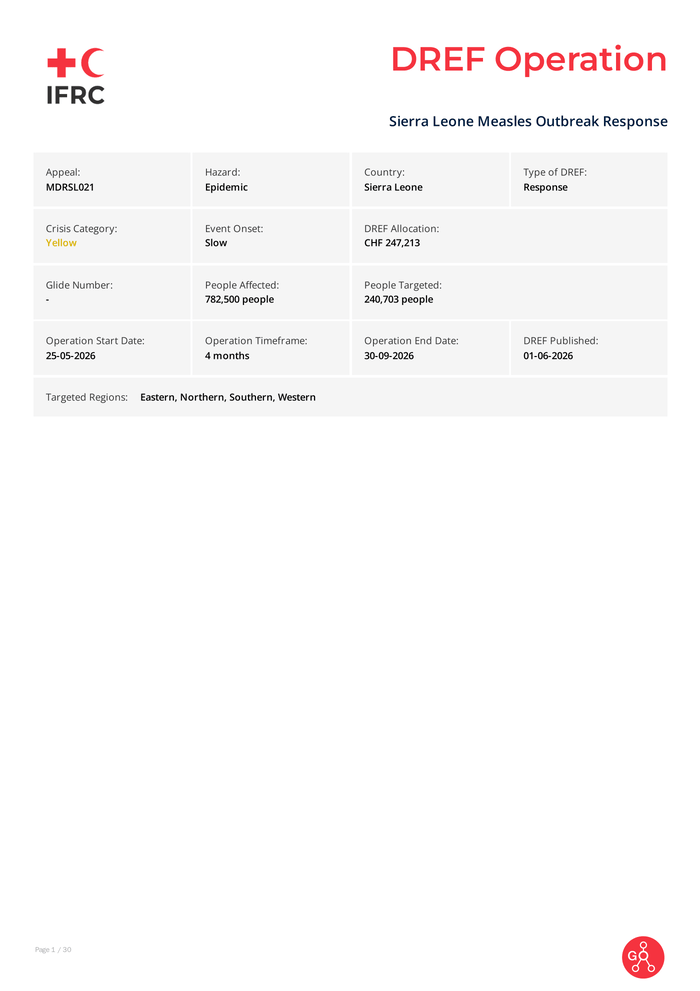
Country: Sierra Leone Source: International Federation of Red Cross and Red Crescent Societies Please refer to the attached file. Description of the Event Date when the trigger was met 13-05-2026 What happened, where and when? On 13 May 2026, the National Public Health Agency (NPHA), in collaboration with the Ministry of Health (MoH), officially declared a measles outbreak in Sierra Leone following confirmation of sustained transmission across multiple districts. On the same day, 41 confirmed cases were reported across eight districts: Western Area Urban (Freetown), Western Area Rural, Port Loko, Bombali, Tonkolili, Bo, Kenema, and Kono. Between 14 and 19 May 2026, an additional 8 confirmed cases were identified, bringing the total to 49 confirmed cases. The outbreak is characterized by a laboratory positivity rate of 75 per cent, indicating active community transmission and likely underdetection of cases through routine surveillance systems. The spread across both urban and rural districts, including densely populated communities in Freetown, significantly increases the risk of rapid nationwide propagation. The outbreak is occurring within a context of persistent immunity gaps linked to suboptimal routine immunization coverage, particularly in underserved and hard-to-reach communities. Children under five years of age remain the most vulnerable due to low vaccination uptake, malnutrition, and limited access to healthcare services. High population mobility, overcrowded settlements, schools, and marketplaces continue to facilitate rapid transmission. Health systems in affected districts are under increasing pressure due to rising demands for surveillance, case investigation, laboratory testing, community engagement, and case management. Existing response efforts are further constrained by weak community-level surveillance, limited outreach capacity for rapid vaccination scale-up, inadequate risk communication coverage, and shortages of operational resources in high-risk districts. In response, the MoH and NPHA activated the Incident Command Centre (ICC) and initiated coordination with humanitarian and development partners to scale up containment measures, including reactive vaccination, surveillance strengthening, community engagement, and case management support. NPHA has specifically requested urgent partner support to reinforce outbreak response efforts, warning that the outbreak risks escalating further, particularly in densely populated districts, if immediate action is not taken. Despite ongoing response measures, transmission continues to expand, highlighting the urgent need for coordinated humanitarian support to contain the outbreak, strengthen vaccination uptake, and reduce preventable morbidity and mortality among vulnerable populations.



GrowthPakistan brings you the latest news to keep an eye on Pakistan’s startup ecosystem. Business keeps you growing when you stay aware of your competitors' moves. GrowthPakistan offers Business, Tech, Global Tech, Global, Auto, and Startup News straight from industries all around the globe. This platform will help you identify upcoming opportunities not only in Pakistan but worldwide.
Email : growthpakistan@gmail.com
Whatsapp : +92320-9497079
© growthpakistan