


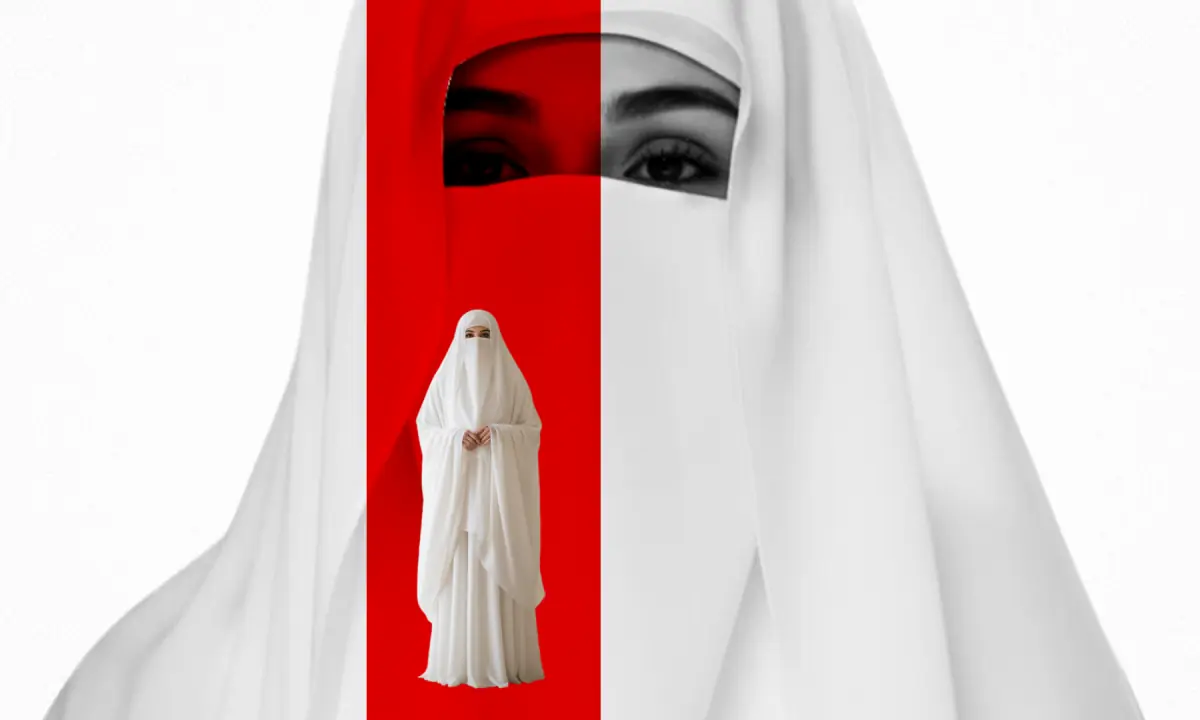
“You have to admit that most women who do something with their lives have been disliked by almost everyone. ” — Françoise Gilot, the French painter who loved Picasso, left him on her own terms, and refused to be remembered just as his muse. There are many who would assert that Pakistan’s former first lady Bushra Bibi should be dismissed as a woman of no substance. She did not, they argue, earn a place in the national imagination by winning over crowds with her speeches or marching for the downtrodden. They would rather say she just weasled her way to the top through wedlock. Her new husband, former Prime Minister Imran Khan, and her previous one, Khawar Maneka, were both men who loomed large in the public eye. One was a cricketing legend who had abandoned his storied appetite for pretty white women and the world’s attention in order to pursue political rebirth back home. The other was a shrine-through-town aristocrat from Pakpattan, known as much for his influence as for his oddities. Bushra Bibi’s effacement began with whispers that Maneka had “offered” his wife to Imran out of a sense of sacrifice and devotion to the country. In this version of the rumour, Bushra Bibi is reduced to be an object passed between two powerful men. The optics that accompanied this story strengthened an impression that she was a silent and passive figure. It began with a myth The scandalous and the sacred persist side by side, as they do in Pakistan, a country propelled more by superstition than socioeconomic sensibilities. Another story went something like this: By early 2018, Imran, restless and on the verge of electoral triumph, turned to Bushra for spiritual counsel. But this time the lore was that she came to him through another reference: Providence. We hear that she has a numinous vision in which Imran would become Prime Minister — but only if he married her. Indeed, he did, albeit in a staged drawing room, set against off-colour drapes and uncertainty. The act was accomplished in haste as her mandatory post-divorce iddat period, investigations later revealed, had barely ended. What of it, some said? Bushra subsequently ascended to become the First Lady. The prediction had come true. But it would not be long before myth would outlast propriety, as it often does in Pakistan. The slim window between her divorce and re-marriage fractured opinion. Civil society, the State and the Deep State squabbled over whether her uterus bore evidence of her menstrual cycle or a religious crime. Since then, ‘The Pirni’, as her critics derisively refer to her, has been cast paradoxically as both maternal protector and cursed magi. She is a woman who prays, rarely smiles, and only speaks through proxies. There were stories of amulets, potions, and nights of whispered prayers. Pakistan, ever performative in its piety, both mocks and secretly believes. A woman who commands through the unseen is dangerous because she turns superstition into strength. We call her a witch because we dare not call her wise or strategic, like a CEO. It frightens the nation too much to assume this woman knows what she’s doing. She frightens us because she refuses to either play the demure domestic mother or the benign spiritual spell-caster. In a place where gender is architecture — man above, woman below — to exist outside that structure is to risk collapse. Imran Khan is in jail now, supposedly doing pull-ups between sermons of resilience to his flock. Some claim that medical neglect during incerceration has led to a loss of vision in one of his eyes — a detail that feels almost hagiographic given that his supporters refer to him as a political messiah. Bushra Bibi is also imprisoned, but no one chants her name or frets over her fate. Not Imran’s followers. Not his family. And least of all his sisters, Aleema, Rubina, Noreen and Uzma, those veteran enforcers of the domestic order, opinionated, omnipresent, often bossy, and conveniently silent. Paying attention to Bushra Bibi would give her legitimacy and legitimacy is the one thing unofficial power is never supposed to have. We prefer to confront power that is not manufactured by ignoring it until we hope it goes away. Fear makes us want to pretend she doesn’t exist. That fear is: she cast a spell once; could she do it again? To loudly declare a woman not worthy of attention is to precisely indicate how much space she occupies. Bushra Bibi is anything but ordinary, and not just in ways that flatter her. Some whisper that she is in league with the Deep State itself. Others claim she defied it. The record, at least for now, says something else: there is hard evidence that has stood its test in court that she is a thief. She and Imran have been convicted of selling state gifts such as luxury watches and jewellery that should have been deposited in the Toshakhana or repository, not flipped for personal gain. Another court sentenced Bushra Bibi to seven and Imran to 14 years over land and money worth £190 million tied to a property tycoon and the Al-Qadir Trust, which prosecutors have argued, emerged suspiciously late to explain financial movements. This gave her critics a reason to now describe her as the woman who pulled an “incorruptible” Imran into the very swamp he had once railed against. In their mind’s eye she ensnared him in a voodoo loyalty as a result of which, for all his talk of Riyasat-e-Madina, he has never really been himself since. All the light we cannot see When the State jailed her husband, Bushra Bibi faced it head-on with no one by her side. She persisted through arrests, tear gas, and jeers. But even her defiance was suspect and taken as proof of guilt. This was the same woman, this alleged mastermind of corruption, who dared to call for a march to the capital in 2024 to fight for her husband’s freedom. In response, every party elder hid behind parliamentary curtains. The men vanished, save Ali Amin Gandapur who showed up with his bravado even if it was brief. Bushra Bibi soldiered on alone, veiled yet vulnerable. Of course, the absolute purdah adds to her grandeur and terror which in turn gives rise to the urge to describe her in an attempt at containment. Except there was nothing to feed the imagination — until an old photo started making the rounds. In it, her striking, Eurocentric face gazed coolly at the camera, unforgettable in its restraint. Now, all we can go by is just the outline of kohl-rimmed eyes and beloved hands. The mystery, allure and obsession deepens, spawning ever more speculation. Has she aged? Does she still enthrall the ageing Imran, a man who once collected beauty the way others collect things? We wonder, because we cannot quite otherwise explain his frantic turn to prayer beads and thievery instead of the raw street fight for justice. Even for the multiple court appearances, Bushra Bibi arrived wrapped in darkness — veil upon veil, veil upon car, her entire being sealed before the judge. She was not making a fashion statement. It was armour against evil, real and imagined. A triple burqa of mystique, fabric and metal. She invents a new form of clerical power. The ghost in the machine Her ex-husband, Khawar Maneka, now performs remorse on television, bowing, crying, then biting. The devotee who once celebrated her visions now condemns her dreams by slandering her as disloyal, negligent, and immoral. “What kind of teachings cannot happen with men in the light of day and must take place alone at night? ” he asks on television, recycling the tired trope of wife-shaming as if it were his invention. In doing so, he gives Pakistan exactly what it craves: the right to accuse, to ridicule, to rebuild its comfort by taking down a woman who dared to act beyond consent. According to her sister, Bushra Bibi is, like many million Pakistani women, a victim of domestic violence, who was imprisoned and tortured by her ex-husband in that feudal way of keeping a woman in line, even after she has produced sons and heirs. In fact, especially after she had produced them. When all else fails, or doubt surfaces, a handy way to take a woman down is to accuse her of being a bad mother. That gender is architecture holds here too because family in Pakistan isn’t built on love but on a caste-like order that needs force to be maintained. The pyramid of control is stacked like this: man, woman, child, servant. Equality, therefore, is a rebellion. Rebellion invites violence. “Honour killings” are simply the State’s domestic franchise of political order or in other words, custodial executions to restore the balance men have clung to for hundreds of years. And so, the paradoxes abound: Imran must get out. Imran must stay in. Imran’s downfall is his wife’s doing. Imran’s rise was her superstition. All opposite things are true all at once. Meanwhile, Bushra Bibi is the auxiliary — the uncredited ghost behind his machinery of power, amplified and distorted by social media. Bushra Bibi vs patriarchy Yet if history were written honestly, it would not be able to deny that Bushra Bibi recharged Imran’s dying political career through her feudal and political connections and her spin across rural Punjab’s sprawling networks of shrines, saints and kinships. Without her, there might have been no path to the premiership. Without the myths, there might have been no miracle to believe in. She is a political force, whether Pakistan admits it or not. She slipped through doors most men can’t find. She deftly handled palace intruige under the banner of piety. She held the prime minister, the preachers, the power brokers, and the public in her orbit, all with that perfectly calm gaze. Even the clergy went quiet. She had power, for it was she who single-handedly helped keep Usman Buzdar — the most uninspiring Punjab chief minister in living memory — comfortably in his seat, a decision even Imran’s own aides now publicly call a mistake. Power to act, and power to stall are both power. We can say what we will: Bushra Bibi outplayed the patriarchy on its home turf and, in doing so, exposed just how fragile Pakistan’s familial custodial order really is. And on that merit alone, I wish her what this country rarely grants any woman: the power to dream, lead, disrupt, remain relevant. Header art by Obair Khan.



GrowthPakistan brings you the latest news to keep an eye on Pakistan’s startup ecosystem. Business keeps you growing when you stay aware of your competitors' moves. GrowthPakistan offers Business, Tech, Global Tech, Global, Auto, and Startup News straight from industries all around the globe. This platform will help you identify upcoming opportunities not only in Pakistan but worldwide.
Email : growthpakistan@gmail.com
Whatsapp : +92320-9497079
© growthpakistan