


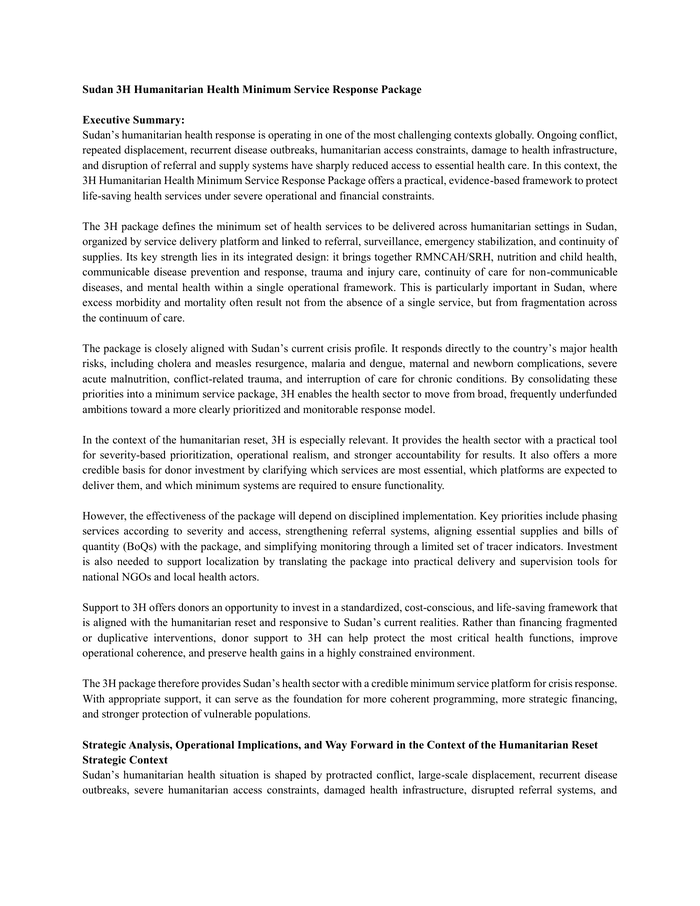
Country: Sudan Sources: Health Cluster, World Health Organization Please refer to the attached file. Executive Summary: Sudan’s humanitarian health response is operating in one of the most challenging contexts globally. Ongoing conflict, repeated displacement, recurrent disease outbreaks, humanitarian access constraints, damage to health infrastructure, and disruption of referral and supply systems have sharply reduced access to essential health care. In this context, the 3H Humanitarian Health Minimum Service Response Package offers a practical, evidence-based framework to protect life-saving health services under severe operational and financial constraints. The 3H package defines the minimum set of health services to be delivered across humanitarian settings in Sudan, organized by service delivery platform and linked to referral, surveillance, emergency stabilization, and continuity of supplies. Its key strength lies in its integrated design: it brings together RMNCAH/SRH, nutrition and child health, communicable disease prevention and response, trauma and injury care, continuity of care for non-communicable diseases, and mental health within a single operational framework. This is particularly important in Sudan, where excess morbidity and mortality often result not from the absence of a single service, but from fragmentation across the continuum of care. The package is closely aligned with Sudan’s current crisis profile. It responds directly to the country’s major health risks, including cholera and measles resurgence, malaria and dengue, maternal and newborn complications, severe acute malnutrition, conflict-related trauma, and interruption of care for chronic conditions. By consolidating these priorities into a minimum service package, 3H enables the health sector to move from broad, frequently underfunded ambitions toward a more clearly prioritized and monitorable response model. In the context of the humanitarian reset, 3H is especially relevant. It provides the health sector with a practical tool for severity-based prioritization, operational realism, and stronger accountability for results. It also offers a more credible basis for donor investment by clarifying which services are most essential, which platforms are expected to deliver them, and which minimum systems are required to ensure functionality. However, the effectiveness of the package will depend on disciplined implementation. Key priorities include phasing services according to severity and access, strengthening referral systems, aligning essential supplies and bills of quantity (BoQs) with the package, and simplifying monitoring through a limited set of tracer indicators. Investment is also needed to support localization by translating the package into practical delivery and supervision tools for national NGOs and local health actors. Support to 3H offers donors an opportunity to invest in a standardized, cost-conscious, and life-saving framework that is aligned with the humanitarian reset and responsive to Sudan’s current realities. Rather than financing fragmented or duplicative interventions, donor support to 3H can help protect the most critical health functions, improve operational coherence, and preserve health gains in a highly constrained environment. The 3H package therefore provides Sudan’s health sector with a credible minimum service platform for crisis response. With appropriate support, it can serve as the foundation for more coherent programming, more strategic financing, and stronger protection of vulnerable populations.



GrowthPakistan brings you the latest news to keep an eye on Pakistan’s startup ecosystem. Business keeps you growing when you stay aware of your competitors' moves. GrowthPakistan offers Business, Tech, Global Tech, Global, Auto, and Startup News straight from industries all around the globe. This platform will help you identify upcoming opportunities not only in Pakistan but worldwide.
Email : growthpakistan@gmail.com
Whatsapp : +92320-9497079
© growthpakistan