

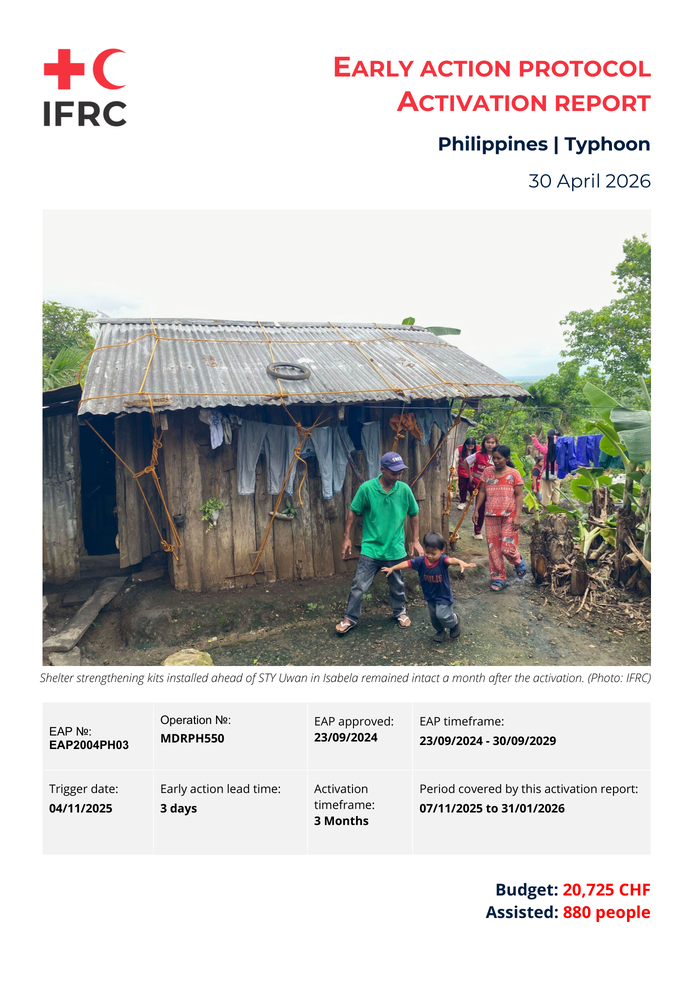
Country: Philippines Source: International Federation of Red Cross and Red Crescent Societies Please refer to the attached file. Back in September 2024, the IFRC Disaster Response Emergency Fund (DREF) allocated CHF 216, 399 for the Philippine Red Cross (PRC) to implement early actions to reduce and mitigate the impact of Typhoon in the Philippines. The early actions conducted under this activation report were based on the pre-agreement with the National Society and are detailed in the Early Action Protocol Summary. The EAP was activated on 7 November 2025. The outcomes of the early action activation were reported in this activation report, including an overview of the activities and expenditures incurred since the early action activation was published until the end of the EAP timeframe. On 4 November 2025, at 8: 00 AM, the low-pressure area (LPA 11a) being monitored outside the Philippine Area of Responsibility (PAR) developed into a tropical depression. Although the weather system remained outside the monitoring domain of the country, the state weather bureau, the Philippine Atmospheric, Geophysical, and Astronomical Services Administration (PAGASA), began issuing tropical cyclone bulletins on the same day due to its expected direct impact on the Philippines and potential intensification into a Super Typhoon. By 6 November 2025 at 2: 00 AM, the tropical depression outside the Philippine Area of Responsibility (PAR) intensified into a tropical storm and further into a severe tropical storm. The weather disturbance continued to move across the waters of the Philippine Sea before intensifying into a Typhoon upon entering PAR on 07 November 2025 and was assigned the local name “Uwan” (Fung-wong). Forecasts projected a west-northwest trajectory toward Northern and Central Luzon, with possible landfall scenarios on 10 November 2025 as Uwan maintains its super typhoon strength with maximum sustained winds of up to 185km/h. Based on PAGASA bulletins and forecasted wind speeds, trigger statement 3 of the Typhoon EAP was met, which indicates that PAGASA issued a typhoon bulletin predicting that a tropical cyclone would reach wind speeds of 185 km/h in CALABARZON, Central or Northern Luzon, 72 hours before expected landfall. Considering the forecast, lead time, and with the assessment of chapters’ capacity, the PRC activated the typhoon EAP through Anticipatory Action under DREF. This included early action to strengthen shelters through the installation of shelter-strengthening kits in identified vulnerable communities. The most at-risk communities in Quirino, Isabela, and Quezon-Lucena were targeted under this activation based on the projected track of the weather system and the vulnerability of the population exposed to the hazard. A total of 224 households has been identified as recipients of assistance in the area where readiness activities have already been conducted.
Philippines | Typhoon: Early Action Protocol Activation (Operation No: MDRPH550) 30 April 2026

RELATED ARTICLES


