


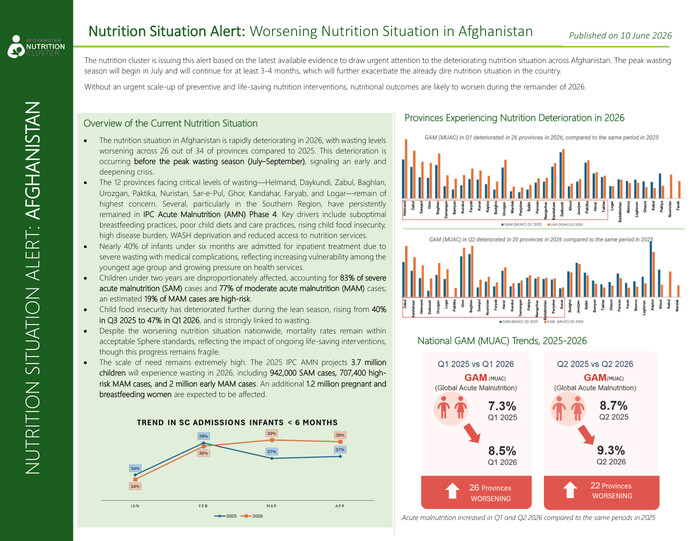
Country: Afghanistan Source: Nutrition Cluster Please refer to the attached file. The nutrition cluster is issuing this alert based on the latest available evidence to draw urgent attention to the deteriorating nutrition situation across Afghanistan. The peak wasting season will begin in July and will continue for at least 3-4 months, which will further exacerbate the already dire nutrition situation in the country. Without an urgent scale-up of preventive and life-saving nutrition interventions, nutritional outcomes are likely to worsen during the remainder of 2026. Overview of the Current Nutrition Situation The nutrition situation in Afghanistan is rapidly deteriorating in 2026, with wasting levels worsening across 26 out of 34 of provinces compared to 2025. This deterioration is occurring before the peak wasting season (July–September), signaling an early and deepening crisis. The 12 provinces facing critical levels of wasting—Helmand, Daykundi, Zabul, Baghlan, Urozgan, Paktika, Nuristan, Sar-e-Pul, Ghor, Kandahar, Faryab, and Logar—remain of highest concern. Several, particularly in the Southern Region, have persistently remained in IPC Acute Malnutrition (AMN) Phase 4. Key drivers include suboptimal breastfeeding practices, poor child diets and care practices, rising child food insecurity, high disease burden, WASH deprivation and reduced access to nutrition services. Nearly 40% of infants under six months are admitted for inpatient treatment due to severe wasting with medical complications, reflecting increasing vulnerability among the youngest age group and growing pressure on health services. Children under two years are disproportionately affected, accounting for 83% of severe acute malnutrition (SAM) cases and 77% of moderate acute malnutrition (MAM) cases; an estimated 19% of MAM cases are high-risk. Child food insecurity has deteriorated further during the lean season, rising from 40% in Q3 2025 to 47% in Q1 2026, and is strongly linked to wasting. Despite the worsening nutrition situation nationwide, mortality rates remain within acceptable Sphere standards, reflecting the impact of ongoing life-saving interventions, though this progress remains fragile. The scale of need remains extremely high. The 2025 IPC AMN projects 3. 7 million children will experience wasting in 2026, including 942, 000 SAM cases, 707, 400 high risk MAM cases, and 2 million early MAM cases. An additional 1. 2 million pregnant and breastfeeding women are expected to be affected.



GrowthPakistan brings you the latest news to keep an eye on Pakistan’s startup ecosystem. Business keeps you growing when you stay aware of your competitors' moves. GrowthPakistan offers Business, Tech, Global Tech, Global, Auto, and Startup News straight from industries all around the globe. This platform will help you identify upcoming opportunities not only in Pakistan but worldwide.
Email : growthpakistan@gmail.com
Whatsapp : +92320-9497079
© growthpakistan