


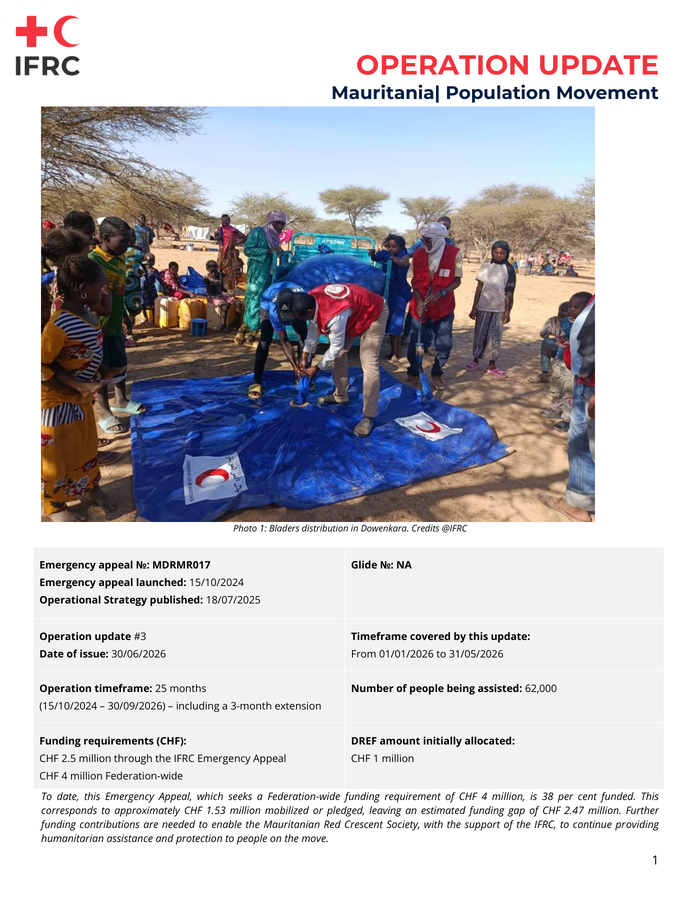
Countries: Mauritania, Mali Source: International Federation of Red Cross and Red Crescent Societies Please refer to the attached file. A. SITUATION ANALYSIS Through this Operations Update, the NS requests a 3-month extension to sustain the activities and scale up multisectoral interventions to address the urgent needs of both refugees and host communities up to 30 September 2026. This extension will allow the operation to adapt to changing needs, strengthen coordination with partners and ensure the effective use of resources mobilized to maximize humanitarian impact and ensure equitable assistance for refugees and host communities. Description of the crisis Humanitarian Situation and Needs Overview Deteriorating Security Situation in Mali The security situation in Mali continues to worsen, particularly in the central and northern regions, where escalating violence and instability are driving new waves of displacement into Mauritania. In Timbuktu and surrounding areas, repeated incursions by non-state armed groups (NSAGs) have led to arbitrary arrests, widespread looting of businesses, and the destruction of livelihoods. These acts have created a pervasive climate of fear and insecurity, forcing civilians to flee across the border in search of safety. In central Mali, NSAGs have imposed forced taxation (“zakat”) on communities, demanding excessive contributions per head of livestock under threat of violence. This systematic extortion, combined with the collapse of local governance and basic services, is fueling further displacement from the regions of Timbuktu, Ségou, Koulikoro, and Léré toward Mauritania. Cross-Border Implications and Population Movements Instability in Mali has direct repercussions for Mauritania’s border regions, particularly Hodh El Chargui, where the situation has sharply deteriorated since renewed fighting in Léré in late October 2025. Refugee arrivals, which had slowed earlier in the year, have surged once again. Mauritania is currently hosting over 306, 000 Malian refugees and more than 65, 000 returnees, making it one of the largest refugee-hosting countries in West Africa. Hodh El Chargui alone accommodates the majority of these displaced populations, placing immense strain on local infrastructure and natural resources. Field reports from refugee coordination meetings indicate new incidents in the locality of Touro (Mali), where Malian civilians have forced Mauritanian pastoralists to cross back into Mauritania, further complicating cross-border dynamics. The new arrivals report widespread violence, including sexual and gender-based violence (SGBV), abductions, torture, extortion, and family separation. An estimated 80% of refugees are women and children, many of whom have endured multiple episodes of trauma and displacement. Conditions and Unmet Humanitarian Needs Only half of the new arrivals have been officially registered as refugees. Approximately 176, 000 individuals live outside formal camps, with little to no access to essential services such as safe water, adequate sanitation, shelter, food security, basic healthcare, protection services, and education for children. The lack of sanitation infrastructure and reliance on unsafe water sources have triggered rising cases of malnutrition and waterborne diseases, particularly among children. Recent outbreaks of measles and diphtheria in Hodh El Chargui highlight the fragility of the health system and underscore the need for strengthened disease surveillance, vaccination campaigns, and community-based health promotion. Host communities, already vulnerable before the crisis, now face acute shortages of food, water, and grazing land. Over 60% of the new arrivals are pastoralists, bringing with them an estimated 1. 7 million heads of livestock. This rapid influx is placing unsustainable pressure on scarce water points and pasturelands, accelerating desertification and threatening the livelihoods of approximately 189, 000 residents in host communities. Rising competition over limited resources risks heightening tensions among refugees, returnees, host populations, and local authorities compounding Risks: Climate and Environmental Hazards. The humanitarian crisis in Mauritania is compounded by the growing impact of climate shocks. Meteorological forecasts predict above-average rainfall in June 2025 for Hodh El Chargui and Guidimakha, heightening the risk of flooding in areas already classified as high-risk. Floods in 2024 and early 2025 destroyed critical infrastructure and displaced communities, while droughts and bushfires continue to undermine agricultural production and food security. The convergence of armed conflict forced displacement, and climate-related shocks threatens to push both refugee and host populations into deeper vulnerability and increased dependence on humanitarian aid. In addition, the ongoing conflict, repeated displacement, and exposure to violence and climate shocks have generated significant mental health and psychosocial support (MHPSS) needs among refugees, returnees, and host communities. Many newly arrived refugees report experiencing traumatic events, including armed attacks, abductions, torture, extortion, sexual and gender-based violence (SGBV), loss of family members, and forced separation from loved ones. Women and children, who constitute approximately 80% of the refugee population, are particularly vulnerable to psychological distress and protection risks. Operational Capacity and Humanitarian Response The Mauritanian Red Crescent (MRC), supported by the International Federation of Red Cross and Red Crescent Societies (IFRC), is at the forefront of the humanitarian response in Bassikounou, Néma, Amourj, and Adel Bagrou, providing life-saving assistance to the most vulnerable populations. However, the scale and complexity of the crisis far exceed the available resources. Limited funding, challenging logistics, and overstretched supply chains are severely constraining the ability of humanitarian actors to deliver essential services and sustain operations in remote areas. In response to the growing humanitarian burden, the Governorate of Hodh El Chargui and local authorities have formally requested that the MRC and IFRC intensify their support and assume a more prominent auxiliary role to public institutions. This includes scaling up multi-sectoral interventions to address the urgent needs of both refugees and host communities, particularly in health, water, sanitation and hygiene (WASH), shelter, food security, and protection—while also strengthening community resilience against future shocks.



GrowthPakistan brings you the latest news to keep an eye on Pakistan’s startup ecosystem. Business keeps you growing when you stay aware of your competitors' moves. GrowthPakistan offers Business, Tech, Global Tech, Global, Auto, and Startup News straight from industries all around the globe. This platform will help you identify upcoming opportunities not only in Pakistan but worldwide.
Email : growthpakistan@gmail.com
Whatsapp : +92320-9497079
© growthpakistan