


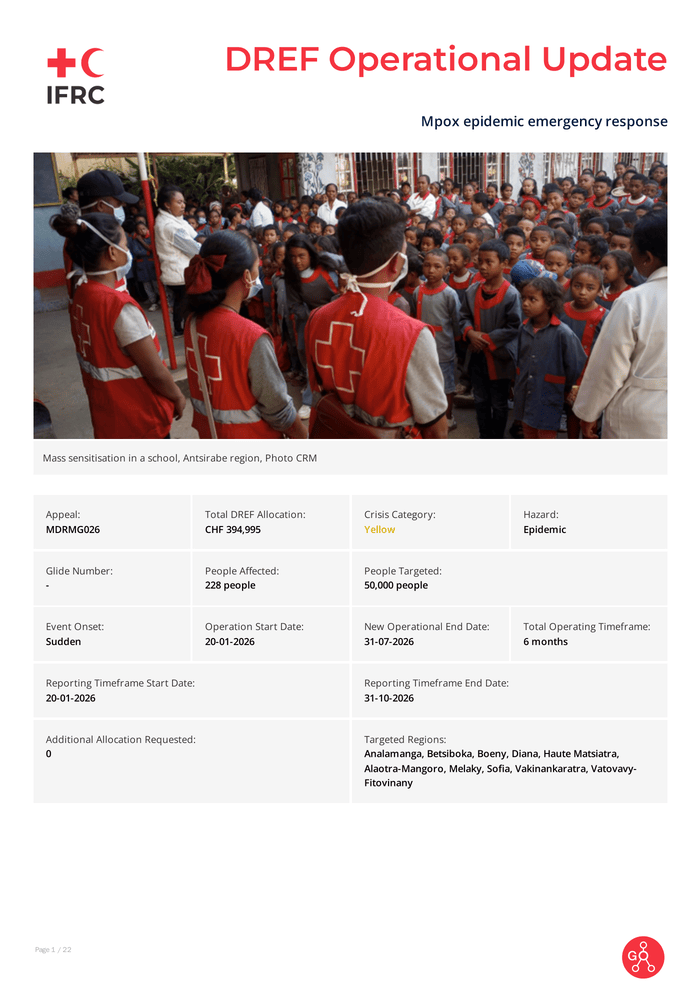
Country: Madagascar Source: International Federation of Red Cross and Red Crescent Societies Please refer to the attached file. What happened, where and when? Madagascar is experiencing its rst documented Mpox epidemic (clade 1b), which began with the detection of the index case on 17 December 2025 (epidemiological week 51). An ocial alert was issued on 31 December 2025, marking the recognition of a rapidly evolving public health threat and triggering the activation of national coordination and response mechanisms. In the early phase of the outbreak, the epidemic showed a sharp increase in cases. As of 12 January 2026, a total of 228 cases had been reported, including 24 laboratory-conrmed and 204 suspected cases, with no deaths recorded (case fatality rate: 0%). The outbreak initially originated and was heavily concentrated in the Boeny region, particularly in Mahajanga I district, which accounted for 66% of reported cases at that time. Rapid geographic expansion was observed, with cases reported in 16 of the country’s 23 regions, including Analamanga (the capital region), Vakinankaratra, Betsiboka, Diana, and Haute Matsiatra. Epidemiological data indicated sustained community transmission, with a positivity rate of 34. 8% and a rapid escalation from 34 cases on 5 January to 228 cases by 12 January 2026. Since the declaration of the alert, the epidemic has continued to expand signicantly. As of mid-April 2026, a cumulative total of 1, 574 suspected cases has been reported, including 749 conrmed cases, reecting sustained transmission and a substantial increase in disease burden. The epidemic remains geographically concentrated in specic regions, with Boeny identied as the epicentre (35. 7% of cases), followed by Analamanga (28. 2%), Soa (6. 5%), Diana (4. 8%) and Atsimo Andrefana (4. 1%) highlighting priority areas for targeted interventions. The other areas accounted for 20. 7% of the cases combined. In response, the Government of Madagascar activated the Public Health Emergency Operations Center (PHEOC/COUSP) on 9 January 2026 to coordinate the national response. This includes the establishment of treatment and isolation centres, deployment of contact tracing systems, and strengthening of surveillance mechanisms, including a national hotline (green line 910). Nine technical commissions have been set up to support the response, covering key areas such as surveillance, laboratory, vaccination, case management, infection prevention and control (IPC/WASH), logistics, research, and risk communication and community engagement (RCCE). A vaccination strategy was also initiated, with 30, 000 vaccine doses delivered on 21 February 2026. The vaccination campaign was launched on 5 March 2026, prioritizing frontline health workers and high-risk populations, including sex workers. Vaccination activities have been rolled out across 14 regions, further reinforcing the national response.



GrowthPakistan brings you the latest news to keep an eye on Pakistan’s startup ecosystem. Business keeps you growing when you stay aware of your competitors' moves. GrowthPakistan offers Business, Tech, Global Tech, Global, Auto, and Startup News straight from industries all around the globe. This platform will help you identify upcoming opportunities not only in Pakistan but worldwide.
Email : growthpakistan@gmail.com
Whatsapp : +92320-9497079
© growthpakistan