

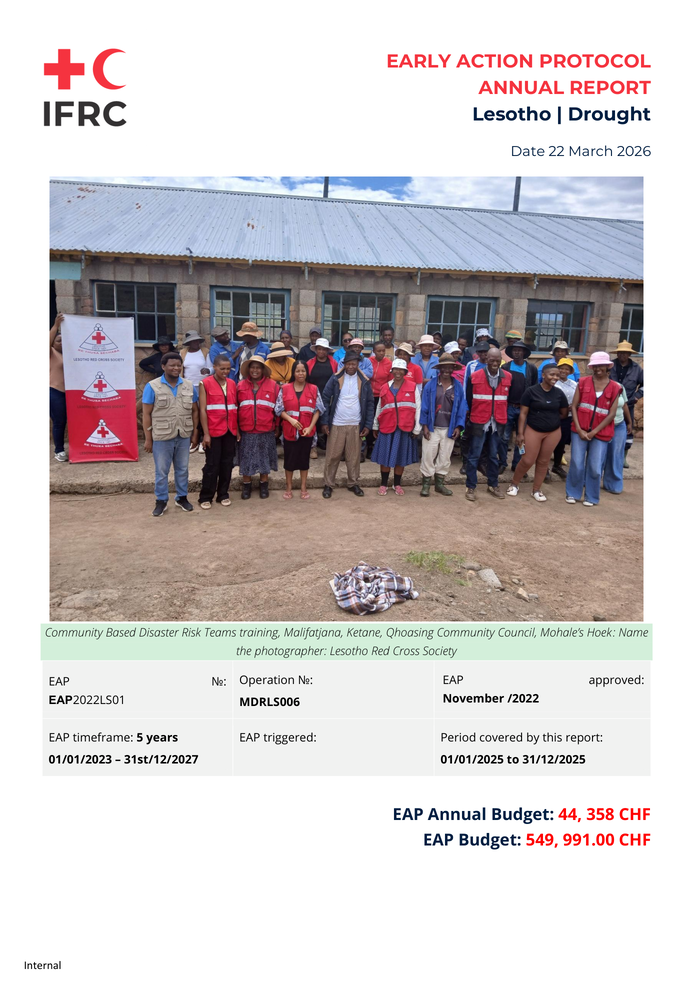
Country: Lesotho Source: International Federation of Red Cross and Red Crescent Societies Please refer to the attached file. SUMMARY OF THE EARLY ACTION PROTOCOL The Lesotho Red Cross Society (LRCS), with support from the IFRC Anticipatory Action (AA) pillar through the Disaster Response Emergency Fund (DREF), is implementing the Drought Early Action Protocol (EAP) with a total allocation of CHF 549, 991. This funding is intended to support the implementation of the EAP alongside a range of preparedness and readiness activities. The overall objective of the allocation is to strengthen anticipatory action, enhance community preparedness, and reduce the adverse impacts of drought in Lesotho. Through the EAP, a set of early actions was collaboratively identified and agreed upon in advance to enable timely and proactive response ahead of drought impacts as aligned with the EAP Summary. Lesotho Drought Early Action Protocol Overview Lesotho Red Cross Society with the support from IFRC is implementing Early Action Protocol (EAP) for drought. This protocol is a set of predefined and agreed-upon actions that are triggered by specific forecasts or early warning signals indicating the imminent occurrence of a disaster or crisis. By defining clear triggers, roles, and actions in advance, the Early Action Protocol (EAP) enables humanitarian actors to take timely, anticipatory measures that help minimize and mitigate the impacts of drought before they fully materialize. This proactive and anticipatory approach does not only help to reduce the severity of drought impacts on vulnerable communities but also strengthens local resilience and preparedness. Furthermore, aligning and integrating the EAP with the national disaster management contingency plans of LRCS has enhanced coordination, improved operational efficiency, and expanded the overall reach and effectiveness of disaster management interventions. During the current reporting period marking the third year of EAP implementation for drought, LRCS carried out a range of targeted interventions in drought-prone areas identified as having high and moderate risk. These activities were strategically designed to strengthen community capacity to interpret and act on climate information and forecasts, enhance preparedness for future shocks, and build the institutional capacity of LRCS to respond swiftly and effectively to impending hazards, particularly drought. The primary goal of the EAP (Early Action Plan) is to proactively address drought by anticipating its occurrence, mitigating its impact whenever feasible, and minimizing human suffering and losses. Within this framework, the Lesotho Red Cross Society (LRCS) has identified two key priorities for early intervention. Firstly, enhancing access to early warning messages which is crucial to empowering communities with timely information, enabling informed decisions and prompt actions. Secondly, providing unconditional cash transfers (UCT) to vulnerable households which is essential to help vulnerable community members to meet their basic food needs during drought periods. To ensure preparedness, LRCS has conducted comprehensive training sessions. Specifically, refresher training sessions were organized for key Disaster Risk Reduction (DRR) structures, targeting community-based structures such as Community Based Disaster Risk Teams (CBDRTs), Village Disaster Management Teams (VDMTs) and Red Cross youth volunteers at community level. Six VDMTs and 4 CDRTS from the prioritized districts from Mafeteng, Quthing and Mohale’s Hoek districts participated in these targeted trainings. The trainings delivered during the reporting period focused on strengthening knowledge and skills in key areas such as climate change, Disaster Risk Reduction (DRR), and the effective dissemination of early warning messages. These sessions were designed to enhance both communities understanding and LRCS capacity to anticipate and respond to climate related hazards such as drought. In addition, Cash and Voucher Assistance (CVA) trainings were conducted for staff and youth volunteers of the Lesotho Red Cross Society (LRCS), with a focus on cash transfer programming, data collection methodologies. Alongside the CVA trainings, volunteers and staff were all trained on the dissemination of early warning messages and existing early warning structures and tools that can be used. Furthermore, LRCS facilitated a trigger review and alignment workshop in collaboration with partner organizations and with support from internal stakeholders. The outcome of this process confirmed that the existing drought triggers remain valid, while emphasizing the importance of strengthened, collaborative monitoring mechanisms by both LRCS and LMS. Therefore, LRCS through the support of Netherlands Red Cross 510 established the Impact-Based Forecasting (IBF) system aimed at enhancing the accuracy and timeliness of early action activation. Furthermore, to test LRCS and key stakeholders (DMA, LMS) and community readiness, a joint simulation exercise for drought and cold wave was conducted in Butha-Buthe District. For institutions, these simulations assessed stakeholders’ preparedness to activate the EAP, as well as their understanding of roles and coordination mechanisms. At the community level, the exercises focused on assessing how early warning messages are received, understood, and acted upon, including the effectiveness of local communication channels and response practices. Beyond trainings and simulation exercises, LRCS also continued to review and maintain key operational agreements, including contracts and Memoranda of Understanding (MoUs), with three Financial Service Providers (FSPs): Chaperone, Vodacom, and Econet. These partnerships are critical for enabling timely and secure delivery of cash assistance once the EAP is activated. Lastly, LRCS strengthened collaboration with the Ministry of Social Development and national disaster management structures, including social workers operating in drought-prone areas. This collaboration supported community sensitization on early actions and facilitated the pre-identification of eligible beneficiaries, ensuring that assistance can be delivered quickly and effectively when triggers are activated.
Lesotho | Drought – Early Action Protocol Annual Report, 22 March 2026 (EAP2022LS01/MDRLS006)

RELATED ARTICLES


