


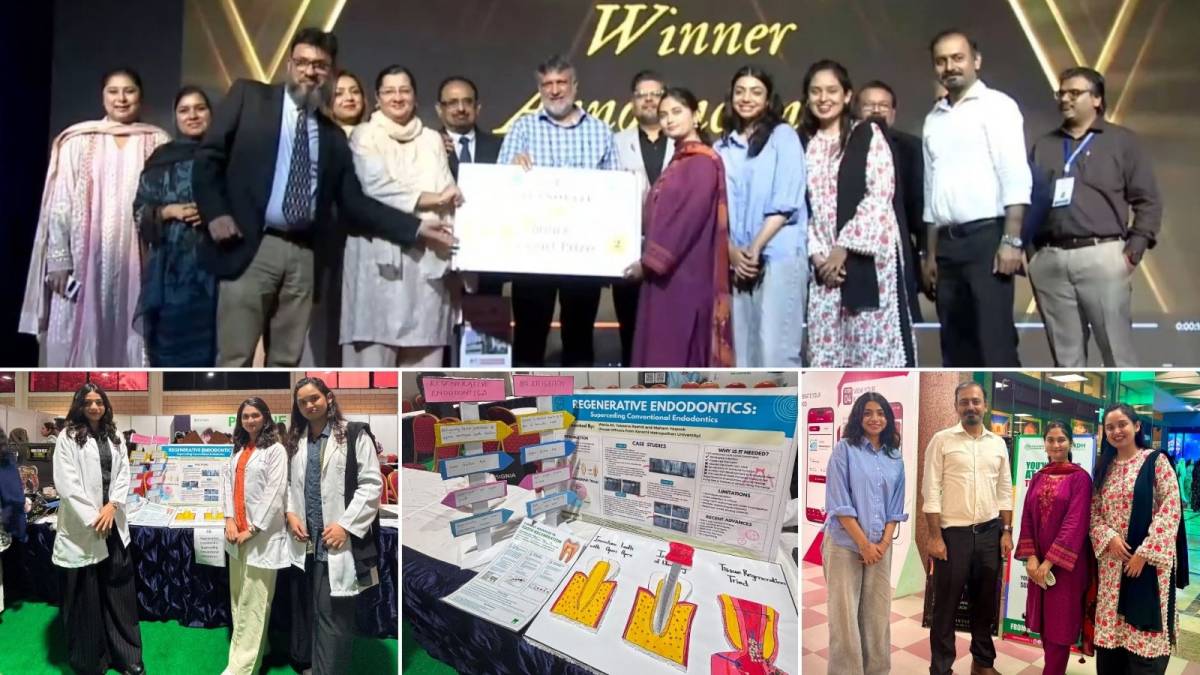
KARACHI: Three house officers from Karachi Metropolitan University (KMU) have secured second position in the highly competitive Table Clinic Competition at Dentalnnovate 3. 0, held at Karachi Expo Centre, after presenting an evidence-based scientific project on regenerative endodontics, an emerging field that aims to biologically restore damaged dental tissues rather than simply replacing them through conventional treatment. Competing against 77 entries from across Sindh, the KMU team impressed judges with its presentation titled “Regenerative Endodontics Superceding Conventional Endodontics,” highlighting one of the fastest-evolving areas in modern restorative dentistry. The award-winning presentation was delivered by Dr Wania Ali, Dr Maham Yaqoob and Dr Tabeena Rashid, all House Officers at KMU, under the supervision of Dr Zaheer Ahmed Soomro, Focal Person and In-charge of the Department of Endodontics at KMU. Regenerative endodontics represents a major shift in dental care According to the team’s scientific abstract, regenerative endodontics has fundamentally changed the management of pulpal disease by focusing on restoring the natural pulp-dentin complex instead of merely eliminating infection. Traditional root canal treatment and apexification remain effective for infection control and tooth retention. However, they leave the treated tooth non-vital and, particularly in immature permanent teeth, may halt normal root development, resulting in thinner dentinal walls and an increased risk of fracture. These limitations have accelerated interest in biologically based regenerative therapies designed to preserve natural tooth vitality whenever possible. Tissue engineering and stem cells are driving the future of endodontics The presentation explained that regenerative endodontics is built upon the three pillars of tissue engineering: • Stem cells• Scaffolds• Signaling molecules Mesenchymal stem cells obtained from the dental pulp and apical papilla possess the ability to differentiate into odontoblast-like cells responsible for dentin formation. Scaffolds—including intracanal blood clot, platelet-rich plasma (PRP), and platelet-rich fibrin (PRF)—provide the biological environment necessary for cellular attachment, vascularization, proliferation, and tissue organization. Meanwhile, growth factors released from dentin or incorporated into scaffolds promote angiogenesis, cell migration, tissue maturation, and regeneration. Biological protocols are replacing aggressive instrumentation The KMU presenters also highlighted that successful regenerative procedures depend on effective canal disinfection while preserving stem cell viability. Current evidence-based clinical protocols typically include: • Minimal canal instrumentation• Irrigation using low-concentration sodium hypochlorite followed by EDTA• Intracanal medicaments such as low-concentration antibiotic paste or calcium hydroxide• Induction of apical bleeding• Placement of a calcium silicate-based coronal barrier These approaches create favourable biological conditions that encourage regeneration while minimizing damage to surviving stem cells and bioactive molecules. Advantages over conventional root canal treatment Compared with conventional endodontic therapy, regenerative procedures offer several potential advantages, particularly for immature permanent teeth. According to the abstract, regenerative endodontics may: • Promote continued root maturation• Increase dentinal wall thickness• Support apical closure• Restore vascularity• Potentially recover sensory function Although researchers acknowledge that standardized protocols and long-term clinical evidence continue to evolve, regenerative endodontics is increasingly viewed as one of the most promising advances in contemporary dental practice. Presentation aimed to promote evidence-based regenerative dentistry The objective of the KMU table clinic was to provide dental professionals with a concise overview of regenerative endodontics by discussing its biological principles, tissue engineering concepts, stem cell therapies, clinical protocols, indications, advantages, limitations, and future directions. The presenters also compared regenerative procedures with conventional endodontic treatment to demonstrate how biologically oriented therapies can improve patient outcomes while supporting minimally invasive, patient-centred dental care. The achievement also highlights the growing emphasis being placed on research, innovation, and evidence-based clinical practice among young dental professionals in Pakistan. Stay connected with Dental News Pakistan pk/30-Jul-2026/kmu-house-officers-second-place-dentalnnovate-3-regenerative-endodontics” target=”_blank” rel=”nofollow noopener noreferrer”>Read full story on Dental News



GrowthPakistan brings you the latest news to keep an eye on Pakistan’s startup ecosystem. Business keeps you growing when you stay aware of your competitors' moves. GrowthPakistan offers Business, Tech, Global Tech, Global, Auto, and Startup News straight from industries all around the globe. This platform will help you identify upcoming opportunities not only in Pakistan but worldwide.
Email : growthpakistan@gmail.com
Whatsapp : +92320-9497079
© growthpakistan