


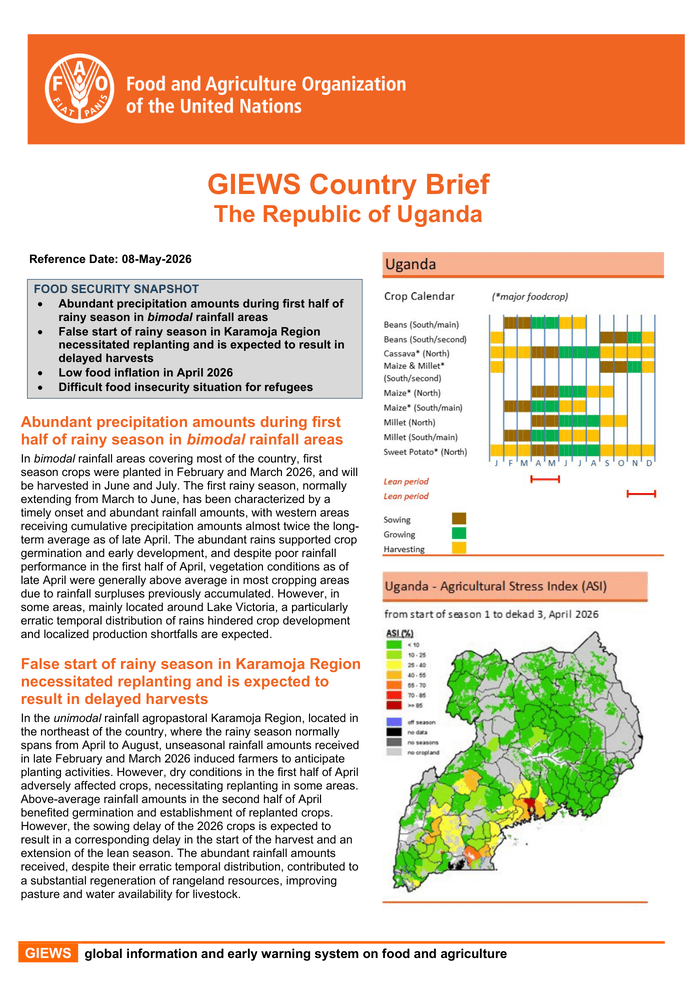
Countries: Uganda, Democratic Republic of the Congo, South Sudan Source: Food and Agriculture Organization of the United Nations Please refer to the attached file. FOOD SECURITY SNAPSHOT Abundant precipitation amounts during first half of rainy season in bimodal rainfall areas False start of rainy season in Karamoja Region necessitated replanting and is expected to result in delayed harvests Low food inflation in April 2026 Difficult food insecurity situation for refugees Abundant precipitation amounts during first half of rainy season in bimodal rainfall areas In bimodal rainfall areas covering most of the country, first season crops were planted in February and March 2026, and will be harvested in June and July. The first rainy season, normally extending from March to June, has been characterized by a timely onset and abundant rainfall amounts, with western areas receiving cumulative precipitation amounts almost twice the long-term average as of late April. The abundant rains supported crop germination and early development, and despite poor rainfall performance in the first half of April, vegetation conditions as of late April were generally above average in most cropping areas due to rainfall surpluses previously accumulated. However, in some areas, mainly located around Lake Victoria, a particularly erratic temporal distribution of rains hindered crop development and localized production shortfalls are expected. False start of rainy season in Karamoja Region necessitated replanting and is expected to result in delayed harvests In the unimodal rainfall agropastoral Karamoja Region, located in the northeast of the country, where the rainy season normally spans from April to August, unseasonal rainfall amounts received in late February and March 2026 induced farmers to anticipate planting activities. However, dry conditions in the first half of April adversely affected crops, necessitating replanting in some areas. Above‐average rainfall amounts in the second half of April benefited germination and establishment of replanted crops. However, the sowing delay of the 2026 crops is expected to result in a corresponding delay in the start of the harvest and an extension of the lean season. The abundant rainfall amounts received, despite their erratic temporal distribution, contributed to a substantial regeneration of rangeland resources, improving pasture and water availability for livestock. According to the latest weather forecast by the Intergovernmental Authority on Development’s (IGADs) Climate Prediction and Application Centre (ICPAC), between May and July 2026, there is high likelihood of above-average rainfall amounts in northwestern and southeastern areas, while rainfall amounts are likely to be below‐average in southwestern and northeastern areas. If these forecasts will materialize, the harvests in bimodal rainfall areas and in Karamoja Region are likely to be affected by substantial crop production shortfalls. Close monitoring of weather conditions is, therefore, warranted. Low food inflation in April 2026 According to the Ugandan Bureau of Statistics, annual inflation was estimated at 3 percent in April 2026, mainly reflecting a low food inflation, estimated at 2. 5 percent. By contrast, energy and fuel inflation was higher, reaching 4. 1 percent, contributing to elevated transport and marketing costs. Difficult food insecurity situation for refugees As of end‐April 2026, the country hosted more than 2 million refugees and asylum seekers, the largest number in Africa, including about 1 million people from South Sudan and about 660 000 people from the Democratic Republic of the Congo. According to the latest Integrated Food Security Phase Classification (IPC) analysis, published in September 2025 and covering 13 refugee settlements, and the capital, Kampala, about 712 000 refugees (representing 37 percent of the analysed population) were estimated to face (IPC Phase 3 [Crisis]) or worse levels of acute food insecurity between August 2025 and February 2026. The severe food insecurity situation observed among refugees reflects a combination of limited access to land and agricultural inputs, reduced income‐earning opportunities that constrain economic access to food, and funding shortfalls that have curtailed humanitarian assistance since mid‐2025.



GrowthPakistan brings you the latest news to keep an eye on Pakistan’s startup ecosystem. Business keeps you growing when you stay aware of your competitors' moves. GrowthPakistan offers Business, Tech, Global Tech, Global, Auto, and Startup News straight from industries all around the globe. This platform will help you identify upcoming opportunities not only in Pakistan but worldwide.
Email : growthpakistan@gmail.com
Whatsapp : +92320-9497079
© growthpakistan