


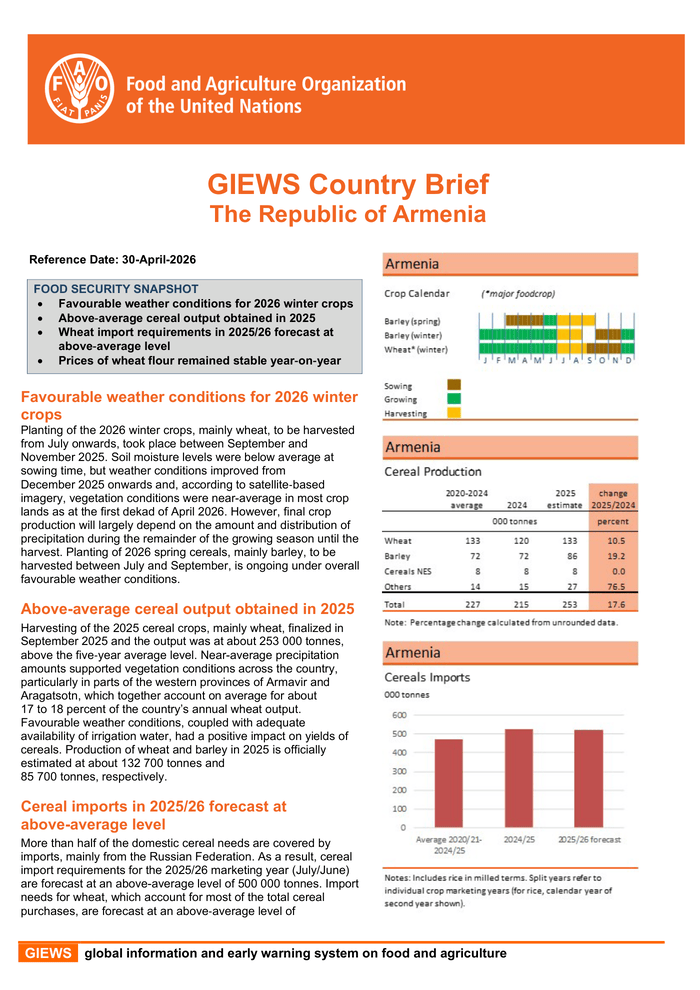
Country: Armenia Source: Food and Agriculture Organization of the United Nations Please refer to the attached file. FOOD SECURITY SNAPSHOT Favourable weather conditions for 2026 winter crops Above‐average cereal output obtained in 2025 Wheat import requirements in 2025/26 forecast at above‐average level Prices of wheat flour remained stable year‐on‐year Favourable weather conditions for 2026 winter crops Planting of the 2026 winter crops, mainly wheat, to be harvested from July onwards, took place between September and November 2025. Soil moisture levels were below average at sowing time, but weather conditions improved from December 2025 onwards and, according to satellite‐based imagery, vegetation conditions were near ‐ average in most crop lands as at the first dekad of April 2026. However, final crop production will largely depend on the amount and distribution of precipitation during the remainder of the growing season until the harvest. Planting of 2026 spring cereals, mainly barley, to be harvested between July and September, is ongoing under overall favourable weather conditions. Above‐average cereal output obtained in 2025 Harvesting of the 2025 cereal crops, mainly wheat, finalized in September 2025 and the output was at about 253 000 tonnes, above the five‐year average level. Near ‐ average precipitation amounts supported vegetation conditions across the country, particularly in parts of the western provinces of Armavir and Aragatsotn, which together account on average for about 17 to 18 percent of the country’s annual wheat output. Favourable weather conditions, coupled with adequate availability of irrigation water, had a positive impact on yields of cereals. Production of wheat and barley in 2025 is officially estimated at about 132 700 tonnes and 85 700 tonnes, respectively. Cereal imports in 2025/26 forecast at above‐average level More than half of the domestic cereal needs are covered by imports, mainly from the Russian Federation. As a result, cereal import requirements for the 2025/26 marketing year (July/June) are forecast at an above‐average level of 500 000 tonnes. Import needs for wheat, which account for most of the total cereal purchases, are forecast at an above‐average level of 400 000 tonnes. The temporary ban on exports of key grains (wheat and barley), initially introduced on 26 June 2025, was extended on 6 January 2026 until 6 July 2026, with the aim of strengthening national food security and limiting domestic price volatility. Prices of wheat flour remained stable year‐on‐year According to the Statistical Committee of the Republic of Armenia, the national average inflation rate increased from 3. 3 percent in 2025 to 4. 3 percent as of January 2026. Retail prices of first grade wheat flour remained broadly stable year‐on‐year as of February 2026, reflecting the combined effects of the temporary export ban and adequate domestic cereal production.



GrowthPakistan brings you the latest news to keep an eye on Pakistan’s startup ecosystem. Business keeps you growing when you stay aware of your competitors' moves. GrowthPakistan offers Business, Tech, Global Tech, Global, Auto, and Startup News straight from industries all around the globe. This platform will help you identify upcoming opportunities not only in Pakistan but worldwide.
Email : growthpakistan@gmail.com
Whatsapp : +92320-9497079
© growthpakistan