


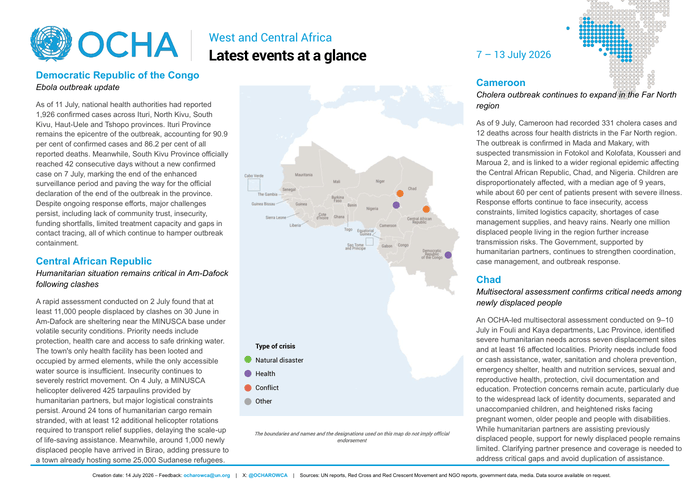
Countries: Democratic Republic of the Congo, Cameroon, Central African Republic, Chad Source: UN Office for the Coordination of Humanitarian Affairs Please refer to the attached Infographic. Democratic Republic of the Congo Ebola outbreak update As of 11 July, national health authorities had reported 1, 926 confirmed cases across Ituri, North Kivu, South Kivu, Haut-Uele and Tshopo provinces. Ituri Province remains the epicentre of the outbreak, accounting for 90. 9 per cent of confirmed cases and 86. 2 per cent of all reported deaths. Meanwhile, South Kivu Province officially reached 42 consecutive days without a new confirmed case on 7 July, marking the end of the enhanced surveillance period and paving the way for the official declaration of the end of the outbreak in the province. Despite ongoing response efforts, major challenges persist, including lack of community trust, insecurity, funding shortfalls, limited treatment capacity and gaps in contact tracing, all of which continue to hamper outbreak containment. Central African Republic Humanitarian situation remains critical in Am-Dafock following clashes A rapid assessment conducted on 2 July found that at least 11, 000 people displaced by clashes on 30 June in Am-Dafock are sheltering near the MINUSCA base under volatile security conditions. Priority needs include protection, health care and access to safe drinking water. The town’s only health facility has been looted and occupied by armed elements, while the only accessible water source is insufficient. Insecurity continues to severely restrict movement. On 4 July, a MINUSCA helicopter delivered 425 tarpaulins provided by humanitarian partners, but major logistical constraints persist. Around 24 tons of humanitarian cargo remain stranded, with at least 12 additional helicopter rotations required to transport relief supplies, delaying the scale-up of life-saving assistance. Meanwhile, around 1, 000 newly displaced people have arrived in Birao, adding pressure to a town already hosting some 25, 000 Sudanese refugees. Cameroon Cholera outbreak continues to expand in the Far North region As of 9 July, Cameroon had recorded 331 cholera cases and 12 deaths across four health districts in the Far North region. The outbreak is confirmed in Mada and Makary, with suspected transmission in Fotokol and Kolofata, Kousseri and Maroua 2, and is linked to a wider regional epidemic affecting the Central African Republic, Chad, and Nigeria. Children are disproportionately affected, with a median age of 9 years, while about 60 per cent of patients present with severe illness. Response efforts continue to face insecurity, access constraints, limited logistics capacity, shortages of case management supplies, and heavy rains. Nearly one million displaced people living in the region further increase transmission risks. The Government, supported by humanitarian partners, continues to strengthen coordination, case management, and outbreak response. Chad Multisectoral assessment confirms critical needs among newly displaced people An OCHA-led multisectoral assessment conducted on 9–10 July in Fouli and Kaya departments, Lac Province, identified severe humanitarian needs across seven displacement sites and at least 16 affected localities. Priority needs include food or cash assistance, water, sanitation and cholera prevention, emergency shelter, health and nutrition services, sexual and reproductive health, protection, civil documentation and education. Protection concerns remain acute, particularly due to the widespread lack of identity documents, separated and unaccompanied children, and heightened risks facing pregnant women, older people and people with disabilities. While humanitarian partners are assisting previously displaced people, support for newly displaced people remains limited. Clarifying partner presence and coverage is needed to address critical gaps and avoid duplication of assistance.



GrowthPakistan brings you the latest news to keep an eye on Pakistan’s startup ecosystem. Business keeps you growing when you stay aware of your competitors' moves. GrowthPakistan offers Business, Tech, Global Tech, Global, Auto, and Startup News straight from industries all around the globe. This platform will help you identify upcoming opportunities not only in Pakistan but worldwide.
Email : growthpakistan@gmail.com
Whatsapp : +92320-9497079
© growthpakistan