

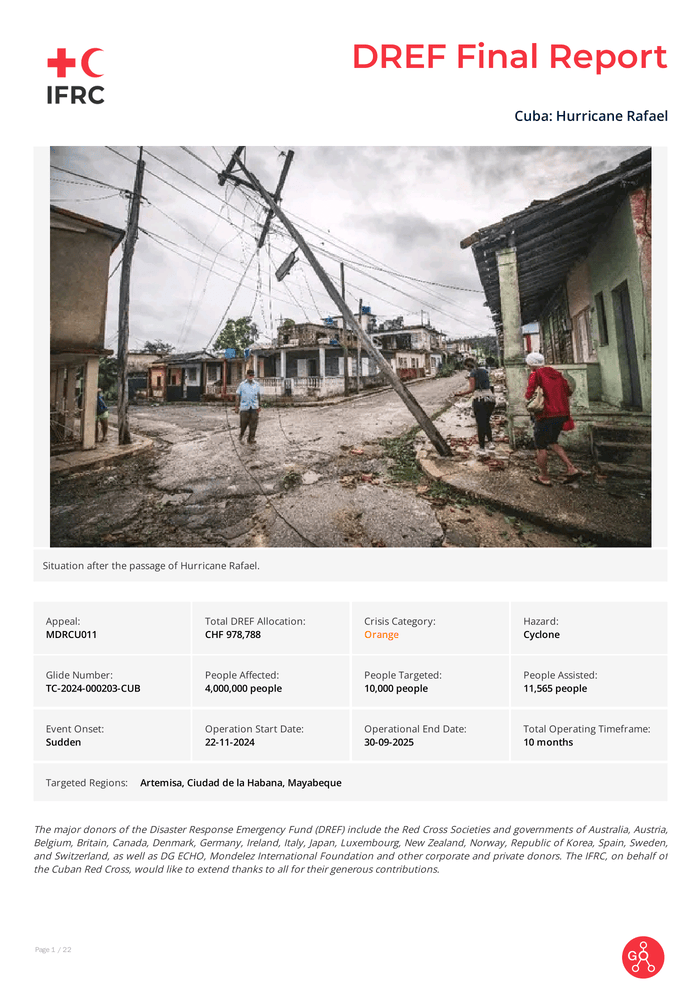
Country: Cuba Source: International Federation of Red Cross and Red Crescent Societies Please refer to the attached file. Description of the Event Date of event 06-11-2024 What happened, where and when? Hurricane Rafael was a historic storm, tied with 1985’s Hurricane Kate as the strongest November tropical cyclone on record in the Gulf of Mexico. As the seventeenth named storm, eleventh hurricane, and fifth major hurricane of the 2024 Atlantic hurricane season, Rafael formed on 4 November 2024, from an area of low pressure associated with a Central American gyre. Over the next two days, the system steadily organized, intensifying into a hurricane early on 6 November as it tracked northwest toward Cuba. Given the hurricane’s rapid development and projected path, the Cuban National Civil Defense issued Informative Note No. 4 on 5 November, placing the provinces of Sancti Spiritus, Cienfuegos, Villa Clara, Matanzas, Mayabeque, Havana, Artemisa, Pinar del Río, and the Isla de la Juventud under an Alarm Phase starting at 06: 00 hours. This declaration enabled the activation of national disaster response protocols, including mass evacuations and resource mobilization. The Cuban Red Cross (CRC) activated its action plan in line with the national disaster response framework, mobilizing resources and personnel across the identified territories. On 6 November 2024, Hurricane Rafael made landfall at Playa Majana, Artemisa Province, at 16: 15 hours as a Category 2 hurricane on the Saffir-Simpson scale. It had maximum sustained winds of 185 km/h, moved northwest through Artemisa at a forward speed of 22 km/h, and brought heavy rain, strong winds, and widespread flooding. By 20: 00 hours, the hurricane exited Artemisa at Bahía de Cabañas, approximately 25 km west of Mariel, with sustained winds of 170 km/h and higher gusts. Maintaining its northwest trajectory, it caused significant impacts across La Habana, Mayabeque, and Villa Clara, including severe damage to housing, infrastructure, and agriculture. Although early warning systems and preparedness efforts helped reduce potential casualties, Rafael’s unprecedented strength and speed caused widespread destruction in several provinces in western Cuba, including Artemisa, La Habana, Mayabeque, Matanzas, Pinar del Rio, and Isla de la Juventud.
Cuba: Hurricane Rafael – DREF Final Report (MDRCU011)

RELATED ARTICLES


