


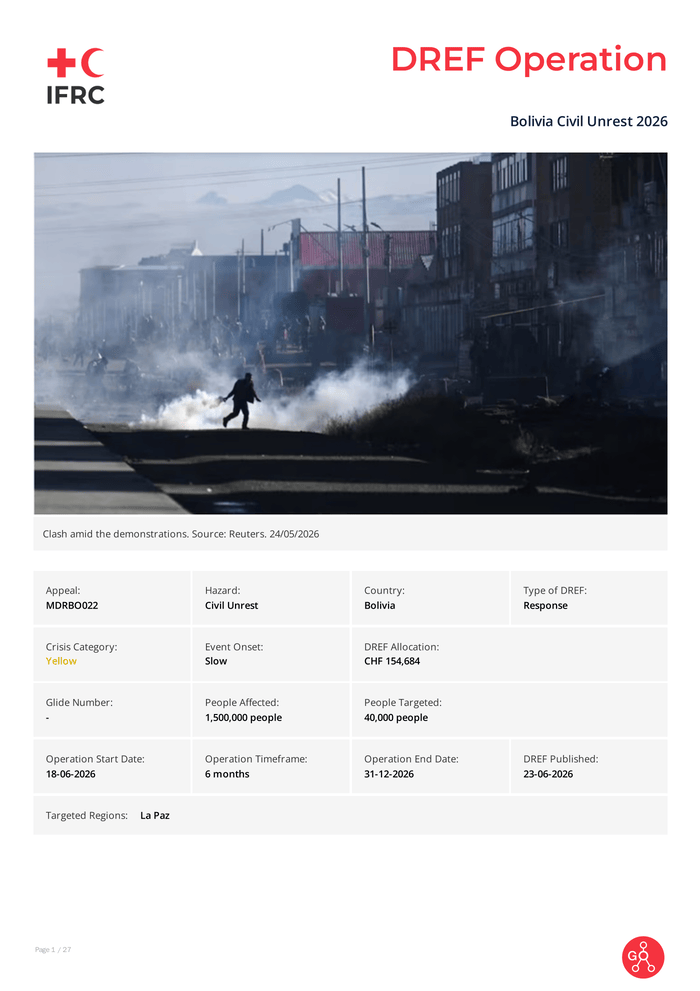
Country: Bolivia (Plurinational State of) Source: International Federation of Red Cross and Red Crescent Societies Please refer to the attached file. What happened, where and when? Since early May 2026, Bolivia has experienced widespread social mobilizations and road blockades, which have progressively disrupted mobility and access to essential services. The situation escalated during the second half of May, when road blockades expanded across key national transport corridors, signicantly restricting movement between departments. By 23–27 May 2026, the number of blockages increased substantially, aecting major routes and limiting access to and from the cities of La Paz and El Alto. During this period, attempts were made by public security forces to enable the passage of essential goods through route clearing operations, although circulation remained constrained. The disruptions have primarily aected the western part of the country, including the departments of La Paz, Oruro, Cochabamba, and Potosí, with additional impacts reported in other regions. The eects have been most evident along interdepartmental corridors connecting these areas. During the last week of May, disruptions to transport and supply chains resulted in reported shortages of food, fuel, and medical supplies. Health services in La Paz and El Alto reported constraints in the availability of critical inputs, including medical oxygen. As of 1 June 2026, the situation remains ongoing, with approximately 90 roadblocks reported nationwide and continued restrictions to interdepartmental mobility. Access conditions remain variable, with partial openings in some areas and persistent restrictions in others. On 2 June, the Government of La Paz declared a health and humanitarian emergency across the entire department due to road blockades that disrupted transportation and the regular supply of essential inputs for healthcare delivery. The decision was based on technical reports from the Departmental Health Service (SEDES), which indicate a critical shortage scenario, particularly aecting medical oxygen, medicines, and other essential supplies. The declaration aims to streamline administrative procedures, strengthen coordination with the Ministry of Health, and facilitate the establishment of humanitarian corridors, as well as enable the reallocation of resources and the implementation of exceptional measures to ensure the continuity of health services and the provision of care to the population. According to the “Second Preliminary Report on Social Conict in Bolivia from May 1 to June 2, 2026” by the Ombudsman’s Oce, a total of 365 people were arrested in the context of social unrest. Of these, 247 individuals (68%) were released, while 118 remain under active legal proceedings or with an unresolved legal status. Within this group, at least 103 individuals were formally charged with oenses related to the conict, including criminal association, public incitement to commit crimes, destruction of state property, and attempted homicide. Regarding legal status, 50 individuals are facing proceedings while remaining at liberty, whereas 36 are subject to precautionary measures, including house arrest, pretrial detention, and alternative measures, resulting in signicant restrictions on their freedom of movement and living conditions. Additionally, 17 individuals have already been sentenced under expedited procedures, all of whom were granted judicial pardon, while 15 individuals still do not have a dened legal status. On Monday, 8 June, Law No. 1740 regulating the State of Exception in Bolivia was enacted. Under this regulation, the Head of State may issue a supreme decree declaring a State of Exception, which must subsequently be submitted to the Plurinational Legislative Assembly for consideration. The Assembly is required to approve or reject the measure within a maximum period of 72 hours. The Constitution establishes that a State of Exception may only be declared under three specic circumstances: (i) external threats, such as invasion or aggression; (ii) internal unrest, dened as serious public disturbances or situations such as blockades that exceed the capacity of regular security forces; and (iii) natural disasters, including epidemics, oods, or similar events.



GrowthPakistan brings you the latest news to keep an eye on Pakistan’s startup ecosystem. Business keeps you growing when you stay aware of your competitors' moves. GrowthPakistan offers Business, Tech, Global Tech, Global, Auto, and Startup News straight from industries all around the globe. This platform will help you identify upcoming opportunities not only in Pakistan but worldwide.
Email : growthpakistan@gmail.com
Whatsapp : +92320-9497079
© growthpakistan