


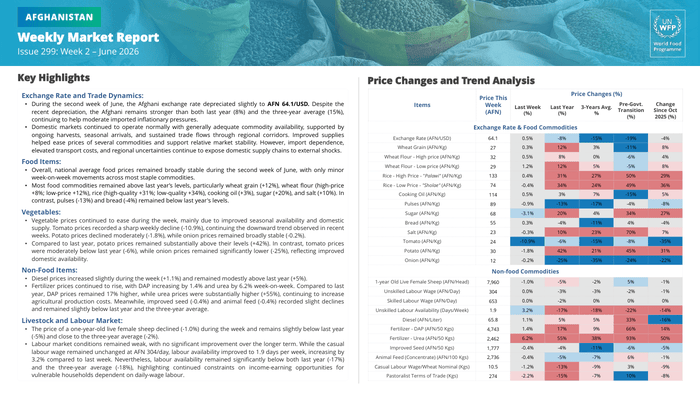
Country: Afghanistan Source: World Food Programme Please refer to the attached file. Key Highlights Exchange Rate and Trade Dynamics: • During the second week of June, the Afghani exchange rate depreciated slightly to AFN 64. 1/USD. Despite the recent depreciation, the Afghani remains stronger than both last year (8%) and the three-year average (15%), continuing to help moderate imported inflationary pressures. • Domestic markets continued to operate normally with generally adequate commodity availability, supported by ongoing harvests, seasonal arrivals, and sustained trade flows through regional corridors. Improved supplies helped ease prices of several commodities and support relative market stability. However, import dependence, elevated transport costs, and regional uncertainties continue to expose domestic supply chains to external shocks. Food Items: • Overall, national average food prices remained broadly stable during the second week of June, with only minor week-on-week movements across most staple commodities. • Most food commodities remained above last year’s levels, particularly wheat grain (+12%), wheat flour (high-price + 8%; low-price +12%), rice (high-quality +31%; low-quality +34%), cooking oil (+3%), sugar (+20%), and salt (+10%). In contrast, pulses (-13%) and bread (-4%) remained below last year’s levels. Vegetables: • Vegetable prices continued to ease during the week, mainly due to improved seasonal availability and domestic supply. Tomato prices recorded a sharp weekly decline (-10. 9%), continuing the downward trend observed in recent weeks. Potato prices declined moderately (-1. 8%), while onion prices remained broadly stable (-0. 2%). • Compared to last year, potato prices remained substantially above their levels (+42%). In contrast, tomato prices were moderately below last year (-6%), while onion prices remained significantly lower (-25%), reflecting improved domestic availability. Non-Food Items: • Diesel prices increased slightly during the week (+1. 1%) and remained modestly above last year (+5%). • Fertilizer prices continued to rise, with DAP increasing by 1. 4% and urea by 6. 2% week-on-week. Compared to last year, DAP prices remained 17% higher, while urea prices were substantially higher (+55%), continuing to increase agricultural production costs. Meanwhile, improved seed (-0. 4%) and animal feed (-0. 4%) recorded slight declines and remained slightly below last year and the three-year average. Livestock and Labour Market: • The price of a one-year-old live female sheep declined (-1. 0%) during the week and remains slightly below last year (-5%) and close to the three-year average (-2%). • Labour market conditions remained weak, with no significant improvement over the longer term. While the casual labour wage remained unchanged at AFN 304/day, labour availability improved to 1. 9 days per week, increasing by 3. 2% compared to last week. Nevertheless, labour availability remained significantly below both last year (-17%) and the three-year average (-18%), highlighting continued constraints on income-earning opportunities for vulnerable households dependent on daily-wage labour.



GrowthPakistan brings you the latest news to keep an eye on Pakistan’s startup ecosystem. Business keeps you growing when you stay aware of your competitors' moves. GrowthPakistan offers Business, Tech, Global Tech, Global, Auto, and Startup News straight from industries all around the globe. This platform will help you identify upcoming opportunities not only in Pakistan but worldwide.
Email : growthpakistan@gmail.com
Whatsapp : +92320-9497079
© growthpakistan