

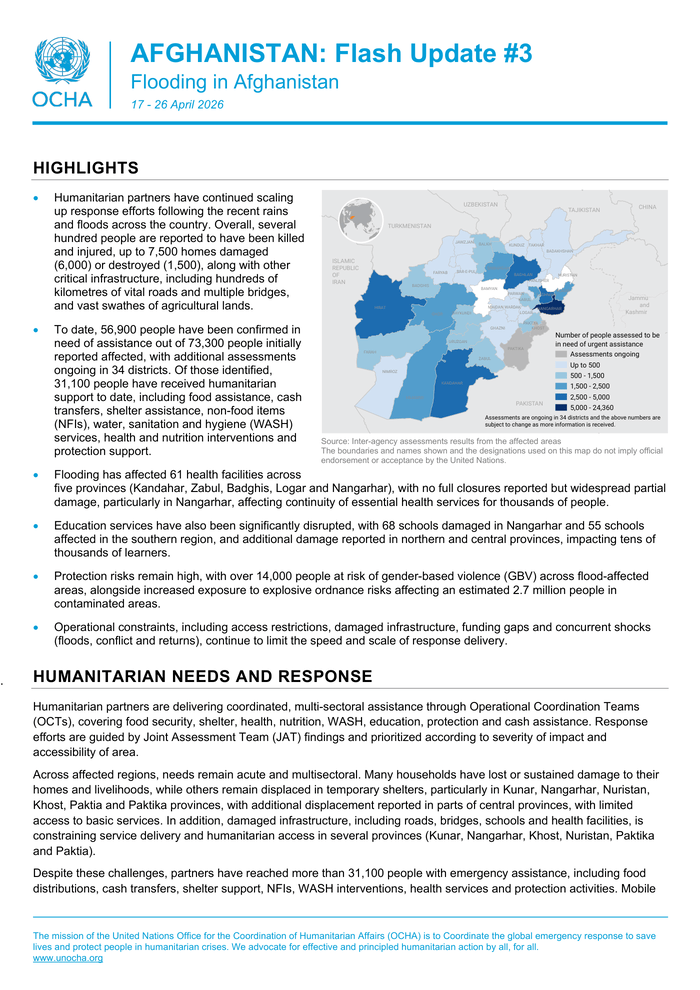
Country: Afghanistan Source: UN Office for the Coordination of Humanitarian Affairs Please refer to the attached file. Highlights Humanitarian partners have continued scaling up response efforts following the recent rains and floods across the country. Overall, several hundred people are reported to have been killed and injured, up to 7, 500 homes damaged (6, 000) or destroyed (1, 500), along with other critical infrastructure, including hundreds of kilometres of vital roads and multiple bridges, and vast swathes of agricultural lands. To date, 56, 900 people have been confirmed in need of assistance out of 73, 300 people initially reported affected, with additional assessments ongoing in 34 districts. Of those identified, 31, 100 people have received humanitarian support to date, including food assistance, cash transfers, shelter assistance, non-food items (NFIs), water, sanitation and hygiene (WASH) services, health and nutrition interventions and protection support. Flooding has affected 61 health facilities across five provinces (Kandahar, Zabul, Badghis, Logar and Nangarhar), with no full closures reported but widespread partial damage, particularly in Nangarhar, affecting continuity of essential health services for thousands of people. Education services have also been significantly disrupted, with 68 schools damaged in Nangarhar and 55 schools affected in the southern region, and additional damage reported in northern and central provinces, impacting tens of thousands of learners. Protection risks remain high, with over 14, 000 people at risk of gender-based violence (GBV) across flood-affected areas, alongside increased exposure to explosive ordnance risks affecting an estimated 2. 7 million people in contaminated areas. Operational constraints, including access restrictions, damaged infrastructure, funding gaps and concurrent shocks (floods, conflict and returns), continue to limit the speed and scale of response delivery. Humanitarian Needs and Response Humanitarian partners are delivering coordinated, multi-sectoral assistance through Operational Coordination Teams (OCTs), covering food security, shelter, health, nutrition, WASH, education, protection and cash assistance. Response efforts are guided by Joint Assessment Team (JAT) findings and prioritized according to severity of impact and accessibility of area. Across affected regions, needs remain acute and multisectoral. Many households have lost or sustained damage to their homes and livelihoods, while others remain displaced in temporary shelters, particularly in Kunar, Nangarhar, Nuristan, Khost, Paktia and Paktika provinces, with additional displacement reported in parts of central provinces, with limited access to basic services. In addition, damaged infrastructure, including roads, bridges, schools and health facilities, is constraining service delivery and humanitarian access in several provinces (Kunar, Nangarhar, Khost, Nuristan, Paktika and Paktia). Despite these challenges, partners have reached more than 31, 100 people with emergency assistance, including food distributions, cash transfers, shelter support, NFIs, WASH interventions, health services and protection activities. Mobile response teams continue to operate in affected areas, including mobile health and nutrition services and civil documentation support. However, response capacity is increasingly constrained by overlapping crises, including flood impacts, supply chain disruption, especially for food and nutrition, due to prolonged border closure between Afghanistan and Pakistan, as well as conflict-related displacement linked to Afghanistan–Pakistan border tensions and returnee inflows. These dynamics are accelerating depletion of contingency stocks and limiting the ability of partners to pre-position and replenish supplies. Operational constraints, including damaged and impassable roads, access restrictions in remote and insecure areas, limited pre-positioned stocks, and funding shortfalls continue to delay response in hard-to-reach districts. Despite these constraints, partners are adapting delivery modalities to ensure continuity of life-saving assistance, including the use of community-based and mobile service delivery approaches. Joint assessments have now been completed in 115 districts, with ongoing assessments in 34 districts.
Afghanistan: Flash Update #3: Flooding in Afghanistan (17 to 26 April 2026)

RELATED ARTICLES


