


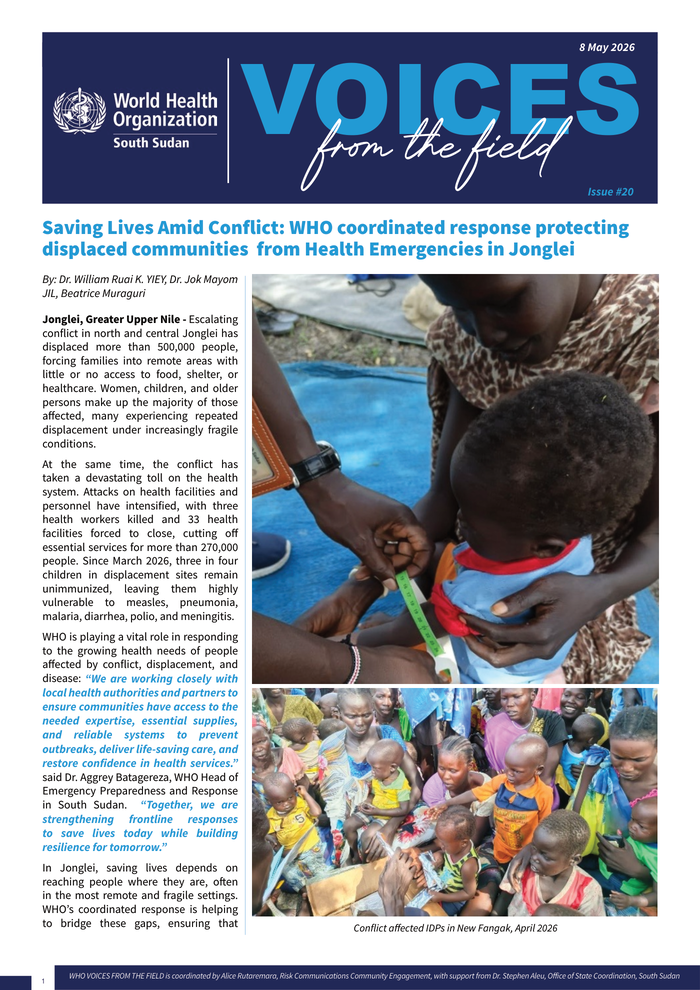
Country: South Sudan Source: World Health Organization Please refer to the attached file. Saving Lives Amid Conflict: WHO coordinated response protecting displaced communities from Health Emergencies in Jonglei By: Dr. William Ruai K. YIEY, Dr. Jok Mayom JIL, Beatrice Muraguri Jonglei, Greater Upper Nile – Escalating conflict in north and central Jonglei has displaced more than 500, 000 people, forcing families into remote areas with little or no access to food, shelter, or healthcare. Women, children, and older persons make up the majority of those affected, many experiencing repeated displacement under increasingly fragile conditions. At the same time, the conflict has taken a devastating toll on the health system. Attacks on health facilities and personnel have intensified, with three health workers killed and 33 health facilities forced to close, cutting off essential services for more than 270, 000 people. Since March 2026, three in four children in displacement sites remain unimmunized, leaving them highly vulnerable to measles, pneumonia, malaria, diarrhea, polio, and meningitis. WHO is playing a vital role in responding to the growing health needs of people affected by conflict, displacement, and disease: “We are working closely with local health authorities and partners to ensure communities have access to the needed expertise, essential supplies, and reliable systems to prevent outbreaks, deliver life-saving care, and restore confidence in health services. ” said Dr. Aggrey Batagereza, WHO Head of Emergency Preparedness and Response in South Sudan. “Together, we are strengthening frontline responses to save lives today while building resilience for tomorrow. ” In Jonglei, saving lives depends on reaching people where they are, often in the most remote and fragile settings. WHO’s coordinated response is helping to bridge these gaps, ensuring that even amid conflict and displacement, essential health services continue to reach those who need them most. In these conditions, preventable diseases quickly become deadly. Cholera, in particular, has spread rapidly in overcrowded settlements with unsafe water and poor sanitation. Nearly 2, 000 cases and 47 deaths were reported across Uror, Ayod, and Duk counties during the crisis, underscoring the severe health consequences of conflict-driven displacement. In response, WHO has played a central role in reducing illness and saving lives through coordinated, evidencebased action. By leading health sector coordination, strengthening disease surveillance, delivering emergency medical supplies, and supporting community engagement, WHO and partners have significantly improved access to care, even in the most difficult conditions. For affected communities, the impact has been deeply personal: “Cholera has taken so many lives in our community, and we lived in constant fear, ” said Nyiboth Deng from Duk. “Since WHO vaccinated my children and me, I feel relieved and protected. For the past one month, we have not seen our community members dying from cholera again. This has given us hope and peace of mind. ” Through WHO-led coordination, partners were able to rapidly identify service gaps, prioritize high-risk areas, and mobilize resources where they were needed most. This collective approach helped reduce cholera-related mortality by 98. 8% and enabled three in five people in affected areas to access essential health services despite ongoing insecurity and displacement. Ensuring that lifesaving supplies reached the frontlines has been critical. Between December 2025 and April 2026, WHO delivered 164 cartons of emergency medical kits, valued at USD 560, 000, supporting health services for an estimated 120, 000 displaced people. These supplies enabled health facilities and mobile teams to treat cholera, manage severe dehydration, and continue care for malaria, pneumonia, and severe acute malnutrition. At the same time, WHO strengthened maternal health services by equipping five Basic Emergency Obstetric and Newborn Care centres, enabling safer deliveries and improved access to antenatal care in displacement-affected areas. WHO also reinforced disease surveillance systems, enabling rapid detection and response to outbreaks. During the same period, 476 public health alerts were investigated and more than 650 samples tested, allowing for early confirmation of diseases and targeted interventions. In Duk County, this approach supported a focused cholera response that reduced transmission by 84% within two months, demonstrating the impact of timely, data-driven action. At the community level, WHO trained 820 Boma Health Workers and supported health education efforts across displacement sites. This strengthened community awareness, improved early detection of disease, and encouraged families to seek care earlier, reducing the risk of severe illness and death. Despite these gains, urgent needs remain. Protecting health workers and facilities, restoring immunization services, expanding access to primary healthcare, strengthening nutrition interventions, and pre-positioning supplies ahead of the rainy season will be critical to sustaining progress and preventing further loss of life.



GrowthPakistan brings you the latest news to keep an eye on Pakistan’s startup ecosystem. Business keeps you growing when you stay aware of your competitors' moves. GrowthPakistan offers Business, Tech, Global Tech, Global, Auto, and Startup News straight from industries all around the globe. This platform will help you identify upcoming opportunities not only in Pakistan but worldwide.
Email : growthpakistan@gmail.com
Whatsapp : +92320-9497079
© growthpakistan