

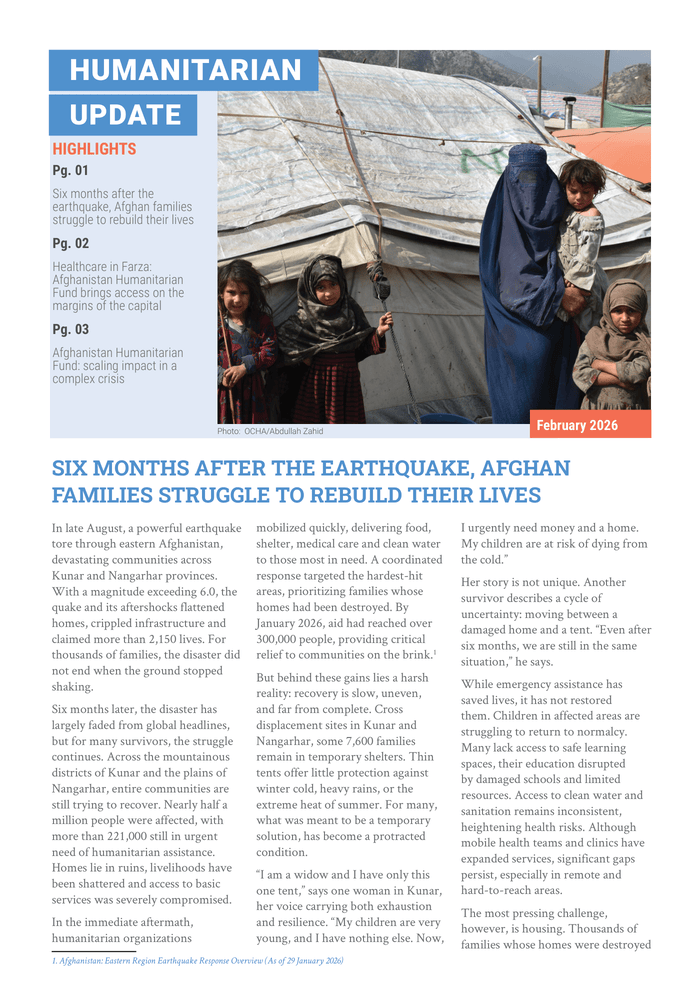
Country: Afghanistan Source: UN Office for the Coordination of Humanitarian Affairs Please refer to the attached file. Six months after the earthquake, Afghan families struggle to rebuild their lives In late August, a powerful earthquake tore through eastern Afghanistan, devastating communities across Kunar and Nangarhar provinces. With a magnitude exceeding 6. 0, the quake and its aftershocks flattened homes, crippled infrastructure and claimed more than 2, 150 lives. For thousands of families, the disaster did not end when the ground stopped shaking. Six months later, the disaster has largely faded from global headlines, but for many survivors, the struggle continues. Across the mountainous districts of Kunar and the plains of Nangarhar, entire communities are still trying to recover. Nearly half a million people were affected, with more than 221, 000 still in urgent need of humanitarian assistance. Homes lie in ruins, livelihoods have been shattered and access to basic services was severely compromised. In the immediate aftermath, humanitarian organizations mobilized quickly, delivering food, shelter, medical care and clean water to those most in need. A coordinated response targeted the hardest-hit areas, prioritizing families whose homes had been destroyed. By January 2026, aid had reached over 300, 000 people, providing critical relief to communities on the brink. But behind these gains lies a harsh reality: recovery is slow, uneven, and far from complete. Cross displacement sites in Kunar and Nangarhar, some 7, 600 families remain in temporary shelters. Thin tents offer little protection against winter cold, heavy rains, or the extreme heat of summer. For many, what was meant to be a temporary solution, has become a protracted condition. “I am a widow and I have only this one tent, ” says one woman in Kunar, her voice carrying both exhaustion and resilience. “My children are very young, and I have nothing else. Now, I urgently need money and a home. My children are at risk of dying from the cold. ” Her story is not unique. Another survivor describes a cycle of uncertainty: moving between a damaged home and a tent. “Even after six months, we are still in the same situation, ” he says. While emergency assistance has saved lives, it has not restored them. Children in affected areas are struggling to return to normalcy. Many lack access to safe learning spaces, their education disrupted by damaged schools and limited resources. Access to clean water and sanitation remains inconsistent, heightening health risks. Although mobile health teams and clinics have expanded services, significant gaps persist, especially in remote and hard-to-reach areas. The most pressing challenge, however, is housing. Thousands of families whose homes were destroyed or severely damaged have yet to be rebuilt. Without adequate financial support, construction materials, or technical assistance, many remain trapped in temporary shelters, unable to move forward. At the same time, funding shortfalls are placing increasing pressure on the humanitarian response. Available resources fall far below what is needed to support full recovery at the required scale or to build longer-term resilience. For affected families, this gap is deeply felt, not in statistics, but in daily survival. As winter tightens its grip and economic hardship deepens, the risk is not only prolonged displacement, but a slide into deeper vulnerability. The story of this earthquake is no longer just about emergency response, it is about what comes next. Rebuilding homes, restoring livelihoods, and ensuring access to education and healthcare are essential steps toward recovery. But these require sustained commitment, predictable funding and continued international attention. Six months on, the resilience of Afghanistan’s earthquake-affected communities is clear in their determination to endure. But resilience alone cannot rebuild homes or protect children from the cold. For that, sustained solidarity is needed. The earthquake may be over, but its impact is still unfolding, day by day, family by family. Healthcare in Farza: Afghanistan Humanitarian Fund brings access on the margins of the capital Just a few hours from Kabul, communities in Farza District continue to face severe barriers to basic healthcare. Despite its proximity to the capital, the district remains largely underserved, with limited facilities, rugged terrain, and widespread poverty leaving thousands without reliable access to medical care. At the Farza Sub-Health Centre, supported by the Afghanistan Humanitarian Fund (AHF) with contributions from the Swiss Agency for Development and Cooperation (SDC) and implemented by Première Urgence – Aide Médicale Internationale (PU-AMI), Dr. Baryalai Rahimi and his small team work under constant pressure. “We see more than 100 patients every day, ” he says. “Most of them are women and children. There is no other clinic nearby, so people come from distant villages. ” For many patients, reaching the facility is a major challenge. Pregnant women walk for up to two and a half hours, often stopping repeatedly due to exhaustion. With no access to transport and harsh winters that isolate communities, this facility is often the only point of care. Qalam Bibi, 65, is among those who depend on the clinic. “My legs hurt, and we don’t have a car, ” she says. “If this clinic didn’t exist, where would we go? ” The clinic provides free consultations, medicines, and essential primary healthcare. Service range from treatment of seasonal illnesses and acute watery diarrhoea to antenatal and postnatal care. A dedicated midwife ensures that women’s can access care in a safe and culturally appropriate environment. Yet, needs remain overwhelming. “Sometimes we refer patients for further tests, ” Dr. Rahimi explains. “But many say they cannot afford it and ask only for medicine. ” Farza is one of five locations across Kabul, Kunar and Paktya provinces where this project is expanding access to primary healthcare. In total, more than 26, 000 people, 65 per cent of them women, are expected to benefit, including pregnant and breastfeeding women, children, persons with disabilities, and other vulnerable groups. Services include outpatient care, immunization, disease screening, and reproductive healthcare, delivered by trained health professionals. During a recent joint visit by OCHA and SDC, community elders voiced deep concern about the clinic’s future. “When this clinic was established, people were very happy, ” one elder said. “Now they hear it may close and they are very worried. This is a mountainous area and in winter it becomes even harder. This is our only clinic. At the very least, it must continue. ” Their message underscores a broader reality: even within Kabul Province, communities like Farza remain at risk of being left behind. Sustained support through the AHF, with contributions from donors such as the SDC and the work of partners like PU-AMI, is essential to ensure that life-saving healthcare continues to reach those who need it most. Afghanistan Humanitarian Fund: scaling impact in a complex crisis In 2025, the AHF continued to provide timely, flexible, and principled funding in one of the world’s most complex crises. Throughout the year, Afghanistan faced multiple overlapping shocks, including increases returns, worsening drought conditions and a major earthquake in the east of the country. These compounded shocks significantly deepened humanitarian needs nationwide. In response, the AHF rapidly mobilized resources through reserve allocations, enabling humanitarian partners to deliver life-saving assistance to the most affected populations. With 22. 9 million people in need, the Fund allocated $73. 5 million in 2025 in line with the Humanitarian Needs and Response Plan. These funds supported assistance across key sectors, including health, food security, nutrition, water and sanitation, shelter, and protection, reaching approximately 3. 5 million vulnerable people, including 1. 9 million women and girls, affected by displacement, climate shocks and natural disasters. AHF has further strengthened its role as one of the largest country-based pooled funds globally, translating donor contributions into rapid, flexible and needs-based action. “The Afghanistan Humanitarian Fund is more than a financing mechanism. In a context of immense and evolving need, the Fund enables us to act with speed, flexibility and purpose, directing resources where they are needed most, empowering those closest to affected communities, and advancing a more localized, accountable and effective humanitarian response, ” said Indrika Ratwatte, the UN Resident and Humanitarian Coordinator for Afghanistan. Joint allocations with the Central Emergency Response Fund enabled a coordinated response that reached more than six million people, while reducing duplication and improving efficiency. Cash assistance remained a key modality, with $14. 3 million allocated to support affected households. This approach provided dignity, flexibility, and cost-effectiveness, while also supporting local markets. Localization, innovation and accountability Localization was a central pillar of the 2025 response. Funding to local and national non-governmental organizations (NGOs) increased to 39 per cent, compared to 28 per cent in 2024, reflecting a stronger commitment to empowering local frontline responders. More than 30 national NGOs worked alongside international partners and UN agencies, expanding reach and access to hard-to-reach areas. The Fund also expanded support to women-led organizations and organizations of persons with disabilities, strengthening inclusive and community-based programming despite operational constraints. In 2025, the AHF also advanced innovative humanitarian approaches, including the piloting of anticipatory action for drought. This marked a significant milestone as the first global instance where pooled funds jointly supported early action for a slow-onset crisis. This enabled humanitarian actors to respond ahead of peak impact, reducing risks for vulnerable communities. In a constrained global funding environment, the Fund adopted a highly strategic allocation approach, prioritizing severity of needs, operational feasibility, and complementarity with other funding sources. Despite significant achievements, humanitarian needs continued to outpace available funding, requiring difficult prioritization decisions. Across Afghanistan, AHF-funded interventions have delivered tangible improvements. In remote communities, access to clean water, healthcare and sanitation services has helped reduce disease and restore dignity. “Today, clean water comes to the doorstep of our home. It’s a blessing we never imagined, ” said one community member from northern Afghanistan. As Afghanistan continues to face recurrent and overlapping crises, the AHF remains a critical lifeline for millions of people. Sustained and flexible donor support is essential to maintain the speed, scale and effectiveness of humanitarian response. Afghanistan: Eastern Region Earthquake Response Overview (As of 29 January 2026) – Afghanistan | ReliefWeb Afghanistan Humanitarian Fund 2025 Annual Report – Afghanistan | ReliefWeb
Afghanistan: Humanitarian Update, February 2026

RELATED ARTICLES


