

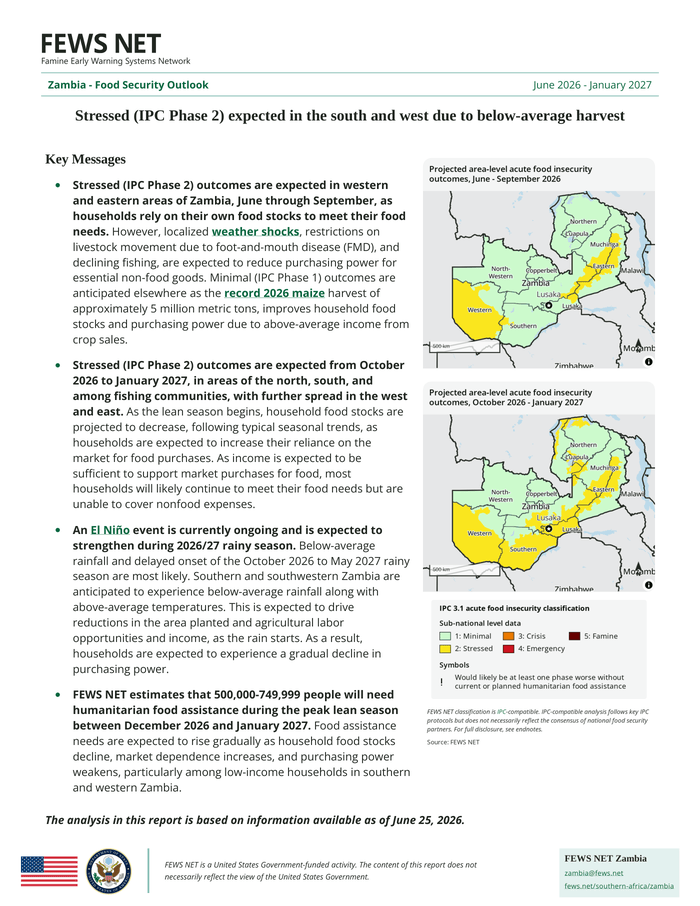
Country: Zambia Source: Famine Early Warning System Network Please refer to the attached file. Key Messages Stressed (IPC Phase 2) outcomes are expected in western and eastern areas of Zambia, June through September, as households rely on their own food stocks to meet their food needs. However, localized weather shocks, restrictions on livestock movement due to foot-and-mouth disease (FMD), and declining fishing, are expected to reduce purchasing power for essential non-food goods. Minimal (IPC Phase 1) outcomes are anticipated elsewhere as the record 2026 maize harvest of approximately 5 million metric tons, improves household food stocks and purchasing power due to above-average income from crop sales. Stressed (IPC Phase 2) outcomes are expected from October 2026 to January 2027, in areas of the north, south, and among fishing communities, with further spread in the west and east. As the lean season begins, household food stocks are projected to decrease, following typical seasonal trends, as households are expected to increase their reliance on the market for food purchases. As income is expected to be sufficient to support market purchases for food, most households will likely continue to meet their food needs but are unable to cover nonfood expenses. An El Niño event is currently ongoing and is expected to strengthen during 2026/27 rainy season. Below-average rainfall and delayed onset of the October 2026 to May 2027 rainy season are most likely. Southern and southwestern Zambia are anticipated to experience below-average rainfall along with above-average temperatures. This is expected to drive reductions in the area planted and agricultural labor opportunities and income, as the rain starts. As a result, households are expected to experience a gradual decline in purchasing power. FEWS NET estimates that 500, 000-749, 999 people will need humanitarian food assistance during the peak lean season between December 2026 and January 2027. Food assistance needs are expected to rise gradually as household food stocks decline, market dependence increases, and purchasing power weakens, particularly among low-income households in southern and western Zambia. The analysis in this report is based on information available as of June 25, 2026. Food security context Food security in Zambia largely depends on agricultural production, which is the primary source of food and income for most households. Approximately 55 percent of the population relies on rainfed smallholder farming, with maize as the main staple grain, alongside cassava, sorghum, and ground nuts. Cash crops such as soybeans, wheat, cotton, and tobacco, along with livestock production, contribute to the economy through export earnings and domestic use. Zambia has one rainy season, from October to March, while irrigation or residual moisture supports limited second season production from April to September. Small-scale fishing also contributes to household food and income near major rivers, lakes, or dams. Overfishing and the decline in the fishing population are the main concerns, and the government has implemented some restrictions to allow replenishment. Crop production varies across Zambia, with Northern and Central provinces benefiting from typically higher and more reliable production, while Southern, Northwestern, and Western provinces are prone to erratic rainfall, leading to poorer harvests. In favorable seasons, Zambia produces a surplus and exports to neighboring countries such as the Democratic Republic of the Congo (DRC) and Malawi. However, the country has untapped agricultural potential, with only 14 percent of its total arable land under cultivation. Crop production is constrained by limited access to inputs, high transportation costs, and poor infrastructure. National food production fluctuates due to seasonal pressures and recurring weather-related shocks, resulting in periods of relative self-sufficiency in good production seasons and increased market dependence during poor production years. During poor seasons, unfavorable yields are compounded by the annual lean season (typically November to March), when food stocks decline, prices rise, and poor households become increasingly reliant on markets or food access. El Niño years are mostly associated with below-average October to March rainfall, a delayed start to the rainy season, and lower water levels in major dams. In contrast, La Niña years are mostly associated with above-average rainfall, with some areas affected by flooding and crop pests/diseases. As both conditions cause extreme weather, parts of the country are affected by drought or flooding. Between 2015 and 2025, recurrent droughts primarily associated with El Niño events, along with floods, dry spells, and pest outbreaks, disrupted agricultural production and food access, particularly in the Southern, Western, and Northwestern provinces. Since the 2016/17 rainy season, the emergence of Fall Armyworm has significantly contributed to reduced harvests in 2017. In 2023/24, the El Niño-induced drought, combined with pest outbreaks, affected more than 70 districts and destroyed nearly half of the planted maize area, resulting in below-average harvests in 2025. Although national maize production recovered in the 2026 production season, localized weather shocks continue to limit food production in the most affected provinces. Mining is a key pillar of Zambia’s economy, with copper and other minerals accounting for about 70 percent of export earnings and serving as the main source of foreign exchange. The sector provides employment and income opportunities for urban households through direct mining jobs and related activities, including trade, transport, construction, and services. Many urban households are heavily dependent on markets for food, leaving them vulnerable to supply disruptions, slowdowns in the mining sector, and food price shocks. Urban employment trends have improved modestly in recent years, supported by increased mining investment, construction activity, and growth in the services sector. Most urban households rely on informal activities, including petty trade, casual labor, transportation services, and small businesses, for income. Consequently, poor urban households remain highly sensitive to fluctuations in food prices and to changes in economic conditions that affect income-earning opportunities.
Zambia Food Security Outlook – June 2026 – January 2027: Stressed (IPC Phase 2) expected in the south and west due to below-average harvest

RELATED ARTICLES


