

Countries: World, Belize, Guyana, Jamaica, Suriname, Trinidad and Tobago Sources: Caribbean Community Secretariat, World Food Programme Please refer to the attached file. Executive Summary The Caribbean enters 2026 facing a convergence of global and regional shocks that pose significant risks to food security, household purchasing power, and economic stability. The simultaneous emergence of a major supply chain disruption in the Middle East combined with a high probability El Niño event threatens to amplify longstanding structural vulnerabilities in a region already grappling with high food import dependence, strong exposure to energy price volatility, constrained fiscal space, and persistently elevated food prices. The escalation of conflict dynamics in the Middle East in early 2026—coupled with severe disruption to traffic through the Strait of Hormuz—has triggered one of the most significant global energy and trade shocks since the COVID19 pandemic and the Ukraine–Russia conflict. Global oil prices peaked at USD 114. 5 per barrel, fertilizer markets tightened sharply due to a physical supply disruption, and maritime shipping has faced unprecedented congestion, insurance costs, and rerouting delays. With the announcement of ceasefire in early April 2026, the potential for a gradual stabilization of trade and transport corridors could lead to an improvement in the long-term outlook. Market volatility is expected to persist; however, with supply risks and price uncertainty remaining elevated in the near term. For the Caribbean—one of the most food import dependent regions globally with the highest cost of a healthy diet in the world1—these global shocks transmit rapidly and intensely into domestic food systems. Rising fuel and freight costs directly increase food import prices, transport and cold chain costs, electricity tariffs, and essential household expenditures. Structural features of Caribbean economies—small market size, the narrow base of suppliers, and the high share of food and transport costs in household consumption—amplify inflationary spillovers, particularly for low-income households. At the same time, climate projections indicate a 61 percent probability of El Niño developing between May and July 2026 and persist through at least the end of 2026. Historically, El Niño is associated with rainfall deficits, higher temperatures, and extended dry spells across Caribbean states, including Belize, Guyana, Suriname, and parts of Jamaica and Trinidad and Tobago. Early seasonal forecasts for 2026 already point to below average rainfall, prompting Belize to activate drought related anticipatory action mechanisms. The combination of reduced precipitation and rising temperatures is expected to intensify evapotranspiration, accelerate soil moisture depletion, increase wildfire risk, and constrain rainfed agricultural production. These emerging risks will hit a population still recovering from consecutive shocks. Over the past five years, food insecurity in the Caribbean has followed a pattern of consistent deterioration: sharp increases during COVID19 and the 2022 Ukraine–Russia conflict were followed by partial recovery, with baseline vulnerability steadily increasing. By mid-2025, moderate food insecurity remained well above pre-pandemic levels, while food prices had risen by an estimated 55–60 percent since 2018—nearly twice the increase observed for non-food prices. Recurrent climate disasters, including Hurricane Beryl in 2024 and Hurricane Melissa in 2025, have further undermined household coping capacity and strained social protection systems. Exposure to this cycle of food security shocks has increased household sensitivity to the impact of emerging risks, including global price volatility and El Niño‐related impacts. In 2025, there was a synchronized spike across food consumption, coping strategies, food insecurity experience, and market access indicators, driven largely by hurricane impacts in Jamaica but reflected across multiple countries. While partial improvement occurred in early 2026, many households remain highly vulnerable to projected economic and climatic shocks. Taken together, the analysis highlights a critical risk window for the Caribbean in 2026. Even with a return to stability over the coming weeks, the cascading consequences of disrupted supply chains, elevated energy and fertilizer prices, and mounting climate stress are likely to persist over the coming months. Without timely, coordinated policy action, the combined effects of global market volatility and El Niño related drought could further degrade food access, diet quality, and livelihoods, particularly among, small-scale farmers and fishers and the urban poor. The analysis underscores the urgency of stabilizing food and input markets in the short term, protecting household purchasing power through shock responsive social protection, safeguarding the upcoming agricultural production cycle, and accelerating investments in climate and disaster resilience. Coordinated regional approaches and support from development partners will be essential to prevent these intersecting shocks from translating into a deeper and more prolonged food security crisis across the Caribbean.
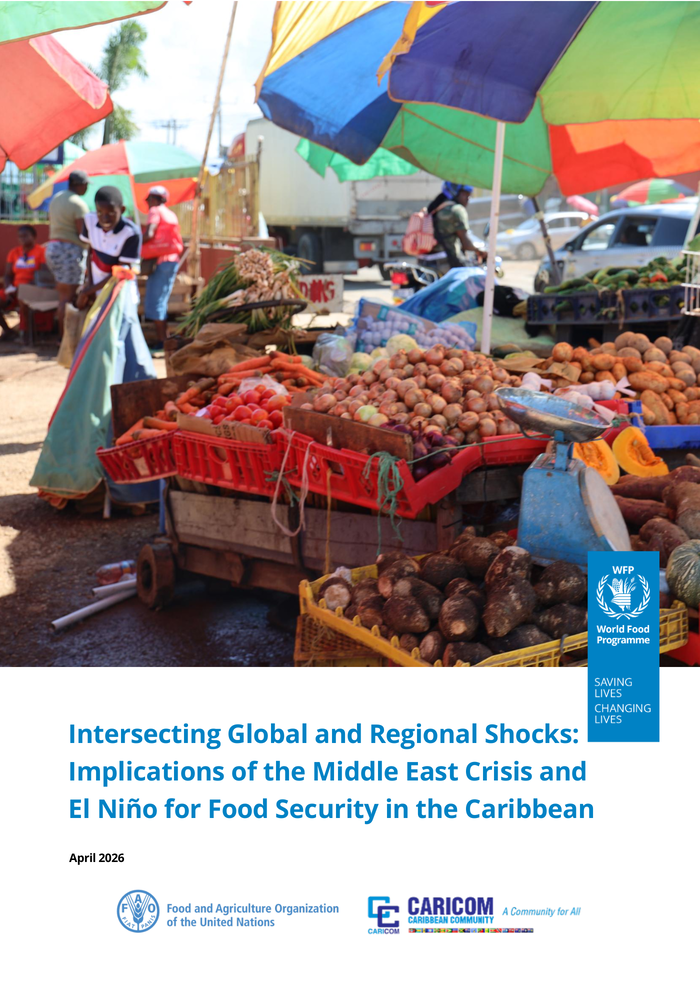
World: Intersecting Global and Regional Shocks: Implications of the Middle East Crisis and El Niño for Food Security in the Caribbean, April 2026

RELATED ARTICLES


