


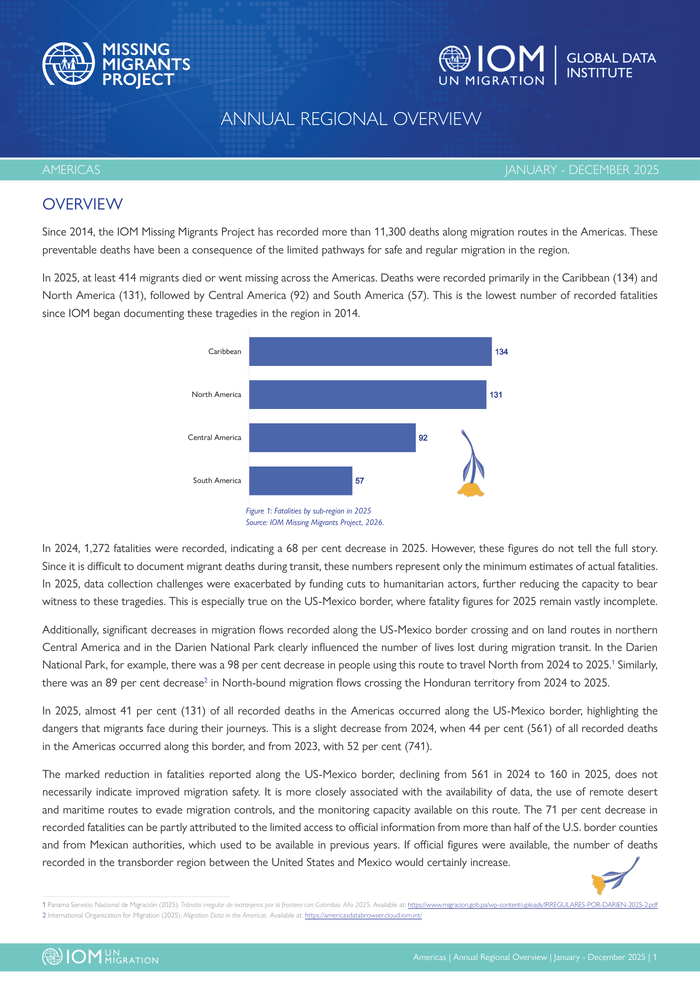
Countries: World, Mexico, United States of America Source: International Organization for Migration Please refer to the attached file. OVERVIEW Since 2014, the IOM Missing Migrants Project has recorded more than 11, 300 deaths along migration routes in the Americas. These preventable deaths have been a consequence of the limited pathways for safe and regular migration in the region. In 2025, at least 414 migrants died or went missing across the Americas. Deaths were recorded primarily in the Caribbean (134) and North America (131), followed by Central America (92) and South America (57). This is the lowest number of recorded fatalities since IOM began documenting these tragedies in the region in 2014. In 2024, 1, 272 fatalities were recorded, indicating a 68 per cent decrease in 2025. However, these figures do not tell the full story. Since it is difficult to document migrant deaths during transit, these numbers represent only the minimum estimates of actual fatalities. In 2025, data collection challenges were exacerbated by funding cuts to humanitarian actors, further reducing the capacity to bear witness to these tragedies. This is especially true on the US-Mexico border, where fatality figures for 2025 remain vastly incomplete. Additionally, significant decreases in migration flows recorded along the US-Mexico border crossing and on land routes in northern Central America and in the Darien National Park clearly influenced the number of lives lost during migration transit. In the Darien National Park, for example, there was a 98 per cent decrease in people using this route to travel North from 2024 to 2025. 1 Similarly, there was an 89 per cent decrease2 in North-bound migration flows crossing the Honduran territory from 2024 to 2025. In 2025, almost 41 per cent (131) of all recorded deaths in the Americas occurred along the US-Mexico border, highlighting the dangers that migrants face during their journeys. This is a slight decrease from 2024, when 44 per cent (561) of all recorded deaths in the Americas occurred along this border, and from 2023, with 52 per cent (741). The marked reduction in fatalities reported along the US-Mexico border, declining from 561 in 2024 to 160 in 2025, does not necessarily indicate improved migration safety. It is more closely associated with the availability of data, the use of remote desert and maritime routes to evade migration controls, and the monitoring capacity available on this route. The 71 per cent decrease in recorded fatalities can be partly attributed to the limited access to official information from more than half of the U. S. border counties and from Mexican authorities, which used to be available in previous years. If official figures were available, the number of deaths recorded in the transborder region between the United States and Mexico would certainly increase. Additionally, the substantial decrease in migratory flows contributed to the decrease in lives lost at the US-Mexico border crossing. There was an 88 per cent3 interannual decrease in encounters with the U. S. Border Patrol and Customs Protection on the southern border of the United States between 2024 and 2025. The encounters recorded by the Office of Field Operations (OFO) also decreased by 76 per cent in 2025, compared to those recorded during 2024. While a decrease in migration flows seems to have resulted in fewer deaths during transit—although not proportionally, 84 per cent decrease in encounters versus 71 per cent decrease in fatalities—the only real long-term solution to deaths during transit are accessible pathways for safe and regular migration. Other regions across the Americas experienced significant increases in migrant deaths in 2025. The highest number of deaths in 2025 was recorded in the Caribbean (134) for the third consecutive year. The routes in the Caribbean continue to be among the most dangerous in the Americas. Despite the decrease mentioned above, the second largest number of deaths (131) was recorded in North America. With 57 recorded deaths, South America experienced a 27 per cent increase in fatalities compared to 2024 (45). Most deaths occurred on land routes across Colombia, Ecuador, Peru, Chile, and at the Bolivia-Chile Colchane border crossing. In terms of causes of death, 25 per cent of deaths in the Americas were due to drowning in rivers and at sea, mainly at crossings between the US and Mexico (30) and from the Caribbean to the US (5). Harsh environmental conditions and lack of access to water, food, and shelter accounted for 15 per cent (61), mainly on the southern border of the United States, followed by Mexico and Panama. Vehicle accidents and deaths linked to hazardous transport accounted for another eight per cent (32) of fatalities, half of which occurred on land routes in Mexico. Similarly, violence accounted for seven per cent (29) of fatalities, mainly involving fights, attacks with blunt weapons, and shootings. However, for the largest proportion of deaths (145), there is extremely little information about those who died, including the causes leading to their deaths.



GrowthPakistan brings you the latest news to keep an eye on Pakistan’s startup ecosystem. Business keeps you growing when you stay aware of your competitors' moves. GrowthPakistan offers Business, Tech, Global Tech, Global, Auto, and Startup News straight from industries all around the globe. This platform will help you identify upcoming opportunities not only in Pakistan but worldwide.
Email : growthpakistan@gmail.com
Whatsapp : +92320-9497079
© growthpakistan