


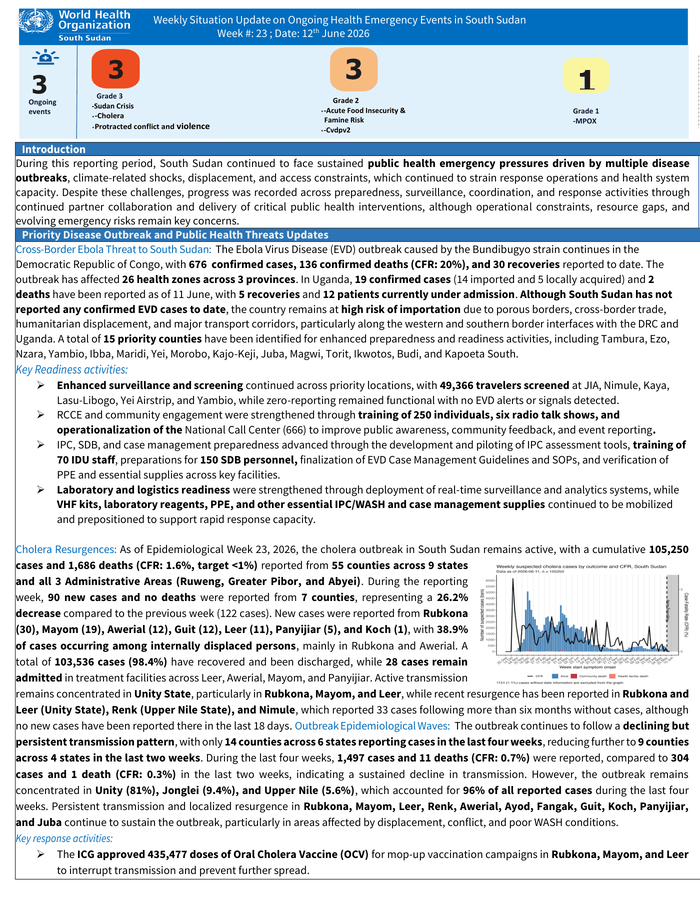
Countries: South Sudan, Democratic Republic of the Congo Source: World Health Organization Please refer to the attached file. Introduction During this reporting period, South Sudan continued to face sustained public health emergency pressures driven by multiple disease outbreaks, climate-related shocks, displacement, and access constraints, which continued to strain response operations and health system capacity. Despite these challenges, progress was recorded across preparedness, surveillance, coordination, and response activities through continued partner collaboration and delivery of critical public health interventions, although operational constraints, resource gaps, and evolving emergency risks remain key concerns. Priority Disease Outbreak and Public Health Threats Updates Cross-Border Ebola Threat to South Sudan: The Ebola Virus Disease (EVD) outbreak caused by the Bundibugyo strain continues in the Democratic Republic of Congo, with 676 confirmed cases, 136 confirmed deaths (CFR: 20%), and 30 recoveries reported to date. The outbreak has affected 26 health zones across 3 provinces. In Uganda, 19 confirmed cases (14 imported and 5 locally acquired) and 2 deaths have been reported as of 11 June, with 5 recoveries and 12 patients currently under admission. Although South Sudan has not reported any confirmed EVD cases to date, the country remains at high risk of importation due to porous borders, cross-border trade, humanitarian displacement, and major transport corridors, particularly along the western and southern border interfaces with the DRC and Uganda. A total of 15 priority counties have been identified for enhanced preparedness and readiness activities, including Tambura, Ezo, Nzara, Yambio, Ibba, Maridi, Yei, Morobo, Kajo-Keji, Juba, Magwi, Torit, Ikwotos, Budi, and Kapoeta South. Key Readiness activities: ➢ Enhanced surveillance and screening continued across priority locations, with 49, 366 travelers screened at JIA, Nimule, Kaya, Lasu-Libogo, Yei Airstrip, and Yambio, while zero-reporting remained functional with no EVD alerts or signals detected. ➢ RCCE and community engagement were strengthened through training of 250 individuals, six radio talk shows, and operationalization of the National Call Center (666) to improve public awareness, community feedback, and event reporting. ➢ IPC, SDB, and case management preparedness advanced through the development and piloting of IPC assessment tools, training of 70 IDU staff, preparations for 150 SDB personnel, finalization of EVD Case Management Guidelines and SOPs, and verification of PPE and essential supplies across key facilities. ➢ Laboratory and logistics readiness were strengthened through deployment of real-time surveillance and analytics systems, while VHF kits, laboratory reagents, PPE, and other essential IPC/WASH and case management supplies continued to be mobilized and prepositioned to support rapid response capacity.



GrowthPakistan brings you the latest news to keep an eye on Pakistan’s startup ecosystem. Business keeps you growing when you stay aware of your competitors' moves. GrowthPakistan offers Business, Tech, Global Tech, Global, Auto, and Startup News straight from industries all around the globe. This platform will help you identify upcoming opportunities not only in Pakistan but worldwide.
Email : growthpakistan@gmail.com
Whatsapp : +92320-9497079
© growthpakistan