


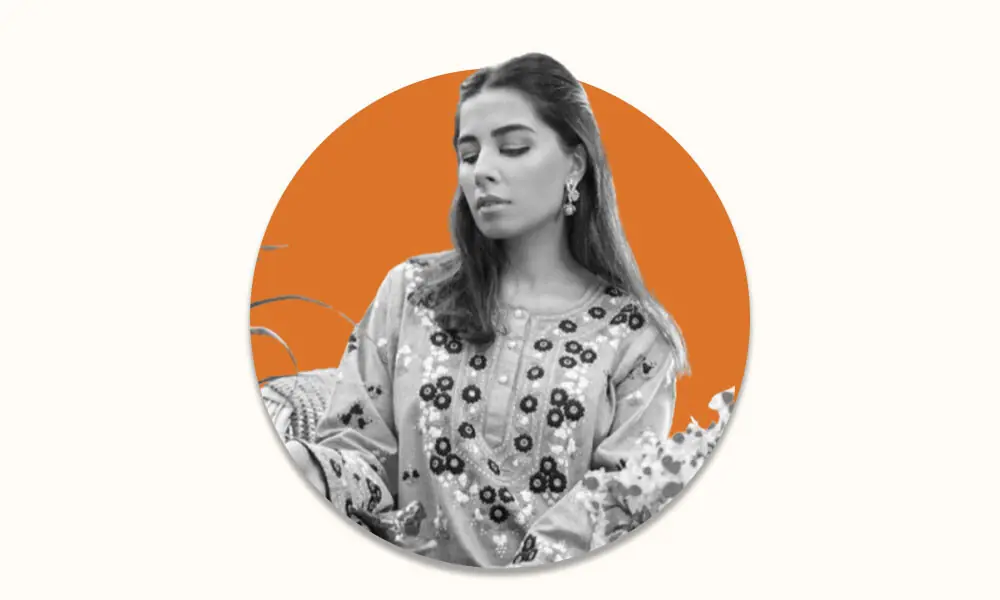
I never imagined I’d end up in fashion, especially after studying Economics & Finance at Warwick Business School and beginning my career in banking in the UK. On paper, it was everything I was meant to do, structured, stable, intellectually rigorous, and widely understood as success. And in many ways, it shaped me. But over time, I began to realize that while I understood the systems I was working within, I did not feel fully connected to them. I had been raised by an artist mother you see, surrounded by beauty, craft, and making, and I carried that same creative instinct within me. Gradually, I found myself drawn back to that part of who I was. Today, I’m the founder of Princess & The Cake, a slow fashion label working with more than 250 women artisans in South Punjab. And if I look back, what connects that early chapter to where I am now is not reinvention, but a long search for work that carries human presence within it, and the absolute joy that comes from the arts, from making something that feels alive, vibrant and exciting. And it was through this very pivotal shift that I began to engage more deeply with the subject (and heart) of slow fashion. In recent years, words like sustainability and slow fashion have entered mainstream fashion discourse with increasing frequency. They are now used across campaigns, brand strategies, and marketing narratives, often as catch-all phrases that signal responsibility. But somewhere down the line, these words have also been stripped of their depth. They have become aesthetic signals rather than actual lived practices. From where I stand, working directly with craftswomen, sustainability is slower, more complex, and far more human than the industry often allows it to be. It’s not a fixed category or a branding choice. It’s a way of working that resists acceleration, because it’s built on time and relationships that cannot be compressed. Fast fashion, on the other hand, has reshaped not just how we buy, but how we value. According to the Ellen MacArthur Foundation, the equivalent of one garbage truck of textiles is landfilled or burned every second globally. Imagine that. This statistic is often repeated, but its meaning is still not fully absorbed. It reveals not only environmental urgency, but a deeper cultural disconnect. Clothing, once made to last and carry memory, has become so transient. What’s often left unexamined in this system is distance. Fast fashion doesn’t only produce waste, it produces separation. Separation between wearer and maker, between garment and origin, between price and process. We’re no longer in relationship with what we wear, we’re in transaction with it. In contrast, handmade clothing exists within an entirely different logic. When I work with my artisans, many of whom I first met in my grandmother’s ancestral village, I’m constantly reminded that making is not just production, it’s inheritance. The embroidery techniques, the motifs, the rhythm of the hand, all carry generational knowledge that’s not documented in manuals, but passed through repetition every single day. This is where the emotional and cultural value of handmade clothing becomes impossible to ignore. And yet, in dominant fashion narratives, this kind of work is still rarely framed as luxury. We tend to associate luxury with exclusivity, branding, or price point. But I’ve come to believe that handmade is the new luxury precisely because it resists haste and speed. It insists on time in a world that has stopped valuing it. It carries emotional density in an industry that has increasingly flattened clothing into content. .. Princess & The Cake grew organically over time, now reaching a community of more than 90, 000 people on Instagram. Our pieces have been worn by women I deeply admire, including Mahira Khan, Hania Aamir, Nadia Jamil, and many more self-made young women in the media spotlight. But visibility has never been the point. What matters more is continuity, that artisans continue their work across seasons without interruption. Building slowly within the local fashion ecosystem in Pakistan also comes with its own set of challenges. One of the most persistent is the lack of meaningful conversation around originality and ownership. Plagiarism remains rampant, and for small independent brands, this can be deeply discouraging. It affects not just business growth, but creative confidence. When ideas are replicated without acknowledgement, often before they have even had space to mature, it raises difficult questions about authorship and value. What does it mean to create in an environment where copying is easy, visible, and largely unchecked? And how do you continue to build when the boundaries of your work are not always respected? It’s a tough path, if I were to be candid. Over time, I’ve learned that the only sustainable response is to keep making, even when the act of making feels fragile in a world that rewards speed and replication. To return, again and again, to the integrity of process, to the belief that what is created with care still holds weight, even if it is not immediately seen or protected. Because what we risk losing when sustainability becomes a polished marketing phrase rather than a lived practice is not only meaning in language, but meaning in work itself. We lose the people inside the process, their time, their histories, their hands. And slowly, without noticing, we begin to lose the ability to recognize value unless it arrives quickly, loudly, or in scale.



GrowthPakistan brings you the latest news to keep an eye on Pakistan’s startup ecosystem. Business keeps you growing when you stay aware of your competitors' moves. GrowthPakistan offers Business, Tech, Global Tech, Global, Auto, and Startup News straight from industries all around the globe. This platform will help you identify upcoming opportunities not only in Pakistan but worldwide.
Email : growthpakistan@gmail.com
Whatsapp : +92320-9497079
© growthpakistan