

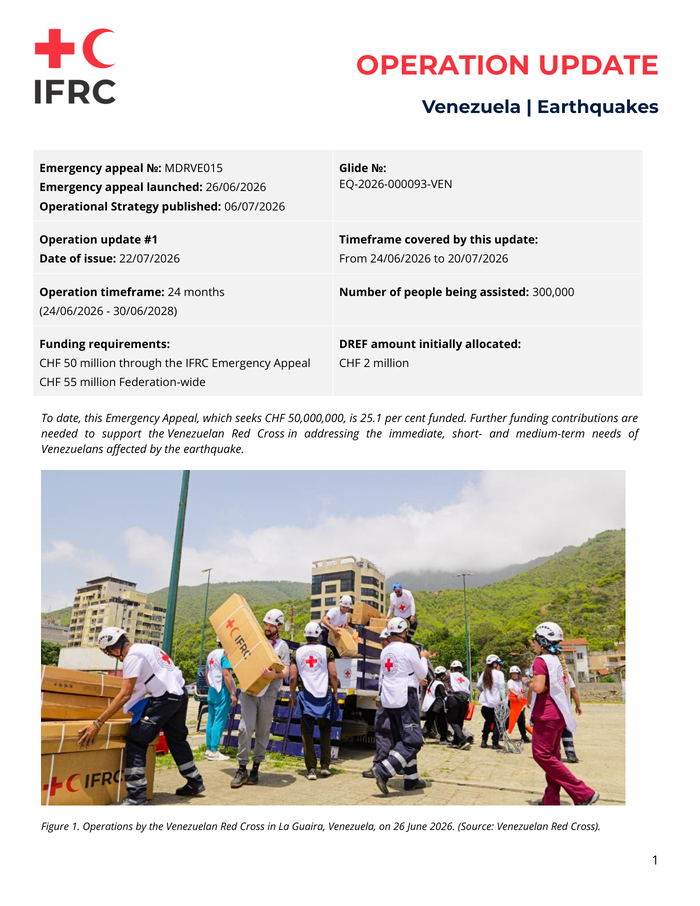
Country: Venezuela (Bolivarian Republic of) Source: International Federation of Red Cross and Red Crescent Societies Please refer to the attached file. A. SITUATION ANALYSIS Description of the crisis On 24 June 2026, two powerful earthquakes struck north-central Venezuela in rapid succession, with preliminary magnitudes of 7. 2 and 7. 5. Authorities have reported more than 1, 000 aftershocks since the event, creating a high risk of further structural collapse. The epicentres were located near Morón and Yumare, in the states of Carabobo and Yaracuy, west of Caracas. The impact was severe and widespread, with tremors felt across much of the country, including the Capital District, La Guaira, Aragua, Carabobo, Miranda, Falcón, and neighbouring states. The Government of Venezuela declared a National State of Emergency the same day and designated La Guaira, where the greatest concentration of damaged infrastructure and rescue operations was concentrated, as a disaster zone. According to the Global Disaster Awareness and Coordination System (GDACS), an estimated 9. 73 million people have been affected, including approximately 530, 000 exposed to extreme earthquake intensity. The event occurred during the San Juan festivities, a national celebration that attracts large numbers of people to coastal areas; and as many workplaces were closed, this also led to families having many or all members present inside their home when the earthquakes happened. In La Guaira, a popular destination to spend this festivity, this resulted in higher population concentrations in public spaces and along the coastline at the time of the event, increasing the number of people potentially exposed to the impacts of the earthquakes. As of 15 July, 4, 829 people were reported dead, 16, 740 injured and approximately 17, 907 had lost their homes due to severe damage to housing1. It is expected for these figures to continue to rise in coming days as the Search and Rescue phase focused on extraction of survivors moves towards a focus on recovery, identification and return to family members of bodies retrieved from collapsed structures. Response teams from over 29 countries deployed to Venezuela, including the United Nations Disaster Assessment and Coordination (UNDAC) team and Urban Search and Rescue (USAR) teams operating under the coordination of the International Search and Rescue Advisory Group (INSARAG)2. International search and rescue deployments are progressively concluding, with several Movement teams having completed their missions. A response focused on search, recovery, debris-removal, shelter provision and efforts to bridge emergency relief to recovery and reconstruction efforts continues under national leadership, with a broad range of bilateral and multilateral support focused on humanitarian assistance, restoration of essential services and recovery. According to OCHA, 2, 501 infrastructure assets had sustained some degree of damage, with 856 affected buildings, including 190 that have collapsed. 3 A comprehensive technical evaluation of structures is underway by respective authorities to identify homes that can be repaired and those that are too dangerous to return to. Evaluation of safe areas to build permanent housing for those affected is also taking place. Damage to residences, commercial buildings and critical infrastructure also disrupted the functioning of electricity, water-supply, telecommunications and transport systems, as well as public transportation and airport operations. Damaged roads and bridges have also restricted access and affected movement to and within some affected areas. The healthcare capacity has been particularly affected, with limited supply of water systems. More than 400 schools were also reported as affected, while some have been repurposed as temporary shelters until the academic cycle resumes after the summer. Damage to water systems has further affected the availability of basic services. Moreover, it is important to note that the main affected area, La Guaira, fulfils multiple critical functions for the country. Its proximity to the Capital, Caracas, the presence of the country’s main international airport (Maiquetía) and one of its major ports, makes it a strategic transportation, logistics, trade, tourism, fishing and service hub. Consequently, the incident impacted not only local communities and visitors present, but also essential infrastructure and activities that facilitate connectivity and the supply of goods to the capital and other regions of the country. This increases the number of people and logistical capacity affected. The physical impacts on affected people remain significant, with thousands of injured, many requiring continued medical care, rehabilitation or referral services, and with families displaced after the destruction or severe damage of their homes. Beyond these physical impacts, the earthquakes have also had significant effects on the mental health and psychosocial well-being of affected people. Many families have experienced loss and grief, injury, displacement, separation from relatives and loss of homes, livelihoods and community support networks. The magnitude of the tragedy on human terms, continued aftershocks, uncertainty regarding housing and recovery, and exposure to damaged environments and recovery operations has contributed to heightened levels of stress, anxiety and sadness among the affected populations. Notably, La Guaira’s geographical location is prone to various types of emergencies. In December 1999, torrential rainfall triggered catastrophic landslides, flash floods and debris flows across the then State of Vargas—now La Guaira—causing widespread destruction and displacement. The exact death toll remains uncertain; however, the United States Geological Survey estimated that between 15, 000 and 30, 000 people were killed. The current earthquake has therefore affected communities with lived and intergenerational memories of one of Venezuela’s most severe disasters.
Venezuela | Earthquake – Operation Update #1 (MDRVE015)

RELATED ARTICLES


