

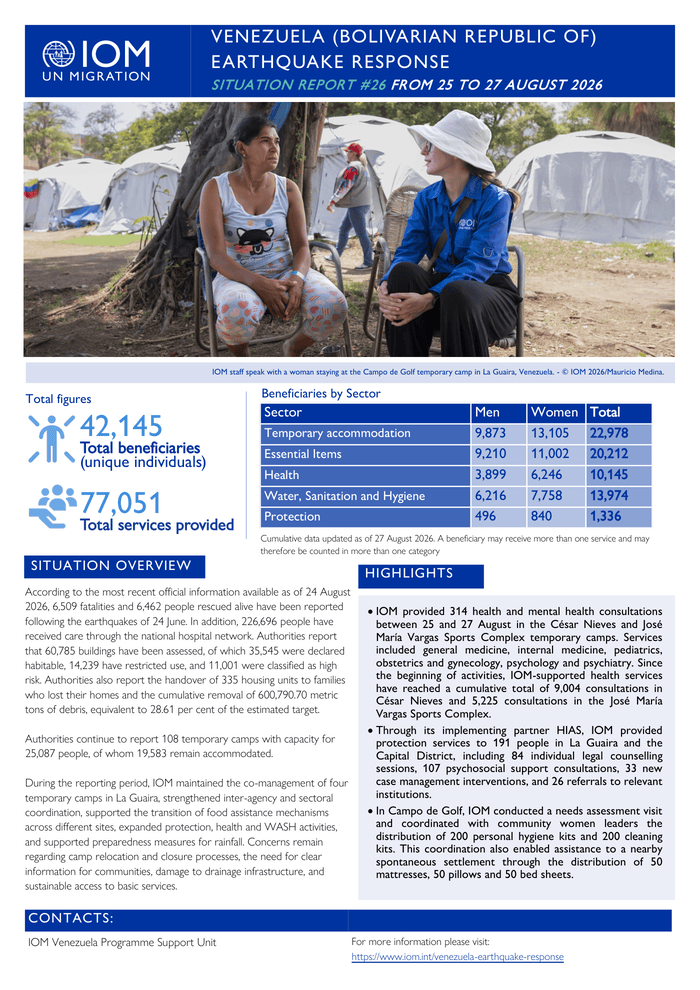
Country: Venezuela (Bolivarian Republic of) Source: International Organization for Migration Please refer to the attached file. Situation Report No. 26 provides an update on IOM’s response to the 24 June earthquakes in the Bolivarian Republic of Venezuela, covering the period from 25 to 27 August 2026. Highlights Between 25 and 27 August, IOM continued its multisectoral response in temporary camps and affected communities through interventions in Shelter and Camp Coordination and Camp Management (CCCM), Health, Protection, Water, Sanitation and Hygiene (WASH), information management, and Prevention of Sexual Exploitation and Abuse (PSEA). During the reporting period, IOM maintained the co-management of four temporary camps in La Guaira, supported preparedness actions for heavy rainfall, strengthened inter-agency coordination, and accompanied ongoing food assistance transition processes. IOM provided 314 health and mental health consultations in the César Nieves and José María Vargas Sports Complex temporary camps, covering general medicine, internal medicine, paediatrics, gynaecology, psychiatry and psychology. Since the beginning of activities, IOM-supported health services have reached a cumulative total of 9, 004 consultations in César Nieves and 5, 225 consultations in the José María Vargas Sports Complex. Through its implementing partner HIAS, IOM provided protection services to 191 people in La Guaira and the Capital District, including legal counselling, psychosocial support, case management and referrals. In addition, IOM coordinated the distribution of 200 personal hygiene kits and 200 cleaning kits in Campo de Golf and supported a nearby spontaneous settlement through the delivery of 50 mattresses, 50 pillows and 50 bed sheets. IOM Activities IOM maintained the management of the José María Vargas Sports Complex and Campo de Golf temporary camps and continued the co-management of the César Nieves and Mare Abajo II sites together with the Norwegian Refugee Council ( NRC ). Across the sites, IOM continued population monitoring, service coordination, infrastructure improvements and support to food assistance transition processes. In César Nieves, camp signage was completed and two vulnerable families received shelter support, while voluntary departures and the start of housing rehabilitation activities were observed at the José María Vargas Sports Complex. IOM’s Non-Food Items ( NFI ) teams conducted assessments to identify additional needs in temporary camps. During the reporting period, through its implementing partner Fundación Vivienda Popular, IOM distributed 146 tarpaulins, 73 kitchen sets and 65 hygiene items. To date, IOM has distributed 9, 622 tarpaulins, 6, 478 collapsible jerrycans, 4, 815 shelter tool kits, 5, 960 kitchen sets and 3, 677 personal hygiene items. IOM also organized a Camp Coordination and Camp Management workshop in Ezequiel Zamora (La Zamorera) temporary camp in Miranda State, bringing together 44 community representatives, authorities and site management stakeholders. In WASH, IOM continued coordinating and monitoring water, sanitation and hygiene services across temporary camps. In Campo de Golf, IOM led emergency preparedness measures for rainfall, coordinated the development of an emergency drainage plan, monitored water quality and maintained the operation of the water treatment plant, which has produced a cumulative 98, 000 litres of safe water since installation. In Mare Abajo II, IOM coordinated mitigation measures following regional water supply disruptions linked to failures at the Punta Gorda treatment plant and supported improvements to sanitation infrastructure and waste management systems. IOM continued delivering health and mental health services through fixed and mobile modalities. In Campo de Golf, IOM led the Health Technical Working Group and promoted the establishment of a unified epidemiological surveillance system and population profiling mechanisms. In César Nieves, IOM maintained regular medical and psychological consultations and strengthened coordination for access to medicines. In Mare Abajo II, IOM coordinated sexual and reproductive health, nutrition and psychological support activities with specialized partners. Through protection teams and its implementing partner HIAS, IOM continued providing legal counselling, psychosocial support, case management and referrals. In Campo de Golf, IOM led the Protection Technical Working Group and supported activities focused on child protection, prevention of violence against women and girls, and community coexistence. In César Nieves, IOM advanced the development of community rules of coexistence and reinforced child safeguarding measures, while in Mare Abajo II it led protection coordination efforts and strengthened information management mechanisms. At the José María Vargas Sports Complex, IOM continued protection referrals and monitored community concerns related to rumours about camp closure and relocation processes. IOM continued population registration and information management activities through the Displacement Tracking Matrix ( DTM ) and other site management systems. During the reporting period, DTM teams updated demographic information in César Nieves and registered three newly arrived families in Mare Abajo II to facilitate access to services and assistance. As part of its inter-agency coordination role, IOM participated in coordination spaces aimed at reducing duplication of assistance, improving service coverage, strengthening referral pathways and harmonizing distributed relief items across humanitarian actors. In addition, the Shelter, Land and Settlements Coordination Cluster, co-led by IOM and the International Federation of Red Cross and Red Crescent Societies ( IFRC ), held its second meeting of the month to provide operational updates and strengthen coordination among partners. In PSEA, IOM conducted capacity-building sessions for community leaders and representatives in Mare Abajo II and the José María Vargas Sports Complex and continued promoting community information mechanisms and the integration of protection and safety considerations across the temporary camps under its management. IOM Planned Response IOM will continue supporting return, relocation and camp transition processes while strengthening site management, infrastructure monitoring and rainfall mitigation measures in temporary camps. IOM will maintain health, mental health, protection, WASH and PSEA activities, including epidemiological surveillance, referral mechanisms, psychological support services, water and sanitation interventions, and community protection initiatives. In addition, IOM will continue population registration and movement tracking, information management activities, coordination with authorities and humanitarian partners, and efforts to strengthen evidence-based planning for return, relocation and camp closure processes.
Venezuela (Bolivarian Republic of): Earthquake Response Situation Report #26 (25 to 27 August 2026)

RELATED ARTICLES


