

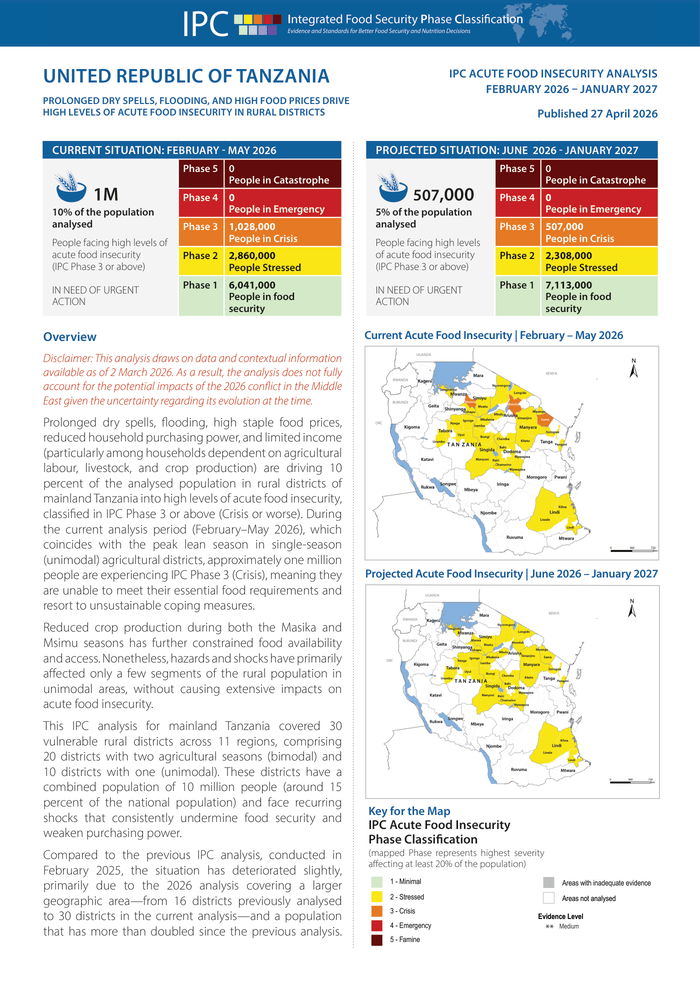
Country: United Republic of Tanzania Source: Integrated Food Security Phase Classification Please refer to the attached file. PROLONGED DRY SPELLS, FLOODING, AND HIGH FOOD PRICES DRIVE HIGH LEVELS OF ACUTE FOOD INSECURITY IN RURAL DISTRICTS Key results Prolonged dry spells, flooding, persistently high staple food prices, declining household purchasing power, and limited income opportunities are driving around 10 percent of the analysed population in rural districts of mainland Tanzania into high levels of acute food insecurity (IPC Phase 3 or above). The impact is particularly severe among households that depend on agricultural labour, livestock, and crop production. During the current analysis period (February–May 2026), which coincides with the peak lean season in single‐season (unimodal) agricultural districts, approximately 1 million people are experiencing IPC Phase 3 (Crisis) conditions, unable to meet their essential food requirements and resorting to unsustainable coping measures. This IPC analysis for mainland Tanzania covers 30 vulnerable rural districts across 11 regions, including 20 districts with bimodal agricultural seasons and 10 districts with a unimodal season. Together, these districts are home to approximately 10 million people, representing around 15 percent of the national population. These areas are repeatedly affected by shocks—such as climatic variability and market instability—that consistently undermine food security and erode household purchasing power. During the projection period (June 2026 to January 2027), which aligns with the Masika and Msimu harvests, the number of people in Phase 3 or above is expected to decrease significantly, to around 507, 000 (5 percent of the analysed population)—marking a reduction of 50 percent, or 521, 000 people. Although this figure is higher than the 242, 000 people classified in IPC Phase 3 or above during the same period last year, the increase is largely explained by the expanded geographical coverage of the analysis (30 districts in 2026 compared to 16 in 2025). Proportionally, the share of the population in Phase 3 or above remains stable at around 5 percent, indicating no substantial deterioration in underlying food security conditions. Recommendations & next steps To address Tanzania’s food insecurity in the 30 analysed districts, the following interventions are recommended for the most vulnerable areas. Response actions: Provision of food grains at subsidised prices in food-insecure district councils between April 2026 and May 2026. Strengthen timely dissemination and use of weather forecast information among all relevant stakeholders. Increase awareness and improve access for the most vulnerable households to essential farm inputs—such as pesticides, fertilisers, and early‐maturing and drought‐tolerant seeds—to boost production during the Masika and Msimu seasons. Enhance pest and livestock disease surveillance systems in all at‐risk areas to ensure early warning and timely delivery of preventive and curative interventions. Promote off‐season horticultural production to improve yields, strengthen household food availability, and enhance dietary diversity during lean periods. Strengthen health education programmes focused on water, sanitation and hygiene (WASH) practices and their direct link to nutrition outcomes, using community outreach and media campaigns to promote safe sanitation and hygiene behaviours. Promote and scale up Climate‐Smart Agriculture practices in crop and livestock production across the most affected areas to improve resilience to climatic shocks and sustain productivity. Invest in improving water and sanitation infrastructure in communities, ensuring access to clean and safe water sources and proper sanitation facilities.
United Republic of Tanzania: IPC Acute Food Insecurity Analysis, February 2026 – January 2027 | Published on 27 April 2026

RELATED ARTICLES


