

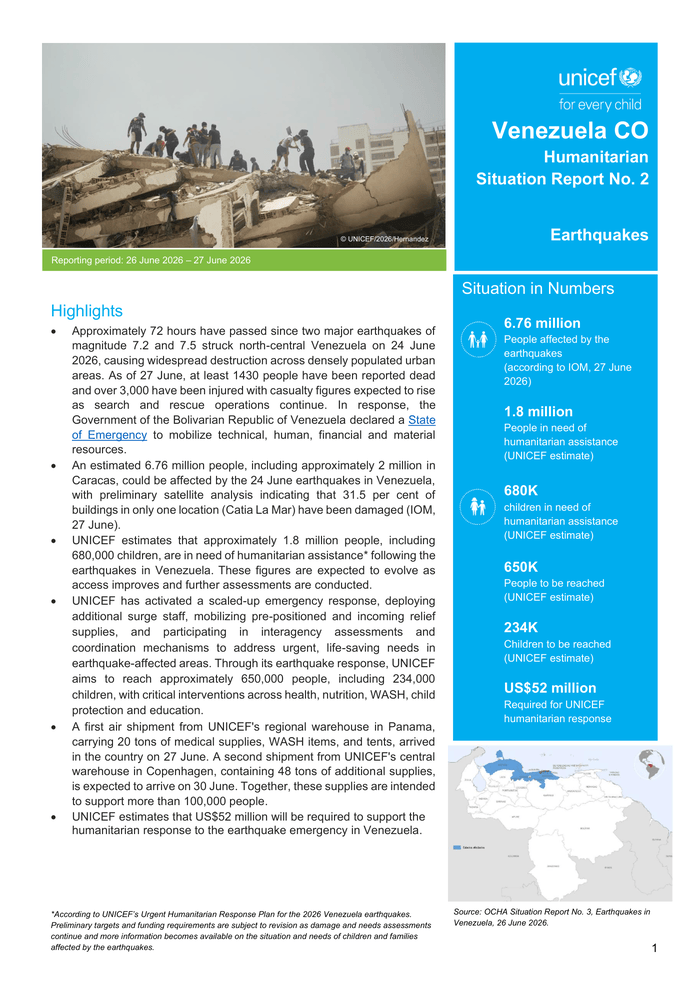
Country: Venezuela (Bolivarian Republic of) Source: UN Children’s Fund Please refer to the attached file. Highlights Approximately 72 hours have passed since two major earthquakes of magnitude 7. 2 and 7. 5 struck north-central Venezuela on 24 June 2026, causing widespread destruction across densely populated urban areas. As of 27 June, at least 1430 people have been reported dead and over 3, 000 have been injured with casualty figures expected to rise as search and rescue operations continue. In response, the Government of the Bolivarian Republic of Venezuela declared a State of Emergency to mobilize technical, human, financial and material resources. An estimated 6. 76 million people, including approximately 2 million in Caracas, could be affected by the 24 June earthquakes in Venezuela, with preliminary satellite analysis indicating that 31. 5 per cent of buildings in only one location (Catia La Mar) have been damaged (IOM, 27 June). UNICEF estimates that approximately 1. 8 million people, including 680, 000 children, are in need of humanitarian assistance* following the earthquakes in Venezuela. These figures are expected to evolve as access improves and further assessments are conducted. UNICEF has activated a scaled-up emergency response, deploying additional surge staff, mobilizing pre-positioned and incoming relief supplies, and participating in interagency assessments and coordination mechanisms to address urgent, life-saving needs in earthquake-affected areas. Through its earthquake response, UNICEF aims to reach approximately 650, 000 people, including 234, 000 children, with critical interventions across health, nutrition, WASH, child protection and education. A first air shipment from UNICEF’s regional warehouse in Panama, carrying 20 tons of medical supplies, WASH items, and tents, arrived in the country on 27 June. A second shipment from UNICEF’s central warehouse in Copenhagen, containing 48 tons of additional supplies, is expected to arrive on 30 June. Together, these supplies are intended to support more than 100, 000 people. UNICEF estimates that US$52 million will be required to support the humanitarian response to the earthquake emergency in Venezuela. Situation in Numbers 6. 76 million People affected by the earthquakes (according to IOM, 27 June 2026) 1. 8 million People in need of humanitarian assistance (UNICEF estimate) 680K children in need of humanitarian assistance (UNICEF estimate) 650K People to be reached (UNICEF estimate) 234K Children to be reached (UNICEF estimate) US$52 million Required for UNICEF humanitarian response Funding Overview and Partnerships UNICEF is seeking US$52 million to respond to the humanitarian consequences of the 24 June earthquakes. Note that before the earthquakes, UNICEF’s 2026 Humanitarian Action for Children appeal for Venezuela stood at US$137. 6 million, with only 35 per cent funded. The earthquake response aims to reach approximately 650, 000 people, including 234, 000 children, with lifesaving assistance across health, nutrition, water, sanitation and hygiene (WASH), child protection and education. The funding requirement come at a time when Venezuela was already facing a protracted humanitarian situation, with an estimated 7. 9 million people, including 3. 9 children, in need of assistance prior to the disaster. UNICEF is grateful for the rapid mobilization of flexible resources and the support of donors and partners that have enabled the immediate deployment of emergency supplies and personnel to support affected children and families. Continued and timely funding will be critical to sustain life-saving interventions, scale up emergency operations and address increasing humanitarian needs as assessments continue and access improves. Flexible contributions will enable UNICEF to complement Government-led response efforts and rapidly adapt to evolving needs on the ground. In addition to external contributions and donor pledges, UNICEF has mobilized approximately US$3. 5 million from its own internal resources, including the Emergency Programme Fund (EPF) and Global Humanitarian Thematic Funds (GHTF), to enable an immediate scale-up of the response and ensure the rapid delivery of life-saving assistance in the initial phase of the emergency. Under the leadership of the Government of the Bolivarian Republic of Venezuela and within the interagency response framework, UNICEF is working closely with national and local authorities, United Nations agencies, civil society organizations and non-governmental organizations through established coordination mechanisms. UNICEF is participating in interagency assessments and supporting sector coordination while leveraging its longstanding partnerships with government institutions, local organizations and the private sector to deliver urgent assistance and support early recovery efforts for children and their families in the affected areas. Situation overview and Humanitarian Needs On 24 June 2026, Venezuela was struck by two major earthquakes of magnitude 7. 2 and 7. 5 within one minute of each other, causing widespread destruction across north-central and densely populated urban areas of the country. Two days after the earthquakes, at least 1430 deaths and more than 3, 000 injured were reported, with casualty figures expected to rise as search and rescue operations continue. The Government of the Bolivarian Republic of Venezuela has declared a State of Emergency throughout the national territory to mobilize technical, human, financial and material resources in support of the response. According to the International Organization for Migration (IOM), preliminary estimates indicate that up to 6. 76 million people, including approximately 2 million people in Caracas, could be affected by the earthquakes. Initial satellite analysis suggests that 31. 5 per cent of buildings in Catia La Mar (La Guaira) alone have sustained damage, i highlighting the severity of the disaster and the potential for significant displacement. UNICEF estimates that approximately 1. 8 million people, including 680, 000 children, are in need of humanitarian assistance, ii with figures expected to evolve as access improves and additional assessments are conducted. The earthquakes have compounded an already fragile humanitarian context. Prior to the disaster, an estimated 7. 9 million people, including 3. 9 million children, required humanitarian assistance due to prolonged socioeconomic challenges and gaps in access to essential services. The earthquakes have further strained already vulnerable communities, creating a complex urban emergency characterized by damaged critical infrastructure, disrupted services and increasing humanitarian needs, particularly among children and families. UNICEF is supporting national response efforts in close coordination with government counterparts, United Nations agencies, humanitarian partners and local actors to ensure that the needs and rights of children remain at the centre of the response. UNICEF has activated a scale-up response, mobilized emergency funding and deployed additional surge personnel to support assessments, coordination and the delivery of life-saving assistance. Through its earthquake response, UNICEF aims to reach approximately 650, 000 people, including 234, 000 children, with critical interventions across health, nutrition, WASH, child protection and education. A first air shipment from UNICEF’s regional warehouse in Panama, carrying 20 metric tons of medical supplies, WASH items and tents, arrived in the country on 27 June. A second shipment of 48 metric tons from UNICEF’s Global Supply Hub in Copenhagen is expected to arrive on 30 June. Together, these supplies are expected to support approximately 100, 000 people with life-saving assistance. UNICEF is also mobilizing pre-positioned supplies and preparing additional shipments to address urgent humanitarian needs. Immediate priorities, beyond search and rescue operations, include the provision of emergency health and nutrition assistance, safe water and sanitation services, psychosocial support for children and caregivers, child protection services and temporary learning spaces to ensure continuity of education. Over the medium and longer term, recovery efforts will focus on restoring essential services and infrastructure, strengthening community resilience and supporting children and families to recover with dignity.
UNICEF Venezuela Humanitarian Situation Report No.2 (Earthquake), 27 June 2026

RELATED ARTICLES


