

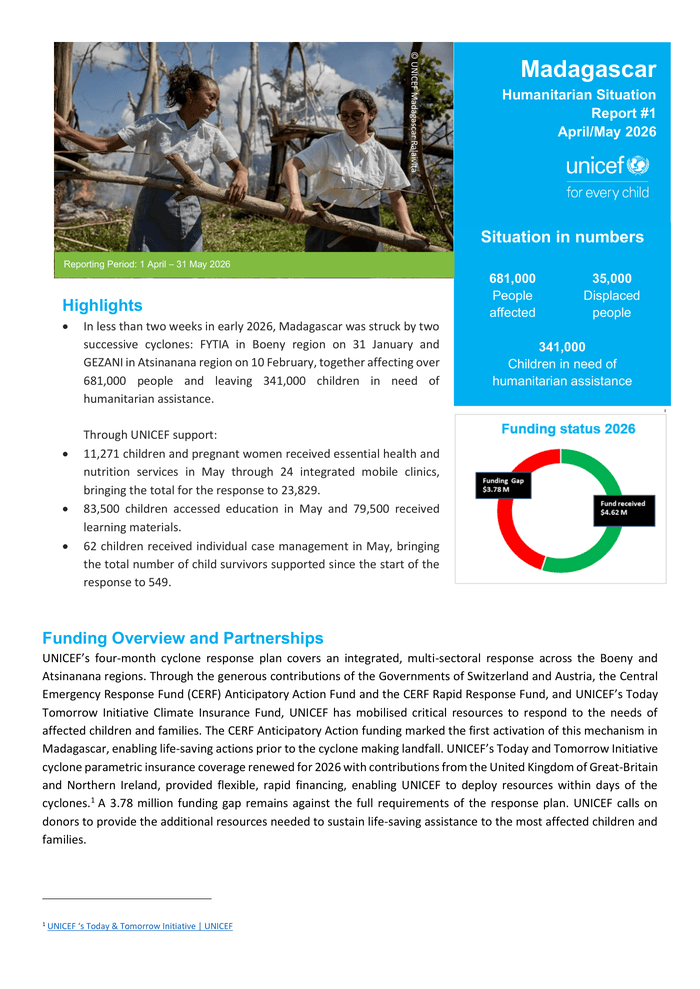
Country: Madagascar Source: UN Children’s Fund Please refer to the attached file. Highlights In less than two weeks in early 2026, Madagascar was struck by two successive cyclones: FYTIA in Boeny region on 31 January and GEZANI in Atsinanana region on 10 February, together affecting over 681, 000 people and leaving 341, 000 children in need of humanitarian assistance. Through UNICEF support: 11, 271 children and pregnant women received essential health and nutrition services in May through 24 integrated mobile clinics, bringing the total for the response to 23, 829. 83, 500 children accessed education in May and 79, 500 received learning materials. 62 children received individual case management in May, bringing the total number of child survivors supported since the start of the response to 549. Situation in numbers 681, 000 People affected 35, 000 Displaced people 341, 000 Children in need of humanitarian assistance Funding Overview and Partnerships UNICEF’s four-month cyclone response plan covers an integrated, multi-sectoral response across the Boeny and Atsinanana regions. Through the generous contributions of the Governments of Switzerland and Austria, the Central Emergency Response Fund (CERF) Anticipatory Action Fund and the CERF Rapid Response Fund, and UNICEF’s Today Tomorrow Initiative Climate Insurance Fund, UNICEF has mobilised critical resources to respond to the needs of affected children and families. The CERF Anticipatory Action funding marked the first activation of this mechanism in Madagascar, enabling life-saving actions prior to the cyclone making landfall. UNICEF’s Today and Tomorrow Initiative cyclone parametric insurance coverage renewed for 2026 with contributions from the United Kingdom of Great-Britain and Northern Ireland, provided flexible, rapid financing, enabling UNICEF to deploy resources within days of the cyclones. 1 A 3. 78 million funding gap remains against the full requirements of the response plan. UNICEF calls on donors to provide the additional resources needed to sustain life-saving assistance to the most affected children and families. Situation Overview and Humanitarian Needs In Boeny region, four months after Tropical Cyclone FYTIA made landfall in Soalala district, reconstruction efforts are underway across the six affected districts of Soalala, Mitsinjo, Marovoay, Ambato Boeny, Mahajanga I and Mahajanga II. FYTIA affected over 203, 000 people, damaging or destroying more than 20, 000 homes, 556 classrooms and 27 health centres. Agricultural losses were severe, with rice crops destroyed across thousands of hectares and losses reaching up to 70 per cent in the worst-affected districts, with significant food security implications. Humanitarian needs remain high against a backdrop of persistent vulnerabilities, with increased circulation of vector-borne diseases including malaria and arboviruses, a suspected measles case, and ongoing Mpox transmission, all requiring an integrated response. Access to Soalala and Mitsinjo remains constrained but is improving. UNHAS monthly missions began in May supporting staff and cargo movements, a joint multisectoral mission covering health, WASH and education was conducted with government authorities and partners to strengthen coordination and update sectoral needs assessments, and larger supplies are being transported by boat to maximise reach. In Atsinanana region, nearly four months after Intense Tropical Cyclone GEZANI struck the urban area of Tamatave I, the peri-urban area of Tamatave II and the district of Brickaville, the emergency response is transitioning to rehabilitation and reconstruction. GEZANI affected over 478, 000 people, claimed 59 lives, and damaged or destroyed more than 102, 000 homes, 761 schools and 30 health centres. Essential services and infrastructure are largely restored, though waste accumulation in fokontany-level streets remains a public health concern. Access to the communes of Ifito and Satrandroy in Tamatave II district remains difficult. To reach the most isolated communities, UNICEF and local authorities deployed teams on foot to deliver hygiene kits and temporary classroom materials, a three to four day journey each way.
UNICEF Madagascar Humanitarian Situation Report No. 1 (Cyclones FYTIA and GEZANI), 31 May 2026

RELATED ARTICLES


