


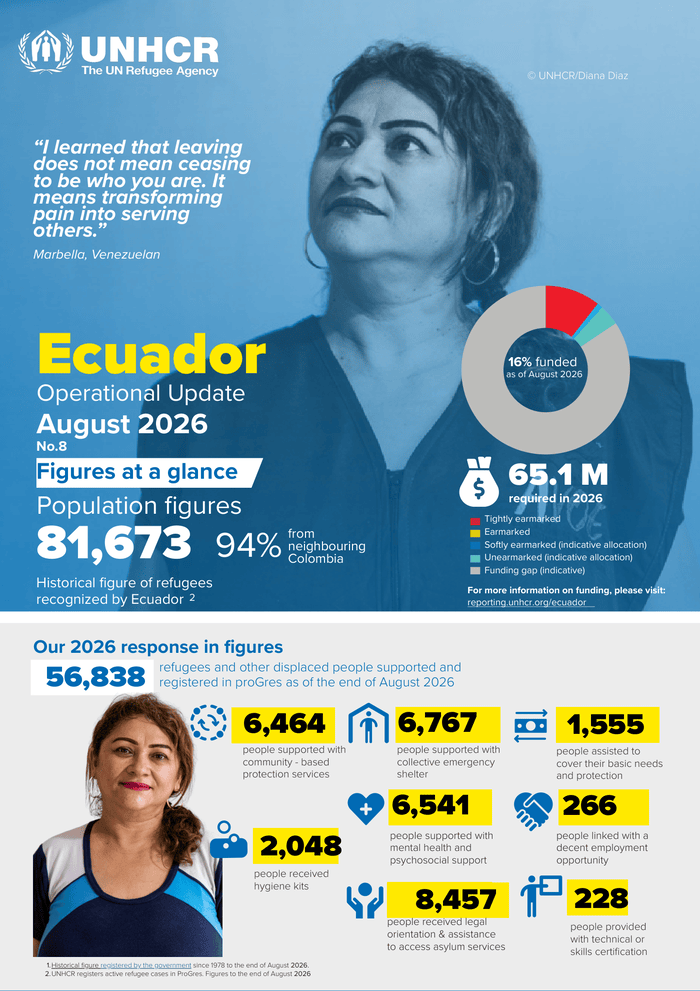
Countries: Ecuador, Colombia, Venezuela (Bolivarian Republic of) Source: UN High Commissioner for Refugees Please refer to the attached file. Operational context UNHCR Ecuador operates in a complex and evolving environment shaped by security, humanitarian and environmental considerations. In August 2026, Ecuador received 1, 441 new asylum applications, including 766 from Venezuelans and 675 from Colombians. Applications increased sharply compared to August 2025, rising by 72% and 239% respectively. Venezuelans accounted for 62% of all asylum claims processed in 2026, while Colombians represented 40%, underscoring the continued demand for international protection despite increased border restrictions and reduced mobility. Security-related incidents continued to affect several coastal areas, including Guayas, Manabí, Esmeraldas, and Santa Elena, including targeted killings in public spaces such as beaches during national holidays, reflecting the continued security challenges affecting the country. Also, the northern border remained an area of particular attention given developments involving transnational criminal and armed groups operating in the wider Colombia-Ecuador area. These dynamics continued to require close monitoring of protection risks and their effects on communities, including refugees, asylum-seekers and other people in need of international protection. In light of these developments, national authorities maintained efforts to address organized crime and strengthen public security including the extension of the state of exception for 30 days across several provinces and cantons. In parallel, legislative developments further strengthened the framework for security operations through enhanced coordination between the Armed Forces and the National Police, and international cooperation. Environmental risks added a further layer of complexity during the reporting period. National authorities maintained a high level of preparedness in anticipation of the potential impacts of the El Niño phenomenon, which is expected to affect the country over the coming months. Rising sea levels and changing weather conditions have increased concerns of flooding, coastal erosion, and potential impacts on livelihoods and infrastructure, particularly in vulnerable coastal areas where forcibly displaced people reside. Authorities also expressed concern about the possible effects on energy production and essential services due to reduced water inflows affecting the country’s hydroelectric generation capacity. The 7. 4-magnitude earthquake that struck western Colombia was felt across several Ecuadorian provinces. In a demonstration of regional solidarity, the Government of Ecuador established humanitarian aid collection points to support affected populations in Colombia. Additionally, UNHCR continued to contribute to national and technical discussions on protection and internal displacement. UNHCR participated in the dialogue “Reflexiones sobre el desplazamiento interno en Ecuador”, organized by FLACSO Ecuador and 3iS, with the participation of the United Nations Special Rapporteur on the Human Rights of Internally Displaced Persons. The exchange contributed evidence-based analysis and fostered academic reflections on internal displacement, supporting ongoing efforts to strengthen understanding of displacement dynamics and protection responses in Ecuador. Overall, the August operational context required continued flexibility, risk monitoring and coordination with national and local authorities, partners and other humanitarian actors. UNHCR maintained its focus on ensuring access to protection and assistance for refugees, asylum-seekers and other people in need of international protection as well as host communities, while adapting its operational approach to the country’s evolving security and humanitarian environment.



GrowthPakistan brings you the latest news to keep an eye on Pakistan’s startup ecosystem. Business keeps you growing when you stay aware of your competitors' moves. GrowthPakistan offers Business, Tech, Global Tech, Global, Auto, and Startup News straight from industries all around the globe. This platform will help you identify upcoming opportunities not only in Pakistan but worldwide.
Email : growthpakistan@gmail.com
Whatsapp : +92320-9497079
© growthpakistan