


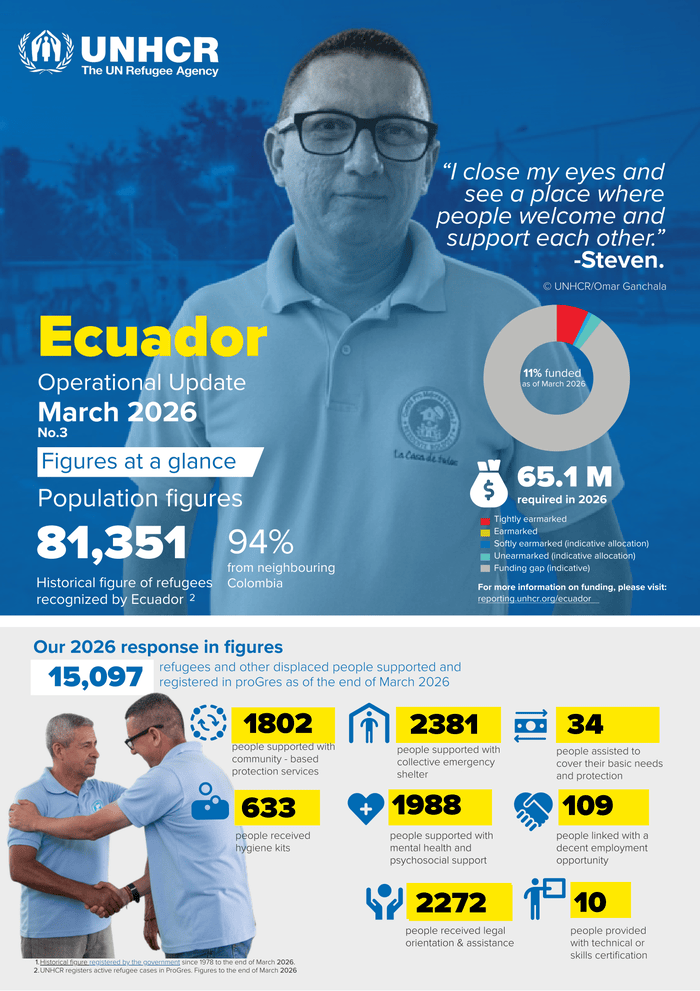
Countries: Ecuador, Colombia, Venezuela (Bolivarian Republic of) Source: UN High Commissioner for Refugees Please refer to the attached file. Operational context In March, rising insecurity, environmental shocks, and crossborder disruptions deepened displacement and humanitarian needs. Despite these challenges, ongoing efforts to provide protection and solutions continue to help displaced populations navigate risks and sustain access to support across the country. Displacement risks are driven by insecurity, environmental shocks, and mobility restrictions. In Eloy Alfaro, Esmeraldas, approximately 400 members of the Chachi community were forcibly displaced following threats from armed groups. Individuals relocated to nearby rural communities and other provinces, with urgent humanitarian needs identified. UNHCR convened the local GTRM and shared information with the National Secretariat for Risk Management to support activation of state response mechanisms. Escalating trade restrictions and tensions between Ecuador and Colombia continue to affect mobility and cross-border livelihoods where people have been left stranded and exposed to irregular corridors and smuggling networks. This situation has affected northern economies, prompting calls for peaceful mobilizations along the border. Also, in northern Ecuador, migration control operations have resulted in deportations of foreign nationals and ongoing raids. UNHCR, in collaboration with the Public Defender’s Office, continues to support with legal assistance to those requiring international protection. At the same time, the security environment remained volatile, marked by renewed exceptional measures under a national strategy, including a 30-day state of exception across nine provinces, curfews, and intensified operations targeting criminal economies, affecting mobility, access to services, and livelihoods. United Nations human rights mechanisms reiterated the need to ensure civilian protection and respect for human rights during operations. Severe rains, flooding, river overflows, and landslides deteriorated humanitarian conditions nationwide, generating displacement and repeated evacuations, leading to a 60-day state of emergency. According to the National Secretariat for Risk Management, more than 47, 000 people were affected nationwide, with 11 fatalities and damage to homes, schools, and hospitals. For example, in Guayas, 20 of 24 cantons reported impacts, with 62 emergencies and more than 7, 000 families affected, while in Esmeraldas, flooding and landslides affected at least 3, 107 people and displaced around 2, 500 people. No disaggregated data is available for people in human mobility. However, displaced populations faced loss of their houses, assets, and increased protection risks. UNHCR coordinated with the National Secretariat for Risk Management and provided emergency support, including eight tents to the Ministry of Human Development, and remains ready to expand assistance. Additionally, environmental impacts in Esmeraldas included a diesel spill that led to a 48-hour suspension of water services and a second refinery fire in 2026, raising concerns about contamination, public health, and maintenance of oil infrastructure. UNHCR continues working with government institutions, local authorities, and partners to support affected communities, strengthening resilience and expanding access to protection and solutions so people can live safely and meet urgent needs. In this context, UNHCR remains present in high risk areas, staying close to communities as they face risks and rebuilding safer, more stable lives.



GrowthPakistan brings you the latest news to keep an eye on Pakistan’s startup ecosystem. Business keeps you growing when you stay aware of your competitors' moves. GrowthPakistan offers Business, Tech, Global Tech, Global, Auto, and Startup News straight from industries all around the globe. This platform will help you identify upcoming opportunities not only in Pakistan but worldwide.
Email : growthpakistan@gmail.com
Whatsapp : +92320-9497079
© growthpakistan