


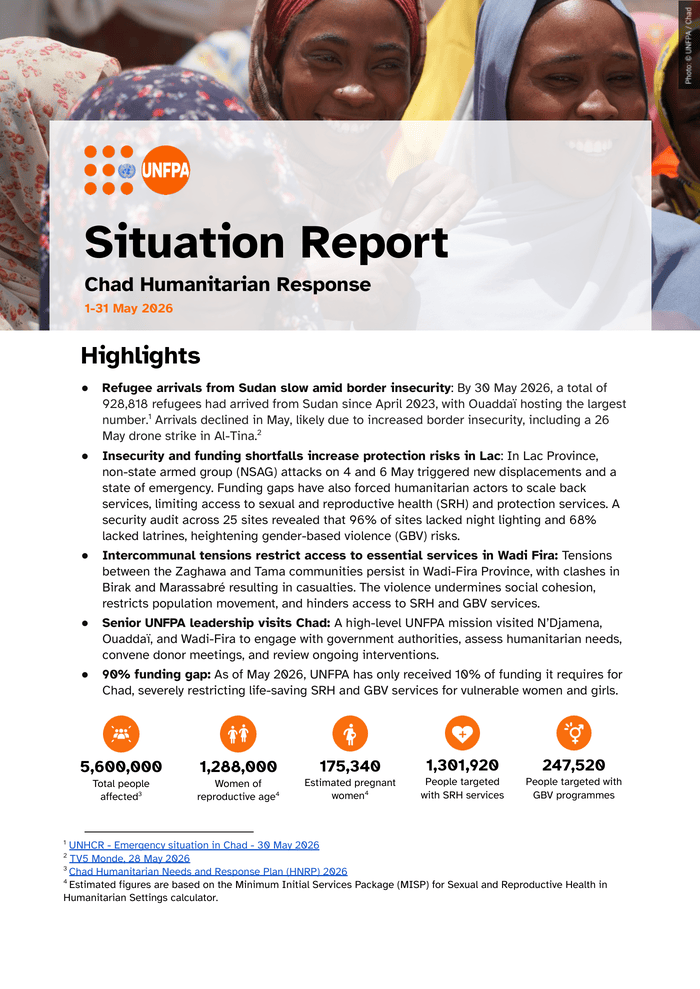
Countries: Chad, Sudan Source: United Nations Population Fund Please refer to the attached file. In May 2026, Chad’s humanitarian crisis intensified due to worsening security and shifting migration, with the total number of Sudanese refugees reaching 928, 818. New displacements in Lac Province, triggered by non-state armed group attacks, led to a state of emergency, while intercommunal violence in Wadi-Fira further disrupted access to essential services. A security audit in Lac Province highlighted critical protection gaps, including insufficient lighting and latrines, which increased the risk of gender-based violence (GBV) for women and girls. Amid these mounting needs, severe funding shortages have forced humanitarian partners to scale back life-saving services, leaving vulnerable women and children — who comprise 85–87% of the refugee population — without critical support. UNFPA has prioritized critical sexual and reproductive health (SRH) and GBV services to ensure the most vulnerable people have access to essential care. UNFPA deployed 98 midwives to humanitarian zones across 72 health facilities, providing antenatal and postnatal care, family planning, management of sexually transmitted infections, and clinical management of rape services. Simultaneously, UNFPA bolstered GBV prevention and response by delivering awareness sessions to over 6, 300 individuals, offering psychosocial and medical support to survivors, training 45 service providers in Ouaddaï, and maintaining 11 women and girls’ safe spaces while providing tents to support 20 additional spaces. As of May 2026, UNFPA has secured only US $1. 9 million of its $18. 7 million requirement for Chad, leaving a 90% funding gap. UNFPA is urgently appealing for critical funding for Chad to address the scale and urgency of the humanitarian needs, particularly for women and girls who require life-saving SRH and protection services.



GrowthPakistan brings you the latest news to keep an eye on Pakistan’s startup ecosystem. Business keeps you growing when you stay aware of your competitors' moves. GrowthPakistan offers Business, Tech, Global Tech, Global, Auto, and Startup News straight from industries all around the globe. This platform will help you identify upcoming opportunities not only in Pakistan but worldwide.
Email : growthpakistan@gmail.com
Whatsapp : +92320-9497079
© growthpakistan