


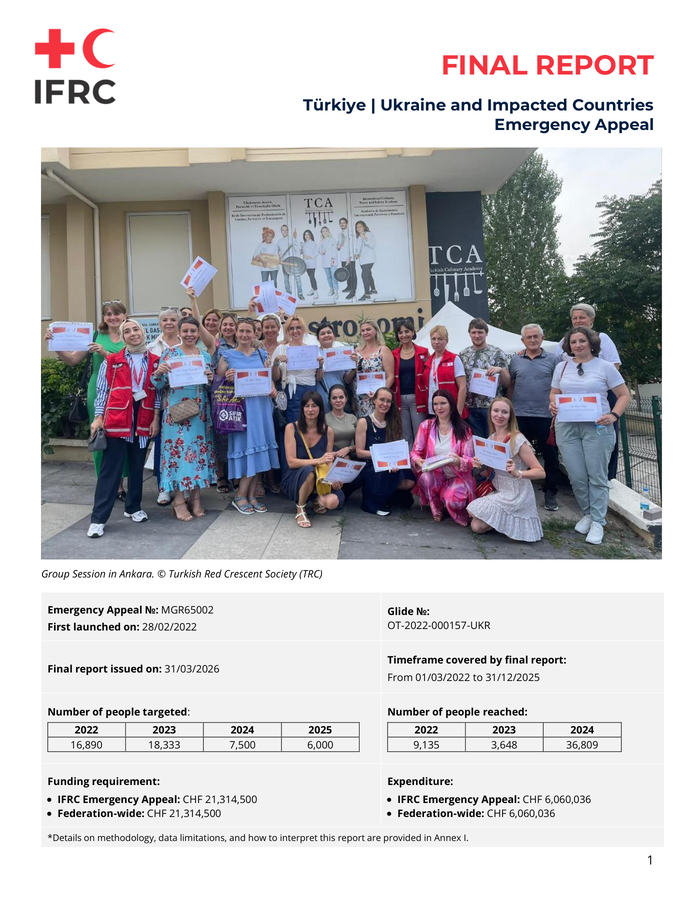
Countries: Türkiye, Ukraine Source: International Federation of Red Cross and Red Crescent Societies Please refer to the attached file. A. SITUATION ANALYSIS Description of the crisis Since the escalation of Russia-Ukraine international armed conflict, Türkiye, which hosts one of the largest refugee populations globally, has continued to receive people affected by the international armed conflict between Russia and Ukraine. According to the Presidency of Migration Management (PMM), 2. 3 million Syrians1 reside in Türkiye under Temporary Protection, alongside a significant number of non-Syrian refugees from countries including Afghanistan, Iraq, Iran, Somalia, and Ukraine who hold International Protection status. Following the escalation of the international armed conflict in February 2022, millions of people were displaced, with many seeking safety in neighbouring countries and across Europe. Displaced people from Ukraine began entering Türkiye primarily through the Bulgarian border, particularly via Edirne and Kırklareli provinces, from March 2022 onwards. Initial reception arrangements included temporary accommodation in government dormitories, after which individuals were relocated to provinces such as Antalya, Bursa, Eskişehir, and Tekirdağ. In response to emerging humanitarian needs related to protection, basic assistance, and psychosocial well-being, Turkish Red Crescent Society (TRC) initiated support activities for people arriving from Ukraine. Early interventions focused on food distribution and the establishment of mobile child-friendly spaces to support children affected by displacement. On 1 November 2022, with support from the International Federation of Red Cross and Red Crescent Societies (IFRC), Turkish Red Crescent launched the Ukraine and Impacted Countries Emergency Appeal. The response operation commenced implementation in Ankara, Antalya, Elazığ, and İstanbul with an implementation period extending through December 2024. Throughout 2023, the humanitarian consequences of the Russia-Ukraine international armed conflict continued to affect displaced people residing in Türkiye. While initial emergency needs had been partially addressed, the protracted nature of displacement led to increasing demand for more stabilisation-oriented and community-based support, particularly for children, families, and individuals with specific vulnerabilities. During this period, Turkish Red Crescent expanded and consolidated its interventions across project locations. Two Mobile Child Friendly Spaces were operationalised in Elazığ Temporary Accommodation Centre and in hotels in Beldibi, Antalya, supporting children’s education and psychosocial well-being. Assistance provided during the year included the distribution of education and hygiene kits, food parcels, and clothing vouchers. In Elazığ Temporary Accommodation Centre, Cash and Voucher Assistance was provided to households through Kızılaykart, with monthly support of 300 TRY to help meet basic needs. In parallel, individuals with urgent needs received support through the Special Needs Fund, including referrals and targeted assistance for rent, temporary accommodation, and health-related services. Protection activities also included Restoring Family Links awareness-raising sessions. To strengthen community engagement and collaboration, protocols were signed in July 2023 with three Ukrainian associations in Ankara, Antalya, and İstanbul, focusing on cooperation and capacity building for humanitarian assistance. In 2024, Türkiye remained affected by the ongoing humanitarian consequences of the Russia-Ukraine international armed conflict. While many activities initiated in 2023 continued, the project entered a transition phase characterised by adjustments to the scope and modality of assistance, informed by community feedback and coordination with other humanitarian actors operating in the same locations. Key changes introduced during the year included the discontinuation of voucher distribution in Elazığ Temporary Accommodation Centre and the removal of health-focused seminars. At the same time, new initiatives were introduced, such as food parcel distribution, the launch of Turkish language courses at the Ankara Community Centre, and the piloting of feedback mechanisms in collaboration with Ukrainian associations. Psychosocial support activities were also adapted in response to participation patterns and needs. The target for individual interviews in psychosocial support sessions was increased, while group sessions were discontinued, as participants in larger urban settings were unable to attend consistently. Greater emphasis was therefore placed on psychosocial support seminars. Due to delays in the production process, the Mobile Child Friendly Space planned for Elazığ in 2023 was deployed in 2024. During the interim period, youth workers continued activities within the school located inside the Temporary Accommodation Centre. Following the establishment of the Mobile Child Friendly Space, activities resumed within the dedicated child-friendly environment. Collaboration with Ukrainian associations continued throughout 2024, with additional feedback mechanisms established within association premises. As of 2025, Türkiye continues to host a large and diverse displaced population, including people affected by the international armed conflict. While some individuals have achieved greater stability, ongoing needs remain, particularly in relation to protection, psychosocial well-being, basic assistance, and social inclusion. The situation continues to require coordinated humanitarian action that balances immediate support with more sustainable, community-based approaches. Interventions planned for the current period build on lessons learned from previous years, community feedback, and the evolving operational context, while acknowledging broader global uncertainties that may affect the availability of resources and the resilience of at-risk populations in Türkiye.



GrowthPakistan brings you the latest news to keep an eye on Pakistan’s startup ecosystem. Business keeps you growing when you stay aware of your competitors' moves. GrowthPakistan offers Business, Tech, Global Tech, Global, Auto, and Startup News straight from industries all around the globe. This platform will help you identify upcoming opportunities not only in Pakistan but worldwide.
Email : growthpakistan@gmail.com
Whatsapp : +92320-9497079
© growthpakistan