


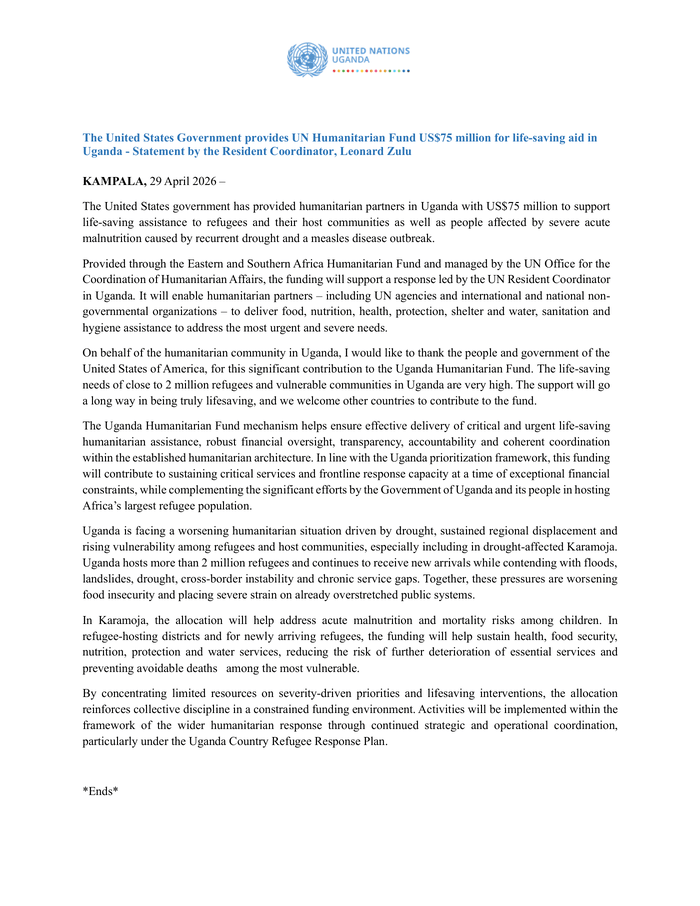
Countries: Uganda, Democratic Republic of the Congo, South Sudan, United States of America Source: UN Resident Coordinator in Uganda Please refer to the attached file. KAMPALA, 29 April 2026 The United States government has provided humanitarian partners in Uganda with US$75 million to support life-saving assistance to refugees and their host communities as well as people affected by severe acute malnutrition caused by recurrent drought and a measles disease outbreak. Provided through the Eastern and Southern Africa Humanitarian Fund and managed by the UN Office for the Coordination of Humanitarian Affairs, the funding will support a response led by the UN Resident Coordinator in Uganda. It will enable humanitarian partners – including UN agencies and international and national non-governmental organizations – to deliver food, nutrition, health, protection, shelter and water, sanitation and hygiene assistance to address the most urgent and severe needs. On behalf of the humanitarian community in Uganda, I would like to thank the people and government of the United States of America, for this significant contribution to the Uganda Humanitarian Fund. The life-saving needs of close to 2 million refugees and vulnerable communities in Uganda are very high. The support will go a long way in being truly lifesaving, and we welcome other countries to contribute to the fund. The Uganda Humanitarian Fund mechanism helps ensure effective delivery of critical and urgent life-saving humanitarian assistance, robust financial oversight, transparency, accountability and coherent coordination within the established humanitarian architecture. In line with the Uganda prioritization framework, this funding will contribute to sustaining critical services and frontline response capacity at a time of exceptional financial constraints, while complementing the significant efforts by the Government of Uganda and its people in hosting Africa’s largest refugee population. Uganda is facing a worsening humanitarian situation driven by drought, sustained regional displacement and rising vulnerability among refugees and host communities, especially including in drought‐affected Karamoja. Uganda hosts more than 2 million refugees and continues to receive new arrivals while contending with floods, landslides, drought, cross‐border instability and chronic service gaps. Together, these pressures are worsening food insecurity and placing severe strain on already overstretched public systems. In Karamoja, the allocation will help address acute malnutrition and mortality risks among children. In refugee‐hosting districts and for newly arriving refugees, the funding will help sustain health, food security, nutrition, protection and water services, reducing the risk of further deterioration of essential services and preventing avoidable deaths among the most vulnerable. By concentrating limited resources on severity-driven priorities and lifesaving interventions, the allocation reinforces collective discipline in a constrained funding environment. Activities will be implemented within the framework of the wider humanitarian response through continued strategic and operational coordination, particularly under the Uganda Country Refugee Response Plan. *Ends*



GrowthPakistan brings you the latest news to keep an eye on Pakistan’s startup ecosystem. Business keeps you growing when you stay aware of your competitors' moves. GrowthPakistan offers Business, Tech, Global Tech, Global, Auto, and Startup News straight from industries all around the globe. This platform will help you identify upcoming opportunities not only in Pakistan but worldwide.
Email : growthpakistan@gmail.com
Whatsapp : +92320-9497079
© growthpakistan